

Origins of German Defensive Doctrine (1916-1941)
In 1941, the German Army’s doctrine for defensive operations was nearly identical to that used by the old Imperial German Army in the final years of World War I. The doctrinal practice of German units on the Western Front in 1917 and 1918 — the doctrine of elastic defense in depth — had been only slightly amended and updated by the beginning of Operation Barbarossa. In contrast to German offensive doctrine, which from 1919 to 1939 moved toward radical innovation, German defensive doctrine followed a conservative course of cautious adaptation and reaffirmation. Consequently, although the German Army in 1941 embraced an offensive doctrine suited for a war of maneuver, it still hewed to a defensive doctrine derived from the positional warfare (Stellungskrieg) of an earlier generation.
Elastic Defense: Legacy of the Great War
The Imperial German Army adopted the elastic defense in depth during the winter of 1916-17 for compelling strategic and tactical reasons. At that time, Germany was locked in a war of attrition against an Allied coalition whose combined resources exceeded those of the Central Powers. The German command team of Field Marshal Paul von Hindenburg and General Erich Ludendorff hoped to break the strategic deadlock by conducting a major offensive on the Russian Front in 1917. Therefore, they needed to economize Germany’s strength on the Western Front in France and Belgium, minimizing casualties while repelling expected Allied offensives.
To accomplish this, they sanctioned a strategic withdrawal in certain sectors to newly prepared defensive positions. This Hindenburg Line shortened the front and more effectively exploited the defensive advantages of terrain than did earlier positions. This withdrawal was a major departure from prevailing defensive philosophy, which hitherto had measured success in the trench war solely on the basis of seizing and holding terrain. In effect, Ludendorff* (*Hindenburg and Ludendorff nominally operated according to the dual-responsibilty principle of the German General Staff, whereby the commander and his chief of staff shared responsibility and authority on a nearly equal basis. In practice, Ludendorff’s energies were so great that Hindenburg regularly deferred to his judgment. Ludendorff also routinely involved himself in matters of technical detail far beneath the Olympian gaze of Hindenburg. In the matters being discussed, Ludendorff thus played the dominant role at both the strategic and tactical levels, adopted a new policy that emphasized conserving German manpower over blindly retaining ground — a strategic philosophy whose tactical component was an elastic defense in depth.
To complement his strategic designs, Ludendorff directed the implementation of the Elastic Defense doctrine. [1] This new doctrine supported the overall strategic goal of minimizing German casualties and also corresponded better than previous methods to the tactical realities of attack and defense in trench warfare. Through the war’s first two years, German (and Allied) doctrinal practice had been to defend every meter of front by concentrating infantry in forward trenches. This prevented any enemy incursion into the German defensive zone but inevitably resulted in heavy losses to defending troops due to Allied artillery fire. Such artillery fire was administered in increasingly massive doses by the Allies, who regarded artillery as absolutely essential for any successful offensive advance. (For example, even the stoutest German trenches had been almost entirely eradicated by the six-day artillery preparation conducted by the British prior to their Somme offensive in 1916.) Consequently, the Germans sought a defensive deployment that would immunize the bulk of their defending forces from the annihilating Allied cannonade.
The simple solution to this problem was to construct the German main defensive line some distance to the rear of a forward security line. Although still within range of Allied guns, the main defensive positions would be masked from direct observation. Fired blindly, most of the Allied preparatory fires would thus be wasted. In developing the Elastic Defense doctrine, the Germans analyzed other lessons of trench warfare as well. The German Army had realized that concentrated firepower, rather than a concentration of personnel, was the most effective means of dealing with waves of Allied infantry. Too, the Germans had learned that the ability of attacking forces to sustain their offensive vigor was seriously circumscribed. Casualties, fatigue, and confusion debilitated assaulting infantry, causing the combat power of the attacker steadily to wane as his advance proceeded.
This erosion of offensive strength was so certain and predictable that penetrating forces were fatally vulnerable to counterattack-provided, of course, that defensive reserves were available to that end. Finally, the Allied artillery, so devasting when laying prepared fires on observed targets, was far less effective in providing continuous support for advancing infantry because of the difficulty in coordinating such fires in the days before portable wireless communications. Indeed, because the ravaged terrain hindered the timely forward displacement of guns, any successful attack normally forfeited its fire support once it advanced beyond the initial range of friendly artillery. [2] Between September 1916 and April 1917, the Germans distilled these tactical lessons into a novel defensive doctrine, the Elastic Defense. [3]
This doctrine focused on defeating enemy attacks at a minimum loss to defending forces rather than on retaining terrain for the sake of prestige. The Elastic Defense was meant to exhaust Allied offensive energies in a system of fortified trenches arrayed in depth. By fighting the defensive battle within, as well as forward of, the German defensive zone, the Germans could exploit the inherent limitations and vulnerabilities of the attacker while conserving their own forces. Only minimal security forces would occupy exposed forward trenches, and thus, most of the defending troops would be safe from the worst effects of the fulsome Allied artillery preparation.
Furthermore, German firepower would continuously weaken the enemy’s attacking infantry forces. If faced with overwhelming combat power at any point, German units would be free to maneuver within the defensive network to develop more favorable conditions. When the Allied attack faltered, German units (including carefully husbanded reserves) would counterattack fiercely. Together, these tactics would create a condition of tactical “elasticity”: advancing Allied forces would steadily lose strength in inverse proportion to growing German resistance. Finally, German counterattacks would overrun the prostrate Allied infantry and “snap” the defense back into its original positions.
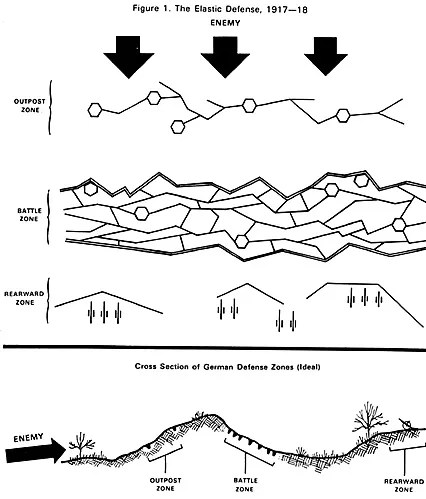
The Germans accomplished this by designating three separate defensive zones — an outpost zone, a battle zone, and a rearward zone (see figure 1). Each zone would consist of a series of interconnected trenches manned by designated units. However, in contrast to the old rigid linear defense that had trenches laid out in parade-ground precision, these zones would be established with a cunning sensitivity to terrain, available forces, and likely enemy action.
The outpost zone was to be manned only in sufficient strength to intercept Allied patrols and to provide continuous observation of Allied positions. When heavy artillery fire announced a major Allied attack, the forces in the outpost zone would move to avoid local artillery concentrations. When Allied infantry approached, the surviving outpost forces would disrupt and delay the enemy advance insofar as possible.
If a determined Allied force advanced through the outpost zone, it was to be arrested and defeated in the battle zone, which was normally 1,500 to 3,000 meters deep. The forward portion of the battle zone, or the main line of resistance, was generally the most heavily garrisoned and, ideally, was masked from enemy ground artillery observation on the reverse slope of hills and ridges. In addition to the normal trenches and dugouts, the battle zone was infested with machine guns and studded with squad-size redoubts capable of all-around defense.
When Allied forces penetrated into the battle zone, they would become bogged down in a series of local engagements against detachments of German troops. These German detachments were free to fight a “mobile defense” within the battle zone, maneuvering as necessary to bring their firepower to bear. [4]
When the Allied advance began to founder, these same small detachments, together with tactical reserves held deep in the battle zone, would initiate local counterattacks. If the situation warranted, fresh reserves from beyond the battle zone also would launch immediate counterattacks to prevent Allied troops from rallying. If Allied forces were able to withstand these hasty counterattacks, the Germans would then prepare a deliberate, coordinated counterattack to eject the enemy from this zone. In this coordinated counterattack, the engaged forces would be reinforced by specially designated assault divisions previously held in reserve. If delivered with sufficient skill and determination, these German counterattacks would alter the entire complexion of the defensive battle. In effect, the German defenders intended to fight an “offensive defensive” by seizing the tactical initiative from the assaulting forces. [5]
The rearward zone was located beyond the reach of all but the heaviest Allied guns. This zone held the bulk of the German artillery and also provided covered positions into which forward units could be rotated for rest. Additionally, the German counterattack divisions assembled in the rearward zone when an Allied offensive was imminent or underway.
In summary, in late 1916, the Imperial German Army adopted a tactical defensive doctrine built on the principles of depth, firepower, maneuver, and counterattack. The Germans used the depth of their position, together with their firepower, to absorb any Allied offensive blow. During attacks, small German units fought a “mobile defense” within their defensive zones, relying on maneuver to sustain their own strength while pouring fire into the Allied infantry. Finally, aggressive counterattacks at all levels wrested the tactical initiative from the stymied Allies, allowing the Germans finally to recover their original positions.
Using the new defensive techniques, the Imperial German Army performed well in the 1917 battles on the Western Front. In April, the massive French Nivelle offensive was stopped cold, with relatively few German losses. The British also tested the German defenses with attacks in Flanders at Arras and Passchendaele. Although the British enjoyed some local successes, no serious rupture of the German defensive system occurred.
Throughout the 1917 battles, the Germans modified and refined the Elastic Defense: among other changes, the battle zone was deepened, heavy machine guns were removed from the static redoubts to provide suppressive fire for the local counterattacks, and German artillery was encouraged to displace rapidly to evade counterbattery fire. [6] On the whole, however, the novel system of elastic defense in depth was thoroughly vindicated. As the German Crown Prince Friedrich Wilhelm remarked in his memoirs, “Had we held to the stiff defense which had hitherto been the case [rather than the Elastic Defense system], I am firmly convinced that we would not have come victoriously through the great defensive battles of 1917.” [7]
One ominous development that seemed to challenge the continued effectiveness of the Elastic Defense was the British tank attack at Cambrai in November 1917. There, massed British tanks broke through the entire German defensive system, and only the combined effects of German counterattacks and British irresolution restored the German lines. This wholesale use of tanks to sustain the forward advance of an Allied attack seemingly upset the logic on which the German defensive concept was based. Although insightful in other aspects of battlefield lore, the Germans mistakenly discounted the combat value of tanks despite the Cambrai incident. While the Germans were impressed by the “moral effect” that tanks could produce against unprepared troops, they also felt that local defensive countermeasures (antitank obstacles, special anti-armor ammunition for rifles and machine guns, direct-fire artillery, and thorough soldier training) virtually neutralized the offensive value of the tank. [8]
In the German assessment, tanks were similar to poison gas and flamethrowers as technological nuisances without decisive potential. [9] The Germans minimized the British success at Cambrai by stating that it was the result of tactical surprise, achieved by the absence of the customary ponderous artillery preparation, rather than from the tank attack itself. In consequence, no reassessment of the Elastic Defense was deemed necessary, and none was undertaken. For example, the updated version of the German doctrinal manual for defensive operations published in 1918 made no special reference to tank defense. [10]
The Final Collapse: Unanswered Questions of WWI
In 1918, the Imperial German Army launched a series of offensive drives on the Western Front. Between March and August, the Germans surged forward in a desperate attempt to achieve a decisive military victory before infusions of American manpower could resuscitate the groggy Allies. Although successful at the tactical level, these attacks were not well conceived strategically. [11]
As a result, these “Ludendorff offensives” achieved only a meaningless advance of the German lines and fatally depleted the last reservoirs of German strength. In fact, they so exhausted the German Army that it was incapable even of consolidating its gains against Allied counterattacks from August onward. The Germans attributed the rapid collapse of their defense after August 1918 primarily to demoralization and inadequate resources rather than to faulty doctrinal methods. As one German general later wrote, “Under such conditions, there could be no longer any mention of tactics” due to the chaotic state of the German armies. [12]
The Ludendorff offensives consumed the most combat-worthy divisions in the German Army. The German attacks were carried forward by specially designated “assault divisions.” When the German offensives faltered, feeble “trench divisions,” whose personnel and equipment were inferior to the assault units, assumed the burden of defensive operations. These trench divisions, which had been purposely starved of replacements to flesh out the shock divisions, turned out not to be merely second-rate but to be flatly “listless and unfit.” [13]
Without support from the burned-out assault divisions, the trench divisions were unable to hold their own against the Allied counteroffensives. As the Allied counterblows gathered momentum, German morale plummeted, and German troops began to surrender in unprecedented numbers. Under these circumstances, German small units could not be relied on to demonstrate the determination and aggressiveness essential to the Elastic Defense. [14]
The tottering German forces were especially vulnerable to the shock effect of Allied tanks, particularly when used with chemical smoke. Looming out of the murk at close range, tanks often touched off epidemics of “tank fright.”Ludendorff belatedly conceded that tank attacks “remained hereafter our most dangerous enemies. The danger increased in proportion as the morale of our troops deteriorated and as our divisions grew weaker and more exhausted.” [15]
Since the Germans had discounted the value of tanks, they had virtually none of their own with which to bolster the morale of their beleaguered infantry. [16] The increasingly general use of tanks by the Allies prompted expedient modifications to the Elastic Defense in the latter months of the war. When used by the Allies en masse, tanks could overrun single lines or even belts of antitank weapons. Consequently, the Germans distributed all types of antitank weapons in greater numbers throughout the depth of the battle zone, transforming it into a tank defense zone wherein enemy armor and infantry could both be destroyed. [17]
These techniques successfully halted even heavy tank attacks, provided that the defending German infantry remained steadfast. As one German commander insisted, “The infantry must again and again be made to realize that the tanks hardly deserve a battle-value at all and that their threatening danger is overcome when the infantry does not permit itself to become frightened by them.” [18] German commanders exhorted their men to steel their nerves and to stand bravely as had the “Teutons of old against the Romans.” [19] Brave words could not compensate for a lack of brave soldiers, however, and the “surrender bacillus” continued to rage through the German ranks. [20]
Lack of sufficient manpower hurt the Germans as much as the lack of combat will. Because of losses in the Ludendorff offensives, the German armies no longer disposed of sufficient reserves to deliver the timely counterattacks that the Elastic Defense required. Time and again, Allied penetrations prompted large-scale German withdrawals lest neighboring frontline units be encircled or enveloped from the enemy salients. [21]
Too, the Allies (particularly the British) had refined their own offensive techniques, eschewing elephantine artillery preparations in favor of short, sharp barrages. Without the customary long artillery pounding that signaled Allied intentions, the Germans were less able to shuttle their few reserves to threatened sectors. The German High Command finally bowed to the inevitable, and an armistice was enacted on 11 November 1918. In later years, many Germans allowed bitterness to cloud the memory of their defeat in the last months of World War I. Many high-ranking military officers blamed Germany’s demise on a “stab in the back” by defeatist elements at home. [22]
In reality, the Imperial German Army was in serious disarray from August 1918 onward and could not have prevented a complete Allied military victory. Frustration and Nazi demagoguery gave the stab-in-the-back story a certain currency during the interwar years, but the popular memory simply did not conform to historical reality. The distorted memories of World War I left behind an uncertain and even contradictory military legacy. Through four grim years, the conflict had been dominated by positional warfare. Consequently, the overriding recollection of the war on the Western Front was of entrenched stalemate, in which the first doctrinal priority was to assure a strong tactical defense.
In the German view, the war as a whole had been an attritional contest, ultimately decided by the superior weight of Allied manpower and resources. Unable to match the Allied coalition in either of these categories, the Germans had sought to maximize their own fighting power by doctrinal means. The Elastic Defense stood alone as the best system for conducting an effective positional defense at minimal cost. (Even the Allies testified to the superiority of the German techniques. The British, for example, attempted to incorporate the German defensive methods into their own postwar field service regulations. [23]
Consequently, a generation of German officers emerged from the Great War steeped in the tactical precepts of the Elastic Defense. To these, the value of the Elastic Defense had been repeatedly assayed by tests in France and Flanders. On many fields, the Germans had successfully pitted defensive depth, firepower, maneuver, and aggressive counterattack against the brutish weight of Allied artillery, infantry, and even tanks. It was a tactical creed that was not to be forgotten.
Less clear, however, were the tactical lessons learned from the war’s final months. Then, positional warfare had briefly given way to battles of movement. The Ludendorff offensives demonstrated the possibility of penetrating Allied trench defenses through attacks by infiltration. The successful Allied counteroffensives from August 1918 onward showed that perhaps even the Elastic Defense was not a perfect talisman against renewed maneuver warfare, since weak and demoralized German forces could not turn away overwhelming tank and infantry assaults through doctrinal charms alone.
However, most Germans excused the final Allied victories as being due to the prostration of German armies rather than to any failure of defensive doctrine. Indeed, isolated examples of German defensive success right up until the armistice seemed to indicate that the Elastic Defense would have prevailed if determined troops had practiced it correctly.
Note:
1. The German publication that set forth the new doctrine did not give a specific title to the new defensive technique. “Grundsatze fur die Abwehrschlacht im Stellungskriege [Principles for Defensive Combat in Positional Warfare],” 20 September 1918 ed., in Urkunden der Obersten Heeresleitung, 3d ed., edited by Erich von Ludendorff (Berlin: E. S. Mittler and Sohn, 1922), hereafter cited as “Grundsatze.” Captain Graeme C. Wynne, a British authority on German defensive doctrine during World War I, suggests that the term “elastic defense” was used informally within the Imperial German Army. Graeme C. Wynne, If Germany Attacks: The Battle in Depth in the West (1940; reprint, Westport, CT: Greenwood Press, 1976), 156, 158-59. The German official history of World War I used the expression “elastic battle procedure” (das elastische Kampfverfahren) in its discussion of the new doctrine. Oberkommando des Heeres, Der Weltkrieg 1914-1918 (Berlin: E. S. Mittler, 1939), 12:45. When the Oberkommando des Heeres (Army High Command) is the author of a source, it is cited as OKH. This research survey will use the term “Elastic Defense” as a title for the German technique of defense in depth.
2. Wilhelm Balck, Development of Tactics-World War, translated by Harry Bell (Fort Leavenworth, KS: The General Service Schools Press, 1922), 79-80.
3. The discussion of the Elastic Defense that follows in the text is from Wynne, If Germany Attacks, 148-64; Timothy T. Lupfer, The Dynamics of Doctrine: The Changes in German Tactical Doctrine During the First World War, Leavenworth Papers no. 4 (Fort Leavenworth, KS: Combat Studies Institute, U.S. Army Command and General Staff College, 1981), 11-21; “Grundsatze”; and “Allgemeines fiber Stellungsbau [Principles of Position Construction],” 10 August 1918 ed., in Urkunden, and edited by Ludendorff.
4. “Grundsatze,” 607.
5. Ibid., 617. The German military vocabulary included separate doctrinal terms for each type of counterattack. A hasty local counterattack by engaged units was a Gegenstoss in der Stellung; one reinforced with fresh reserves was a Gegenstoss aus der Tief; and a deliberate, coordinated counterattack was a Gegenangriff. This distinctive vocabulary illustrates the careful attention the Germans paid to counterattack. No comparable terms exist in the American military lexicon.
6. Ibid., 606-15; Wynne, If Germany Attacks, 209-10.
7. Wilhelm, Crown Prince of Germany, My War Experiences (London: Hurst and Blackett, 1923), 267.
8. See, for example, “General von Maur’s Memorandum on the English Tank Attack of April 11, 1917,” translated by David G. Rempel and Gertrude Rendtorff, in Fall of the German Empire, 1914-1918, edited by Ralph Haswell Lutz (Stanford, CA: Stanford University Press, 1932), 1:625-27.
9. Erich von Ludendorff, Ludendorff’s Own Story (New York: Harper and Brothers, 1919), 2:202-3.
10. See “Grundsatze.”
11. A good critique of the German 1918 strategy is given in Gordon Craig, “Delbruck: The Military Historian,” in Makers of Modern Strategy, edited by Edward Mead Earle (1941; reprint, New York: Atheneum, 1969), 275-82. Following World War I, an official German investigating commission examined the 1918 collapse and later presented its findings to the Reichstag. Extracts from the commission’s reports appear as “Report of the Commission of the German Constituent Assembly and of the German Reichstag, 1919-1928,” in The Causes of the German Collapse in 1918, edited by Ralph Haswell Lutz, translated by W. L. Campbell (Stanford, CA: Stanford University Press, 1934), hereafter cited as “Commission Report.” A critical assessment of the 1918 German offensive strategy is on pages 72-90.
12. Balck, Development of Tactics, 87.
13. “Commission Report,” 81. See also Lupfer, Dynamics of Doctrine, 48-49.
14. Crown Prince Wilhelm, who commanded a German Army Group in the 1918 battles, wrote after the war that, “In view of the ever-increasing weight of the attack … it [the Elastic Defense] was without doubt right in principle, but it was dependent upon strictly-disciplined, well-trained and skillfully-led troops. As the war progressed, these conditions became increasingly difficult to fulfill.” Wilhelm, My War Experiences, 282-83.
15. Ludendorff, Ludendorff’s Own Story, 2:341-42.
16. “Commission Report,” 71-72; Hermann Joseph von Kuhl, Entstehung, Durchfuhrung and Zusammenbruch der Offensive von 1918 (Berlin: Deutsche Verlagsgesellschaft fur Politik and Geschichte m.b.H., 1927), 79-86.
17. Balck, Development of Tactics, 289-90.
18. “Headquarters, Fifth [German] Reserve Corps: Experiences from the Fighting on the West Bank of the Meuse, 29 September 1918,” in Lutz, Fall, 662.
19. Hans Ritter, Kritik des Weltkrieges: das Erbe Moltkes and Schlieffen im grossen Kriege (Leipzig: K. F. Koehler, 1920), 64. Published anonymously by “A General Staff Officer.”
20. Wilhelm, My War Experiences, 267. 21. Balck, Development of Tactics, 288.
22. A particularly impassioned version of the “stab in the back” is given by Balck, who asserted that the “criminal responsible for our fall … should be sought in the ranks of the leaders of our political parties [who] … placed pursuit of their own ends above the weal and woe of Germany.” These cowards, according to Balck, struck down the German Army “like Hagen of old did to the unconquerable hero, Siegfried.” Ibid., 294.
3. Graeme C. Wynne, “The Legacy,” Army Quarterly 39 (October 1939 and January 1940), 26.
Autore: Maj. Timothy A. Wray


Rispondi