
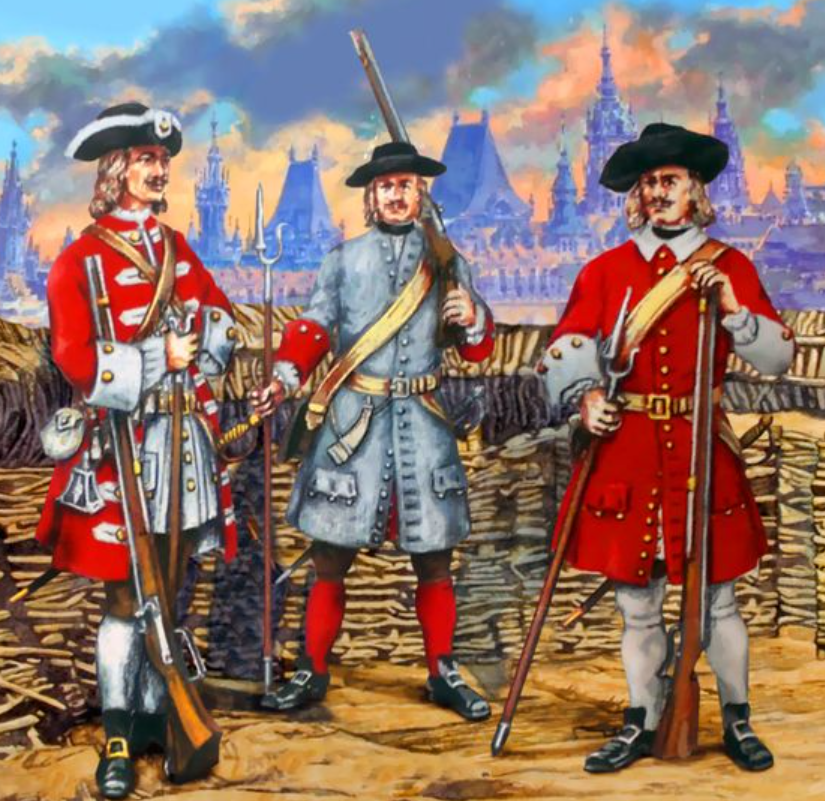
The Manpower Revolution or the Military Revolution in the Early-Modern German States by Thomas Wollschläger The German states during the early modern period offer a vastly diverse picture, regarding the developments of the so-called Military Revolution and its various manifestations. Even if taken into account that there is no uniform set of Military Revolution “rules” or “core elements”, the peculiar nature of the German situation prevented a coherent developmental drive throughout that period. On the one hand, the hideous experiences of the Thirty Years’ War, raging over the German landscape more than over other European territories and devastating German lands more than others, generated a major driving force in overall adopting the concepts of absolutism and its standing armies, not least aimed at preventing the Landsknecht’s system. On the other hand, the existence of several hundred states and principalities, claiming (and in many cases, having factual) sovereignty provided for many different speeds and implementations of the military developments. Between the mid-17th and mid-18th century, these led to notable divergences, resulting in new powers rising and old powers declining, forming new political and military realities at the outset of the Seven Years’ War. The article focuses especially on Brandenburg-Prussia and Saxony, as they are the most important German states during that period and offer an interesting parallel and diverging development at the same time. Whereas Prussia emerged as the leading military power during that period, it has to be asked why so and on what basis. What role did the other innovative forces of the Military Revolution play, like military engineering, fortress building/warfare, and artillery? How did both states address the most prominent resource problem, the recruiting of sufficient soldiers to fill the standing army and militia structures? In the end, a unique and revolutionary system, implemented in Prussia, did indeed solve the manpower problem and led to its outstanding military performance during the 18th century. Keywords: Prussia, Saxony, Recruitment, Canton system (Kantonssystem)
The concept of Military Revolution has been first published by Michael Roberts[1] in 1956, more than 65 years ago. It has lived to see important expansions and broadenings, notably by Geoffrey Parker[2], as well as numerous adjustments and modifications, broad criticism and revisions, prominently by Jeremy Black [3]. It has been suggested to replace the Military Revolution concept by one of an evolution, and it has been declared that the use of the term “revolutionary” for these so-called evolutionary military processes would be rather unjustified[4]. At least the Military Revolution concept can be called an important impulse to initiate a fruitful debate on European history [5]. As the Military Revolution has experienced such a challenging life, it presents somewhat of a challenge, too, when it comes to a possible application of that very concept onto the German states. Could the whole concept with all its extensions be applied to Germany? Or would that approach be having its limitations? If preferring the notion that there were several Military Revolutions (like a basic Military Revolution, a Military Revolution in technology, a Revolution in Military Affairs or geographically separated Military Revolutions), which one, if any, appeared in German lands? There can be a little doubt that the basic criteria of the original Military Revolution thesis were well being present in all the early-modern German states: the rise of infantry firepower, differentiated infantry, cavalry and artillery formations on the battlefield, advanced military training, emerging military administration, eventually leading to the standing army of the absolutist state[6]. However, the more the extended aspects and elements of the Military Revolution are being matched with the developments found in Germany, the more it becomes difficult to find enough common ground to actually execute such matches. Two examples will illustrate these difficulties.
Before doing so, it should also be noted that the peculiar nature of the German lands in the early-modern era generates additional problems for any comparison. Formally under the roof of the Holy German Empire, the several hundred German territories and estates led a quasi-independent life, forming reciprocal political and religious alliances within the Empire and across its borders. The Empire was performing less and less, if anything better perhaps in the wars against the Ottoman Empire between 1682 and 1718. Although barely two German states could be named proportionally equal, the most important role played the secular estates that formed the prince-electors: Bohemia, (Palatine), Bavaria, Hanover, Saxony and Brandenburg[7]. Namely Saxony and Brandenburg-Prussia increasingly became entangled in some sort of rivalling competition for the hegemony in north-east Germany around the turn of the 18th century. Saxony as the more important and wealthier state for several centuries sought to counter the expanding territorial and political influence of its neighbour to the north, culminating in acquiring the Polish crown in 1697. Brandenburg-Prussia became second, gaining the title of “King in Prussia” in 1701[8]. Whereas never been in direct military conflict until 1740, the two kingdoms and prince-elector states continued their rivalry, especially under the rule of King Frederick William I (Brandenburg-Prussia) and Frederick August I (Saxony), respectively, with Brandenburg-Prussia slowly but steadily gaining the upper hand[9]. In his greatly widened version of the Military Revolution, Geoffrey Parker emphasized the important role of the warfare at sea; an area that had not yet earned a very significant role in Roberts’ original concept. The Armada campaign in 1588 was seen as a culmination of a continuing progress, having begun almost a hundred years before.
The Military Revolution at sea had its main phase between that time and the mid-17th century, resulting in the development of the standing high-seas fleets of the European (sea) powers[10]. Parker as well as Jeremy Black and others rightly pointed to the key role of these fleets for the expansion of the European empires over (eventually) all the world’s oceans to overseas, to challenge non-Western powers, and to the influences and dependencies those fleets had on the economy, logistics, science, administration and state’s organization during that period[11]. In fact, the latter effects hardly can be overestimated, as an example on the gun numbers that have been employed on the battle fields might illustrate. In one of the largest maritime battles of the 17th century at Cape Barfleur & La Houge in 1692, the combined British/Dutch and French fleets totalled well over 9.000 guns. Even less large but still important sea battles led several thousand guns into fire. In 1710, in the battle of Kjøge Bay in the Baltic Sea during the War of the Spanish Succession, the number of guns reached roughly 3.200 pieces; in 1759, in the battle of Quiberon (the largest sea battle of the Seven Years War), the number reached almost 3.400 pieces. Proportional to the number of ships involved, these numbers can be found similarly in any given sea battle between the mid-17th and the end of the 18th century [12]. Taken for itself, those numbers might not seem significant, until being compared with the guns employed on the major land battlefields of the Seven Years War.
One of those is the battle of Leuthen in 1757, the most famous victory of King Frederick II of Prussia. This battle saw a total of 407 guns of all calibres. The battle of Kunersdorf in 1759, Frederick’s greatest defeat, came up with only 372 guns; the battle of Torgau in 1760, the last major battle of the war, numbered at least 531 guns[13]. As in the case of the sea battles, these numbers are quite representative for every land battle of the European theatre of war between 1756 and 1763. Generally, the number of guns involved in any major sea battle totalled approximately 8 to 10 times the number of guns involved in any major land battle. Actually, almost any five ships-of-the-line, meeting for a small skirmish, would meet the number of guns of Leuthen with ease.
With every right the development and employment of the artillery have been named as crucial elements of the Military Revolution, more or less independently from the particular scenario[14]. Not only did the artillery revolutionize warfare as such but the production and logistics of artillery deployment certainly have enormous consequences. Beyond the mere numbers, one has to see the production cycles behind the thousands of guns employed at sea and its constant replacements (even a few ships, sunk during a storm and without any enemy contact, could easily cost several hundreds of guns without any gain[15]): manufactures and foundries; iron ore mining; powder mills and charcoal production to produce gunpowder, and again charcoal for the foundries; increasingly coal mining and the beginning of the steam engine use around the turn to the 18th century; tooling of all sorts; wood supply and production; transport and logistics, to name only some of the most important ones. All the combined factors constituted a major driving force for both military and economic areas, paving the road right into the Industrial Revolution. None of the German states, however, could profit from these driving forces since none of them participated in any significant maritime developments. Even in Brandenburg-Prussia, the only state to ever employ a small fleet, shipbuilding and maritime activities occurred as a short episode between 1675 and 1697. The largest ship ever built in the Brandenburg dockyard at Pillau was a frigate, that – and gradually most of the other ships – was lost against the overwhelming maritime domination of the large sea powers, the small Brandenburg fleet never standing a chance to protect trade routes, support an oversea’s colonial expansion or successfully engaging in privateering[16]. In 1711, the Brandenburg-Prussian navy was formally dissolved but had already been bankrupt since the turn of the century. Thus, neither the fleet episode nor any maritime (including artillery) developments left any impact that could be counted as a part of revolutionary influences in an overall Military Revolution in German lands.
A second area that has been playing a progressive expanding role as the Military Revolution concepts kept progressing, is the field of fortress building, fortress warfare and military engineering in the early modern era. Parker had already emphasized its importance by discussing artillery fortresses and the struggle race between attack and defence up to the Thirty Years War[17]; Black extended the relevant period to post-1660 and based many arguments on Vauban plus other engineers and the systematization of fortress warfare before and after the beginning of the 18th century[18]. Again, the role of fortification and fortress warfare hardly can be overestimated. The task of building substantial numbers of artillery fortresses, of maintaining and supplying them, of keeping a vast logistical enterprise behind all of it, and of establishing an engineering corps to guide and advance these undertakings made a similar impression on economy, military and society as did the maritime developments; France being one of the foremost examples. Did those developments have an effect in Germany? Yes and no. Truly, the new principles of fortress warfare, established by both Vauban himself and during its time, had their impact on the German states. Vauban’s principles were heavily discussed by the German engineers and, provided it was possible, put into effect in some ways[19]. But it was next to impossible to defend even one German state by the necessary numbers of Vauban type fortresses. Most of the states were too small to support even one major fortress (e.g. for the capital city or a major port). Most of the largest ones possessed very fragmented territories that could not be surrounded by an expedient chain of fortresses, let alone being supported by the necessary resources, finances and logistics. Even for the two most important states, Saxony and Brandenburg-Prussia, the impact of fortification and engineering was less than average in a European comparison. Saxony inherited the more compact territory but their fortresses were more neglected than improved; and despite having a rather well-disposed engineering corps with a high degree of institutionalization but due to the lack of funds and support by the elector-king, the engineers couldn’t improve the situation significantly.
Brandenburg-Prussia, on the other hand, had quite a number of fortresses and was trying to keep them in good order but had the most wide-spread and splintered territory; therefore, it concentrated on key fortresses. For about 25 years, its engineering corps achieved a major status and played not a minor role during the Silesian Wars but nearly got lost in insignificance after the fall of its commanding officer; during the Seven-Years-War, Prussia lost a number of fortresses without any real impact on the war[20]. Whereas the innovative influence of modern engineering and fortification was quite measurable in terms of quality – some of the engineers in Germany were as good as Vauban and very adaptive to regional challenges –[21], there is no indication that the developments in that area left an even somewhat comparable impact on economy and military as they did in other European states such as France, the Netherlands or Italy[22]. Thus, the new principles perhaps revolutionized parts of the military thinking but were no major driving force in terms of a Military Revolution that would transform society. The lack of these characteristic Military Revolution features doesn’t necessarily mean, however, that no military related developments had taken place that could be described as no less than revolutionary. The origin of those changes can be found in the experiences of the Thirty Years War. That war had taken place mostly on German lands and had left devastating effects on nearly everything – destroyed cities and villages, a harshly decimated population, a ruined economy, and depleted means of subsistence[23]
Those singular impressions became a major driving force for the developments of the absolutist states and the organization of standing armies in Germany, focussing on the elimination of private armies and the landsknecht’s system as well as on the alleviation of the damage that the military, the soldiers, or the irregularities of warfare could bring upon on land and society.
Apart from these general developments, an important part played thorough policies towards a so-called “Verschonung des Landes” (conservation/preservation of the lands). The first of those measures can be found in the 1670s, and they were continued far into the 1730s. They clearly show that the inhabitants of the lands were seen to require explicit protection, along with their possessions, especially livestock and crops. All military conduct should no longer endanger the basics of subsistence in rural areas and, slightly later, the cities as well. Military commanders of stationed or passing units were encouraged to not only guarantee the inviolacy of the inhabitants but also to provide preventive orders and actions against any misconduct or unnecessary harm to people or subsistence[24]. The efforts not just affected the regular and wartime presence of the state’s own military. Even in times of conflict and occupation, authorities and/or the occupying forces themselves tried to establish comprehensive sets of rules for their troop’s behaviour (especially during any sort of quartering), of guarantees towards people, economy and subsistence, and for means of appeal the inhabitants or local authorities could use in cases of misconduct[25]. In general, the measures targeted the following aspects. Preservation of wood, fruit trees, gardens, vineyards, fields, and lawns. Preservation of livestock and horses. Preservation of craft shops, mines, wells, houses, furniture, and fences. Prohibition of hunting and fishing by soldiers. Protection of free trade, post service, and travel. Military sutlers were disallowed to interfere with local trade. Prohibition of plunder, arson, theft, violence, and excesses by soldiers. Protection of religious freedom and local jurisdiction. Prohibition of quartering without adequate payment; obligation to use assigned quarters. Prohibition to claim transport and other services without payment. Regulation of rationing quotes, obligation to pay regularly for quartering and rations. Prohibition of self-justice by soldiers against local inhabitants. Regulation of legitimate complaints against the military and guarantee of appeal options.
Obviously, the repeated decree of those measures didn’t necessarily guarantee their ultimate fulfilment. In fact, a goodly number of complaints against the military, especially about quartering, have been recorded throughout the period. However, all violations against those rules and policies were seen for what they were – violations, and they were being dealt with. Quite a few complaints reached the highest authorities (electors, kings and even the emperor himself[26]) which showed themselves very interested in upholding peace and quiet, good order and discipline in their territories and purview. Apart from quartering, undoubtedly the single most important issue that could affect, or severely disrupt, the local economy and living as well as the overall peace and social order had been recruitment. Until the end of the Seven Years War, recruitment often drew away any men halfway fit for military service, regardless of their status and their importance for family alimentation, the survival of the village or the functioning of the city. In some states, that practise continued also afterwards; in numerous other states, however, a fundamental system of exceptions from military recruitment became established. These exceptions from military service and recruitment of essential personnel were aimed to guarantee the continuing work of vital craft producers, unreplaceable professions and services, and others. Disregarding special exceptions that were unique to certain states, it is feasible to discern three major groups of exempted persons. Typical rural craftsmen, such as millers, charcoal burners, shepherds, village smiths and village bakers, innkeepers, salaried winemakers, quarry men, miners, employees of smelters and forges.
Typical urban professions, such as pharmacists, doctors, scientists, goldsmiths, printers, brewers, gunsmiths, wig makers, city bakers, apprentices, students, town and court employees, advocates, scholars, church personnel. Other (overall) groups, such as employees of the king and elector, servants and employees of the nobility, traders, merchants, manufacturers, custodians and foremen of manors, noble hunters and, in some cases, journeymen and marketeers[27]. As with the preservation issues, also the exception policies have been the subject of many and vigorous discussions, e.g. which groups should be included or excluded, how the local economy would be affected by continuing or discontinuing certain exceptions, or how individual hardship cases should be treated. In general, those discussions rather led to more exceptions than otherwise. Even past recruitments were put to the test on several occasions. In 1738, the Saxon regiments were scoured through for drafted craftsmen apprentices with unfinished training, and 152 recruits from eight battalions discharged eventually[28]. In Saxony and Prussia also many single applications for exception were being filed, sometimes to the king himself, with many of them being granted[29]. In 1736, the Saxon High War Council (Geheimes Kriegsratskollegium) even complained that “there is almost no single subject left in our lands who, when being drafted, should not find an excuse to blend in amongst a certain class of exempted persons”[30].
Obviously, that was somewhat of an exaggeration. But the discussions and complaints didn’t cease, and that shows that it remained difficult to balance the needs of recruitment for the regular troops and for the state’s militia against the needs for preservation of the lands and its inhabitants. In any case, the essential and exigent need for the exemptions and the according preservation of the social and economic order remained a continuous policy issue or constraint and called badly for a comprehensive solution. Most German states struggled heavily with that issue (in Saxony alone, no less than twelve attempts, projects and proposals to address the questions of regular and militia recruiting were issued between 1700 and 1736)[31] but failed to solve it satisfactorily. The real solution was found in Brandenburg-Prussia, and it consisted of nothing else than the Kantonsystem (cantonal system), introduced by King Frederick William I in 1733. The key features of that new system were the following: partition of the entire state into enrolment cantons, having different sizes for infantry and cavalry regiments[32]; subdivision of each canton into districts, with one district each for every company; and finally, drafting a limited number (up to four) recruits, the so-called “Kantonisten” (cantonists) per year from each district[33]. Thus, the system spread the weight of the recruitment balanced over the whole state, at the same time allowing for a different allocation of social, economic and manpower resources. The almost immediate and thoroughgoing effects were the following. Harmonizing of the recruitment needs and the necessary exemptions. Military controlled recruiting on the basis of enrolment by registering non-exempted personnel in order of property, instead of civilian-corporate drafting. Practical assessment of the military service in terms of economic and other interests, and its adaption onto the needs of an agrarian society[34].
Especially the last aspect meant quite a deep intervention into the usual semi-independent company administration within the Prussian military system. Having extended furlough permission shortly after his ascension to the throne in 1714 already, now Frederick William I established an exceedingly high quota of furlough, a defined maximum of full-service (mostly, two years) followed by three months per year exercise periods only. Those exercise periods laid strictly within the agrarian downtime between sowing and harvest. If necessary, the cantonal system was adapted to territorial needs; e.g. if the social and economic specifics demanded modifications time periods or numbers. How deep that intervention really was, becomes more visible if we look at the reaction to the Prussian way in the other German states. Most of the other German rulers didn’t just fail to adopt the Prussian example for their own territories but they deliberately decided against that model. Very prominently can be named the elector-king of Saxony, Frederick August II. In a rescript against “Excessive Furlough” from 1741, he referred to the cantonal system and declared: “One should send in all [Saxon] lands and examine all services whether one example of such absurd suspension as in Prussia … exists. [If so], then it has to be shut off without delay, if not to be punished.” Why was the elector so explicit? Because – he wrote – “if an officer sees his soldiers only one month a year but the other eleven they are dispersed over the lands, then the maintaining of the good order and militia will be ruined completely”[35]. The words of the Saxon sovereign vividly show how the Prussian way was seen – it was “absurd”, a danger to the “good order”, an abomination of the appropriate standing of an absolutist army and the representative values which a status-conscious ruler would his army let represent.
One just didn’t employ the precious army for harvest duty or find pragmatic solutions to serve socio-economic interests in favour of prestige-driven standards. In this case, Saxony struggled with the problem of army and militia replacements, recruiting and the necessary negotiations with the land estates throughout the 18th century, facing a laborious process most of the time, with only partial successes[36]. Very few German states did follow the Prussian example even partially by allowing themselves to be influenced by it, whereupon some argue that the introduction of conscription in Hessen-Kassel (1762) and Austria (1771) were going back to the cantonal system successes[37]. The introduction of the cantonal system was not the only measure that addressed the manpower question in Brandenburg-Prussia, of course. Quite a few other policies coincided with it, notably the encouragement of immigration that welcomed a goodly number of skilled and valuable citizens to Brandenburg and Prussian lands; the religious tolerance towards such immigrants; the furthered and systematic peopling[38] of areas poor in own resources; and others more. The newly developed territories became future cantons (thus, providing for future cantonists), and many of the immigrated people became major assets for the economic growth. Taken together, all those policies were rather successful in turning unfavourable conditions and rare resources of Brandenburg-Prussian state into new assets, and they amplified the long-term impact of the cantonal system. The lasting effects of that system finally became apparent during wartime. Already during the Silesian Wars in 1740-45, Prussia demonstrated to be a formidable military power and was able to sustain its territorial gains against Austria and Saxony comparatively straightforward. The real challenge proved to be the Seven Years War, however. During that long-term conflict with dozens of major and many minor battles, Prussia held its ground almost alone (at least on the European land theatre) against the greatest military powers of the age combined, notably Russia, France, and Austria. That war strained the manpower resources of all belligerents to the extreme, for not only battles lost accounted for heavy losses that needed to be replaced. Even victorious battles and costly victories could lead to considerable manpower reductions (large numbers of wounded soldiers becoming unfit for duty permanently or at least long-term). Prussia, however, was able to replace its losses over the whole duration of the war[39].
The fact that the whole territory of the state had been incorporated into the cantonal system ensured that even if some areas were occupied by enemy forces, the overall manpower replacement became effected only marginally. With Russia dropping out of the war in 1762, the other anti-Prussian parties saw little perspective of a foreseeable exhaustion of the Prussian means of war and began to settle for an eventual end of the conflict. Prussia had outlasted them all, against very unfavourable odds. But not only did Prussia prevail over their opponents in maintaining the status quo ante bellum and in keeping the territorial gains from the first two Silesian Wars. The political landscape had been changed considerably, compared to only a few years ago. Prussia had emerged from the conflict as a major European power, militarily and politically. There were no more secondary powers left that might be struggling with Prussia for the hegemony in Germany[40], as it had been the case between Saxony and Prussia roughly sixty years earlier. The three states of Saxony, Bavaria and Hanover formed a group of third-rate powers and leastwise played some significant role, compared to all the other minor states. Although the cantonal system has been playing such a crucial role for the Brandenburg-Prussian state, it has been criticized for representing a militarization of the society[41]. Be that as it may, it should be remarked that, from an early-modern perspective, a militarized society by no means had to have any negative notion; the latter is a far more modern perception. As the New Military History Movement in Germany has been pointing out for roughly 25 years by now, the relation between military and society in the early-modern period cannot be expressed by describing it as a mere militarization but must be seen as a complex reciprocity. A certain arrangement of society along military needs and structures was matched by a tantamount civilization of the military, as the cantonal system and the preservation of the lands have demonstrate [42].
That does not only concern the naming of the subject: it could be “Social history of intra-military discipline” – to leave aside the more problematical “social disciplining” (Sozialdisziplinierung) concept by G. Oestreich; on the other hand, we could speak about a “militarization of society” [43]. In any case, far more important is the question whether that central policy of the Prussian state had rather been welcomed or rather been opposed by the resident population. In fact, the cantonal system highly contributed to pacify the lands. Compared to a history of excesses and devastations, of misconduct and violations, and of a high uncertainty of life (all of it still very present in the people’s memorizations), the new system and the present life made for quite liveable conditions. As Hartmut Harnisch has aptly put it, “the Kantonsystem became a calculable parameter for the population, and it turned out quite tolerable” [44]. Desertion, unrest, protest, denial, and other disturbances decreased markedly and especially did not endanger any vital functions of the state, of its military or of its economy anymore. In this respect, militarization – if we were to rate the cantonal system as such – was a welcomed way to social peace in early modern Germany. In any case, the revolutionary Kantonsystem had proven its high value. To summarize, it can be said that the concept of the Military Revolution most certainly has its merit. The more detailed the overall concept became, however, the less it has become adaptable to each and every state; as shown, there are considerable difficulties with the application to the German lands. The state of Saxony, for example, did match some important qualitative aspects of revolutionary military innovation but other aspects, as in various other German states as well, are far less applicable. Despite innovations, Saxony failed to employ military change as a driving force to new state’s power, hence experiencing a decline in comparison to its great rival Prussia. On the other hand, there can be no doubt that there were processes at work that can be described as revolutionary, most importantly the revolution in military administration that transformed Brandenburg-Prussia to a major European power during the first half of the 18th century. As that development relied mainly on the revolutionary new cantonal system that, combined with other measures and policies, solved the manpower problem, and allowed for the preservation of the lands at the same time, this specific Military Revolution justifiably can be called the “Manpower Revolution” and would fit into the concept of specific Military Revolutions, depending on the respective state or territory[45]
Note:
[1] M. Roberts, The Military Revolution 1560 – 1660, M. Boyd, Belfast 1956.
[2] G. Parker, The Military Revolution. Military Innovation and the Rise of the West 1500-1800, Cambridge Univ. Press, Cambridge 1988.
[3] J. Black, A Military Revolution? Military Change and European Society 1550-1800, Macmillan, Basingstoke 1991; and several other works from 1990 onwards.
[4] Prominently Marcus Meumann in the recent edition of the Enzyklopädie der Neuzeit; see M. Meumann, Militärische Revolution, in Enzyklopädie der Neuzeit, Vol. 8: Manufaktur/ Naturgeschichte, Verlag J. B. Metzler, Stuttgart 2008, col. 506-10.
[5] For an intermediate summary on the Military Revolution debate see C. Rogers, The Military Revolution Debate. Readings on the Military Transformation of Early Modern Europe, WestView Press, Boulder 1995.
[6] Roberts sets the ending point of the Military Revolution in the year 1660. “Mass armies, strict discipline, absolute submergence of the individual, had already arrived, the conjoint ascendancy of financial power and applied science was already established in all its malignity”. See Roberts, The Military Revolution, cit., p. 25.
[7] Originally, the secular prince-electors were Bohemia, Palatine, Saxony and Brandenburg. Bavaria replaced Palatine in 1623, only to gain a separate elector role in 1648; Palatine remained without real importance since that time. The crown of Bohemia lay with the House of Habsburg, in a personal union. It has become widespread accepted to regard the Habsburg monarchy (mostly simplified as: Austria) as an empire of its own, beside the other German states, although belonging to the Holy Roman Empire and bearing its crown until 1806. For the peculiar role of the Habsburg monarchy, see G. Parker, The Thirty Years’ War, Routledge, London 2006², pp. 2-10.
[8]
The title was changed to “King of Prussia” only in 1772, when the Hohenzollern dynasty acquired all Prussian territories. Before that, the title only referred to the Prussian territories in Hohenzollern hands (Brandenburg), therefore being that of a “King in Prussia”.
[9]
A concise overview on the topic in T. Wollschläger, Die Military Revolution und der deutsche Territorialstaat. Determinanten der Staatskonsolidierung im europäischen Kontext 1670-1740, BoD, Norderstedt 2004, pp. 21-4. For an older but still interesting monograph on the Saxon-Prussian competition see A. Haake, Kursachsen oder Brandenburg-Preußen? Geschichte eines Wettstreits, Ebering, Berlin 1939.
[10]
Parker, The Military Revolution. Military Innovation, cit., pp. 114-6 and 121-5.
[11]
See Parker, The Military Revolution. Military Innovation, cit. and J. Black, Beyond the Military Revolution. Warfare in the Seventeenth-century World, Palgrave Macmillan, London 2011, pp. 151, 160-1, 163-9.
[12]
The numbers stated refer mainly to the guns placed on the ships-of-the-line involved in these battles; if one takes all the other ships (like frigates, sloops, fireships) into account, the numbers will be significantly higher yet. See H. Pemsel, Seeherrschaft. Eine maritime Weltgeschichte von den Anfängen bis 1850, Bernard & Graefe, Koblenz 1995, pp. 258, 274-5, 294-6.
[13]
For those numbers see G. Dorn – J. Engelmann, Die Schlachten Friedrichs des Großen, Bechtermünz, Augsburg 1997, pp. 89-92 (Leuthen), 121-3 (Kunersdorf ), 142-4 (Torgau).
[14]
See J. Black, Warfare in the Eighteenth Century, Cassell, London 1999, p. 163.
[15]
For example, on December 8 th , 1703, the English lost 13 ships during a heavy storm, amongst them six ships-of-the-line with 430 guns in total; see H. Pemsel, Seeherrschaft. Eine maritime Weltgeschichte von den Anfängen bis 1850, Bernard & Graefe, Koblenz 1995, p. 270. Moreover, guns lost at sea generally were total losses (sunk at the bottom of the ocean), whereas guns lost at land in most cases were captured and could be re-used by the victorious party.
[16]
A modern analysis of the Brandenburg-Prussian naval developments is still lacking; among the older works see R. Schück, Brandenburg-Preußens Kolonialpolitik unter dem Großen Kurfürsten und seinen Nachfolgern 1647-1721, Vol. I, Grunow, Leipzig 1889, pp. 199, 251, 268-9, 276-8; H.-G. Steltzer, Mit herrlichen Häfen versehen. Brandenburgisch-preußische Seefahrt vor 300 Jahren, Ullstein, Frankfurt 1981, pp. 10911, 190-5.
[17]
Parker, The Military Revolution. Military Innovation, cit., pp. 26-34.
[18]
See Black, A Military Revolution? Military Change, cit., pp. 51-7, 90-5; Idem, Warfare in the Eighteenth Century, cit., pp. 175-6; Idem, Beyond the Military Revolution, cit., pp. 98-9.
[19]
For the influence of Vauban on engineers in Germany and the resulting controversies see T. Wollschläger, Military Engineers and the Development of the Princely State in Germany, in B. P. Lenman (ed.), Military Engineers and the Development of the Early-modern European State, Dundee University Press, Dundee 2013, pp. 112-6.
[20]
For a detailed treatise on fortresses in Saxony and Prussia and on the respective developments of the engineers in both states, see Wollschläger, Die Military Revolution, cit., pp. 51-75 (Prussia) and p. 76-87 (Saxony).
[21]
Notably G. C. von Walrawe, Prussian chief engineer from 1729 to 1748 (see Wollschläger Die Military Revolution, cit., passim) and L. C. Sturm in Brunswick-Wolfenbüttel from 1696 to 1719 about whom, see T. Wollschläger, Military Engineers and the Development of the Princely State in Germany, in B. P. Lenman (ed.), Military Engineers and the Development of the Early-modern European State, Dundee University Press, Dundee 2013, pp. 114-5 and 126-8.
[22]
As for respective overviews, see B. Downing, The Military Revolution and Political Change. Origins of Democracy and Autocracy in Early Modern Europe, Princeton Univ. Press, Princeton 1993, pp. 113-139, 212-238.
[23]
See Black, Beyond the Military Revolution, cit., pp. 67-69, and Parker’s monograph on the war as a whole: G. Parker, The Thirty Years’ War, Routledge, London 2006².
[24]
The following source materials can be relevant: Geheimes Staatsarchiv Preußischer Kulturbesitz, (GStA PK), 1. HA, Rep. 63, No. 10 G2 c2, p. 1, from February 19, 1675; No. 247 II, fasc. 33 (printed leaflet), from August 14, 1711; Hauptarchiv der Stadt Wetzlar, Alte Abteilung, No. XVIII, 6, p. 66 from October 15, 1734; No. XVIII, 1, p. 67, from November 1, 1735.
[25]
See notably the set of rules during the Swedish occupation of Saxon lands during the Great Northern War, established on September 24 th , 1706; in GStA PK, 1. HA, Rep. 11, No. 247 fasc. 13 (Articles I to XV).
[26]
The latter being directly responsible for all (free) imperial cities and their territories throughout the Holy Roman Empire; their number varied and averaged around 50 at the end of the 18 th century.
[27]
The data originate from the following sources: Sächsisches Hauptstaatsarchiv (SächsHStA), Geheimes Kriegsratskollegium, (new) no. 36, pp. 8-11 (the document being from 1736 but describing the situation in 1710/11); SächsHStA, Geheimes Konsilium, Kriegssachen/Generalia, HStA 6417, p. 4 (from 1734). For a comprehensive synopsis of all exceptions, see Wollschläger, Die Military Revolution, cit., p. 124-8.
[28]
See SächsHStA, Geheimes Kriegsratskollegium, no. 479.
[29]
Sometimes after the appointment of a replacement person for the military service only. Many applications referred to a changed personal status, like the death of the family father and the subsequent passing of the craft shop to the applicant. See GStA PK, 1. HA, Rep. 96, No. 519b and 520b; SächsHStA, Geheimes Kriegsratskollegium, No. 479, and (new) no. 36, p. 13, 14, 17.
[30]
Cited from SächsHStA, Geheimes Kriegsratskollegium, (new) no. 36, p. 12.
[31]
Many of those are summarized in: SächsHStA, Geheimes Kriegsratskollegium, (new) no. 36.
[32]
For infantry: approximately 5,000 households; for cavalry: approximately 1,800 households. These numbers varied over time.
[33]
The company was the smallest administrative unit in the Prussian army, and was managed by the so-called “Kompaniewirtschaft” (a complex term, meaning the integrated administration, financing and supply of the company by its owner).
[34]
As compiled by Jürgen Kloosterhuis in a conference contribution in 1995; see J. Kloosterhuis, Zwischen Aufruhr und Akzeptanz: Zur Ausformung und Einbettung des Kantonsystems in die Wirtschafts- und Sozialstrukturen des preußischen Westfalen, in
B. R. Kroener and R. Pröve (eds.), Krieg und Frieden. Militär und Gesellschaft in der Frühen Neuzeit, Schöningh, Paderborn 1996, pp. 178-9.
[35]
Citations from SächsHStA, Geheimes Kriegsratskollegium, (new) no. 36, document “Rescript gegen die excessive Beurlaubung” (without pagination).
[36]
See S. Kroll, Aushandeln von Herrschaft am Beispiel der Landrekrutenstellung in Kursachsen im 18. Jahrhundert, in Herrschaft in der Frühen Neuzeit. Umrisse eines dynamisch-kommunikativen Prozesses, LIT, Münster 2004, pp. 161-94, and esp. 173, 191-4.
[37]
See Wilson, Social Militarization in Eighteenth-Century Germany, cit., pp. 168-9 including fn. 29.
[38]
In German, that policy is called by the early-modern name, “Peuplierung”.
[39]
The introduction of the cantonal system in 1733 did not mean the end of recruitment of foreign soldiers and officers, of course. But along the duration of the war, the foreign personnel accounted for most deserters and missing soldiers; in effect, at the end of the war, the great majority of the still serving soldiers were cantonists. See Harnisch, Preußisches Kantonsystem und ländliche Gesellschaft, cit., pp. 137-8.
[40]
See above, fn 8 for the separate role of Austria that is rated separately, aside from the other German states.
[41]
See the article on the subject and the respective literature references in Wilson, Social Militarization in Eighteenth-Century Germany, cit., pp. 161 fn 1, 163 fn 11.
[42]
Most relevant is here the summary of the first meeting and founding conference of the “Arbeitskreis Militär und Gesellschaft in der Frühen Neuzeit” in 1995; see Ergebnisse der Schlussdiskussion, in Krieg und Frieden. Militär und Gesellschaft in der Frühen Neuzeit, cit., pp. 349-53. For the New Military History Movement see R. Pröve, Vom Schmuddelkind zur anerkannten Subdisziplin? Die “neue Militärgeschichte” der Frühen Neuzeit – Perspektiven, Entwicklungen, Probleme, in “Geschichte in Wissenschaft und Unterricht” 51, 2000, pp. 1-39 and esp. 21-2.
[43]
See P. Burschel, Zur Sozialgeschichte innermilitärischer Disziplinierung im 16. und 17. Jahrhundert, “Zeischrift für Geschichtswissenschaft” 42, 1994, pp. 965-981; W. Schulze, „Gerhard Oestreichs Begriff” Sozialdisziplinierung in der frühen Neuzeit, “Zeitschrift für historische Forschung”, 14, 1987, pp. 265-302.
[44]
See Harnisch, Preußisches Kantonsystem und ländliche Gesellschaft, cit., p. 142.
[45]
Wilson uses the phrase „manpower policy” but it is referring to the smaller German states rather than acknowledging Prussia as a major power. He is, however, emphasizing the notion to view the developments in Germany and Eastern Europe as “distinct forms [of a sort of Military Revolutions] in their own right”; see Wilson, Social Militarization in Eighteenth-Century Germany, cit., p. 199
Autore: Thomas Wollschläger.


Rispondi