
Antitank Defense
Because the Allies used tanks impressively in 1918, German officers gave serious consideration to antitank defense methods. Rooted in their memories of the 1918 collapse was the nagging fear that-as Ludendorff had finally conceded-tanks had become the single most effective tool for prying open the German Elastic Defense. However, General Beck confined this interest to traditional channels.
Beck, who in Truppenfuhrung returned the German Army to the Elastic Defense, held profoundly orthodox views. One symptom of this orthodoxy was Beck’s reluctance to embrace new ideas about tank warfare. Beck’s logic recalled the emphatic pronouncements of German officers in 1918 that tanks were merely nuisances to a properly organized elastic defense in depth. Beck saw the traditional combat arms — infantry, artillery, and even cavalry — as being decisive, and he resisted the notion that armored formations could have a pivotal battlefield impact. [54]
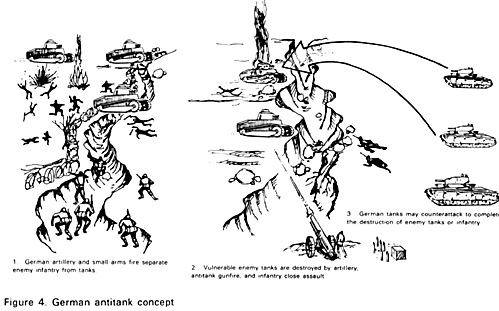
Given such a conception, Beck deemed antitank defense measures as secondary to the central problem of halting artillerysupported attacks by enemy infantry. According to the new German field manuals, the key to defeating enemy combined arms attacks thus lay in separating the enemy’s tank and infantry forces. German soldiers were trained to concentrate their small-arms fire on the enemy infantrymen in order to separate them from any supporting tanks. While shredding the attacking infantry forces, German defenders were supposed to dodge enemy tanks, leaving the destruction of these metal monsters to specially designated antitank teams. [55]
Once the opposing infantry attack had been smashed, any surviving tanks were considered both vulnerable and relatively inconsequential. Those tanks, rampaging through the German defensive zones like rogue elephants, could be dispatched almost at leisure by antitank weapons located to the rear.
Specific measures prescribed for antitank defense were mostly codifications of 1918 practices. Tanks were to be neutralized by a combination of obstacles, minefields, and antitank weapons. Although antitank rifles would be available in all parts of the German defensive zones, the crew-served antitank guns (Panzerabwehr Kanonen, or Paks) and direct-fire artillery would generally be located to the rear of the main line of resistance. [56] (The rearmed German Army of 1939 had a seven-man antitank section armed with three antitank rifles in each rifle company. Each infantry regiment also contained a Pak antitank company, and each infantry division had a divisional antitank battalion of three additional Pak companies. [57])
Although Pak sections could be attached to forward elements in certain circumstances, the Germans thought these guns could be used more effectively as a “backstop” for the main infantry trench systems. They reasoned that these rearward antitank weapons would be relatively safe from any preliminary artillery bombardment, would be free to mass opposite tank penetrations as necessary, and would be able to engage those tanks without embarrassment from enemy infantry (see figure 4). German doctrine also allowed for the creation of special antitank assault groups composed of small teams of infantrymen who would try to destroy enemy tanks with mines and explosive charges from close range. As always, all German units were expected to counterattack vigorously in order to regain any position, even if it had been temporarily overrun by hostile tanks.
Through the 1930s, German antitank doctrine thus corresponded to the techniques first hammered out in 1917 and 1918. The first task of the defending forces was to halt the enemy infantry; that done, the isolated enemy tanks would then be at the mercy of German antitank weapons and close assault. [58]
Virtually all German writings about antitank warfare in the interwar period were based on the assumption that tanks without infantry were pitifully vulnerable to antitank weapons, an article of faith reaching back to the difficult last days of the Great War. One retired general praised the ability of “nearly invisible” antitank riflemen to prey on enemy tanks. [59] Another German officer spoke for many when he asserted that experience in the Spanish Civil War confirmed that “the defense is superior” to tanks since every tank-antitank duel in Spain had allegedly ended with victory for the antitank gunners. [60]
Defensive Use of German Tanks
One remarkable omission from the list of German antitank weapons was the tank itself. General Ludwig Ritter von Eimannsberger, a prolific writer on antitank matters, characterized most German officers when he wrote in 1934 that “the principle claiming the tank to be the best antitank weapon has already been outlived and rendered untrue.” [61]
Like other facets of German doctrine, this belief stemmed from remembrances of the Great War, in which German tanks had played no such role. German tank design in the 19308 provided physical evidence of this prejudice, since few German tanks in production prior to September 1939 mounted a truly effective antitank gun. [62] Furthermore, during World War I, the German Army had become convinced that tanks were “expressly weapons of attack.” This opinion was elevated to dogma in interwar German manuals and was frequently reiterated by Heinz Guderian and other German tank enthusiasts. [63]
Although panzers were not considered antitank weapons themselves, the Germans did develop a doctrinal role for their armored forces that exploited the tank’s offensive nature and conformed neatly to the Elastic Defense format. In defensive battles, panzer units were to be held in reserve for delivering the counterattacks vital to the elastic defense in depth. The shock and mobility of the panzers would lend weight to German counterblows, thus assuring the annihilation of enemy infantry or armor mired in the German defensive zones. [64]
Some German officers saw in this system a clear-cut division of labor between tanks and infantry. Panzer units would be used exclusively in offensive roles, even within defensive scenarios. Infantry forces, presumably unable to keep up with the offensive battles of maneuver envisioned by the panzer generals, would be indispensable for defensive purposes due to their ability to occupy and hold terrain. That panzer forces might have to conduct defensive operations unrelieved by German infantry divisions was almost totally discounted.
Early Trials: Poland and France
The campaigns in Poland and France provoked no changes to German defensive doctrine. If anything, operations during these spectacularly successful German offensives seemed to diminish the importance of defensive precautions. Skewered by German panzer thrusts, the Polish and French Armies succumbed without seriously testing German defensive measures in return.
In each campaign, the Germans fought a small number of defensive engagements. Although the Germans learned some valuable tactical lessons, they were insufficient to spur a reevaluation of German defensive techniques. After-action reports from the Polish campaign revealed a general dissatisfaction with training and small-unit leadership within the German Army. [66] Singled out for criticism were a number of reservist units that in their training and cohesion were not prepared for the rigors of the Elastic Defense. [67]
In October 1939, in an Army High Command memorandum detailing deficiencies uncovered in Poland, defensive operations was listed as an area in need of immediate improvement. This complaint, however, emphasized performance rather than doctrine. [68]
The campaign in France likewise was not without its defensive lessons. Most disquieting was the British tank attack at Arras on 21 May 1940. There, the rapidly advancing German panzers had become separated from their following infantry. Falling on the unsupported German infantry forces, the British armored attack illustrated not only the danger inherent in the de facto German policy of giving separate offensive and defensive roles to their tanks and infantry, but also the inadequacy of German antitank weaponry. Only the timely fire of German 88-mm flak guns and 105-mm field guns prevented the German infantry from being entirely overrun, as shells from the German 37-mm Paks and the even lighter antitank rifles rattled off the British Matildas without apparent effect. German tanks, hurriedly retracing their steps and returning to the scene, were also outgunned by both the British tanks and antitank guns.
The close call at Arras caused some ripples of concern within the German Army; however, this concern did not mature into reform. Although the German panzer and infantry forces had become perilously divided during the advance to the Channel — a situation to be repeated on an even grander scale in Russia-neither the French nor the British had been able to exploit this vulnerability decisively. The Germans, therefore, shrugged off the potential danger. A few new motorized infantry divisions were activated in the year between the fall of France and the invasion of Russia, but not nearly enough to provide defensive security for the panzers or to take up the slack between the mobile units and the trudging infantry forces. Indeed, the Germans shortly reaffirmed the exclusively offensive role of their panzer divisions: a new panzer operations manual published in December 1940 devoted twenty-six pages to discussing attack techniques, but only two paragraphs discussed defense. [69]
More immediately disquieting was the woeful German antitank weaponry. Hitler ordered the punchless Panzer IIIs upgunned, an overhaul that was completed within the next year. [70] The German Paks, however, could not be so easily replaced or repaired. Although some captured French 47-mm guns and a few new 50-mm Paks were introduced to augment the 37-mm antitank guns, the smaller (and virtually ineffective) weapons remained the primary dedicated crew-served antitank weapons of German infantry divisions at the beginning of Barbarossa. [71] As an interim precautionary measure, German field artillery units placed greater emphasis on close-range antitank engagements during training in the spring of 1941. [72]
Overview: German Doctrine on the Eve of Barbarossa
Before the beginning of Operation Barbarossa in 1941, the German Army adhered to a defensive doctrine originally developed to address battlefield conditions of World War I. Although temporarily shunted aside in the 1920s during a faddish pursuit of offensive maneuver, the conservative defensive practices of 1918 had been reinstated in the German Army by the mid-1930s. This defensive doctrine concentrated on halting enemy infantry attacks by means of a defense in depth consisting of a series of defensive zones. Within these zones, enemy infantry forces were to be defeated by firepower, tactical maneuver, and vigorous counterattack.
In the 1918 tradition, tanks were regarded as a lesser threat than enemy infantry. German antitank measures followed the 1918 outlines: enemy tanks would have their accompanying infantry stripped away; their advance would be obstructed by mines and obstacles; and a mixture of direct-fire artillery, antitank gunfire, and individual close assault would destroy those tanks that actually penetrated the German defensive positions. German tank units had no defensive role other than to deliver counterattacks where necessary to help crush enemy penetrations.
Whatever its potential faults, this doctrine suited the structure of the 1941 German armies. Its few panzer units aside, the Wehrmacht was as overwhelmingly pedestrian as had been the Imperial German Army of 1918. The Elastic Defense fit the skills, capabilities, and disposition of this preponderantly infantry-based force. On the eve of World War II, foreign military observers correctly concluded that, with regard to defensive doctrine, the “German training manuals [showed] that the new German Army accepted the legacy of war-experience of its predecessors unreservedly.” [73]
The German Elastic Defense doctrine made the following assumptions about modern warfare, and they would be severely tested in the campaign against Russia. The burden of any sustained defensive fighting would be borne by infantry divisions, supported only as necessary by panzers held in reserve for counterattack.
Sufficient quantities of German infantrymen would be available in defensive situations to organize a cohesive defense in depth. The principal threat would be posed by the enemy’s infantry forces, and therefore, any German defense should be disposed primarily with an eye to defeating a dismounted attack.
German commanders in defensive operations would be allowed the flexibility to select positions and conduct the defense in an “elastic” fashion as had been the 1918 custom.
None of these assumptions had been disproved in the 1939 or 1940 campaigns. However, within the first two years of the Russian campaign, the German Army conducted major defensive operations under circumstances that invalidated them all.
Note
54. Guderian, Panzer Leader, 32-33; Addington, Blitzkrieg Era, 35-38.
55. OKH, GSII, Truppenfuhrung, Teil 2, H.Dv. 300/2 (1934; reprint, Berlin, 1941), 8-10 (“Abwehr gepanzerter Kampffahrzeuge”); OKH, GSII, Die Standige Front, Teil 2: Der Kampf der Infanterie (Berlin, 1940), 25-27.
56. OKH, Der Stellungskrieg, 77-78. See also the sketch in “Truppenfuhrung. Stellungskrieg,” 1509-10.
57. OKH, Die Infanterie, Waffenhefte des Heeres (Munich: Deutscher Volksverlag, 1938?), 7; Mueller-Hillebrand, Das Heer, 1:158-59. The German antitank rifles were the 7.92-mm Panzer苑iichse 38 and Panzerbuchse 39. Neither proved particularly effective in combat. The German crew-served antitank gun was the 37-mm Pak, whose armor-piercing ammunition could penetrate 1.93 inches of homogeneous armor (30-degree slope) at 400 yards. U.S. War Department, TM-E 30-451, Handbook on German Military Forces (Washington, DC: U.S. Government Printing Office, 1945), VII-9-VII-10, VII-31-VII-32.
58. One outspoken critic of the German antitank concept was General Ludwig Ritter von Eimanns苑erger, who proposed a complete overhaul of German defensive doctrine in order to place primary importance on antitank defense. Eimannsberger’s ideas on this and other topics related to mech苔nized warfare are in his Der Kampfwagen Krieg (Munich: J. F. Lehmanns Verlag, 1934), type貞cript English translation at the U.S. Army Military History Institute, Carlisle Barracks, Pennsylvania. Antitank defense is discussed on pages 117-49 of this typescript.
59. Ludwig Ritter von Eimannsberger, “Panzertaktik,” Militar-Wochenblatt, no. 26 (8 January 1937):1448-53.
60. Major Sieberg, untitled commentary on fighting in Spain, Militdr-Wochenblatt, no. 33 (11 February 1938):2097. Foertsch asserted that the combination of new antitank weaponry and skillful use of elastic defense in depth meant that “such advantages as tanks enjoyed in 1917 and 1918 will hardly survive.” Foertsch, Modern Warfare, 136-37. For examples of technical disputes on antitank tactics, see “Panzerabwehr in der Praxis,” Militar-Wochenblatt, no. 18 (29 October 1937): 1101-3; Guderian, Panzer Leader, 37; and Eimannsberger, “Panzertaktik,” 1452.
61. Eimannsberger, Kampfwagen Krieg (MHI typescript), 143.
62. At the outbreak of World War II, German tank armaments were: Panzer I, two machine guns only; Panzer II, a 20-mm cannon; Panzer III, a 37-mm cannon (same ammunition and performance characteristics as the 37-mm Pak); and Panzer IV, a short-barreled, low-velocity 75衫m cannon. The last three models also had machine guns of various types.
63. Compare FuG, 2:46; TF 1:195; and Foertsch, Modern Warfare, 155.
64. TF 1:195; OKH, Der Stellungskrieg, 77.
65. Edgar Rohricht, Probleme der Kesselschlacht (Karlsruhe: Condor-Verlag, 1958), xv; Hermann Metz, “Die Deutsche Infanterie,” in Die Deutsche Wehrmacht, edited by G. Wetzel (Berlin, 1939).
66. The impact of the Polish campaign on the German Army is described in Williamson Murray, “The German Response to Victory in Poland: A Case Study in Professionalism,” Armed Forces and Society 7 (Winter 1981).
67. Ibid., 289.
68. Der Oberbefehlshaber des Heeres, GS la Nr. 400/39g, dated 13 October 1939, “Ausbildung des Feldheeres,” microfilm series T-312, roll 234, frame 7787781, National Archives, Washington, DC. Further references to National Archives microfilm will be cited as NAM.
69. OKH, GSII, Richtlinien fur Fiihrung and Einsatz der Panzer-Division, D-66, dated 3 December 1940 (Berlin, 1940). The two paragraphs on defense are on page 54.
70. Guderian, Panzer Leader, 143-44. Although the Panzer III’s main gun was enlarged to 50-mm, the German Army Ordnance Office selected a shorter, lower-velocity gun tube than the 50-mm L60 ordered by Hitler.
71. Some units also received Czechoslovakian 37-mm antitank guns. The expansion of the German Army prior to Barbarossa caused many new German divisions to have fewer antitank guns of any type than authorized. Mueller-Hillebrand, Das Heer, 2:108. Despite the proliferation of new weapons, German antitank training remained based on dated manuals and training guides. See OKH, GSII, Die Infanterie-Panzerabwehrkompanie, H.Dv. 130/5 (Berlin, 1938); and Edler Ritter von Peter and Kurt von Tippelskirch, Das Panzerabwehrbuch (Berlin: Offene Worte, 1937).
72. Joseph Prinner, “Organization, Advance and Combat of the 81st Artillery Regiment in 1941,” Foreign Military Studies no. MS D-251 (Historical Division, U.S. Army, Europe, 1947), 2, hereafter cited as MS D-251.
73. Wynne, “Legacy,” 29. See also Armand Mermet, Siegfried Taktik 37 (Paris: Charles-Lavauzelle, 1939).
Autore: Maj. Timothy A. Wray


Rispondi