The Byzantines encountered many different nations on the battlefield during their long history. The surveys of foreign peoples in the military manuals amply illustrate the Byzantines’ readiness not only to analyze the tactics and characteristics of their enemies, but also even to learn from them when necessary (1). Their recognition of the need to study and to adapt themselves to the unfamiliar methods of warfare practised by their enemies pays witness to the intellectual and practical character of the Byzantine approach to war (2).
The recorded observation of enemy skills and tactics was a feature which the Byzantines added to the long tradition of military science inherited from classical Antiquity (3). The study of war was energetically renewed in tenth-century Byzantium, as the number of important manuscripts and texts dating from this period clearly demonstrates. This renewal of military science was largely in response to the increasing danger from the Arabs, whom the Byzantines had come to consider their most formidable enemies (4). It is always a difficult problem to determine what relation there was between traditional theory and contemporary practice in the Byzantine military texts — to what extent did the tenth-century strategists combine theory with practice to create formations and tactics which would be effective against the Arabs?
The analysis of the battle formation and tactics prescribed for infantry in the Praecepta militaria (5) (ca. 965) sheds interesting light on this question. The choice of this subject will provide the opportunity to examine the underestimated role and importance of infantry in Byzantine armies of the period, as well as to see how the author of the Praecepta relied on earlier sources and his own observations to develop a formation and set of tactics for Byzantine infantry facing Arab cavalry.
The attribution of the Praecepta to the emperor Nikephoros II Phokas is doubtful, but it can be said that the author, whoever he may have been, was an experienced soldier who wrote the treatise for the use of expeditionary armies fighting the Arabs beyond the eastern frontiers of the empire. The question concerning the sources which he used in combination with his direct experience leads to a general and to a specific answer. The general answer is that he shows a good grasp of technical terms, which in turn presupposes a reasonable acquaintance with the classical or Byzantine tacticians who had used or defined these terms. He does not hesitate to use such terminology to clarify certain points in his exposition of infantry deployment and tactics, and these instances will be noted where relevant in the discussion below.
The specific answer is that the author of the Praecepta drew the basic design and principle of his infantry formation and tactics directly from the model outlined in chapter XLVII of the Sylloge Tacticorum (ca. 950) (6). This chapter, dealing with the deployment and tactics for combined armies of infantry and cavalry, gives instructions that the infantry should be arrayed in a large hollow square (called an ισόπλευρος τετράγωνος παράταξις) (7). The square allowed intervals (διαλείμματα) in all four sides, thus enabling the cavalry to ride through into or out of the formation. The idea of a square formation was nothing new, of course, since Greek and Roman armies had used such a formation for marching, for encampments, or in an emergency, especially when threatened from any direction by enemy cavalry (8). Other tenth-century treatises show that the Byzantines also used a square for the same purposes, but the Sylloge is the first text in which a square is prescribed as the standard battle formation for Byzantine infantry. According to this text, one employed the infantry square to act as a mobile base for cavalry, either to follow in support of a successful cavalry attack on the enemy or to offer an immediate place of refuge in case the cavalry met with defeat (9). The author of the Praecepta followed the Sylloge closely as the blueprint for the basic deployment and tactics for infantry supporting cavalry in battle, occasionally even quoting his main source (10). But at the same time, it must be said that he read the Sylloge critically and realistically, leaving aside all of its painstaking calculations of the manpower in the infantry force or of the measurements of the infantry square. In selecting only material which he knew conformed with the types of soldier and equipment at his disposal, the author of the Praecepta sought to give an up-to-date account of the Byzantine army (11). The real departure from the Sylloge, however, begins with his systematic description of the infantry force and the situations which it might have to confront on the battlefield.
The first and second chapters of the Praecepta treat the numbers, equipment, deployment and tactics for the infantry force attending the cavalry. The infantry were divided into twelve ταξιαρχίαι of one thousand men each (12). A single ταξιαρχία included four types of infantryman in the following quantities : four hundred όπλΐται (heavy infantrymen, armed with spear and sword, and protected by corslet, cap and shield), three hundred τοξόται (archers, « called ψιλοί by the ancients »), two hundred άκοντισταί and σφενδοβολισταί (light spearmen and slingers), and one hundred μοναυλάτοι (heavy infantrymen who carried an exceptionally thick and solid spear, the μοναύλιον) (13). The author informs us that the heavy infantrymen were to be picked out from both Byzantines and Armenians (who formed a particularly ferocious contingent in the armies of Nikephoros Phokas), while the lighter άκοντισταί were supplied by « Russians » (Ρως) or by other foreigners (14).
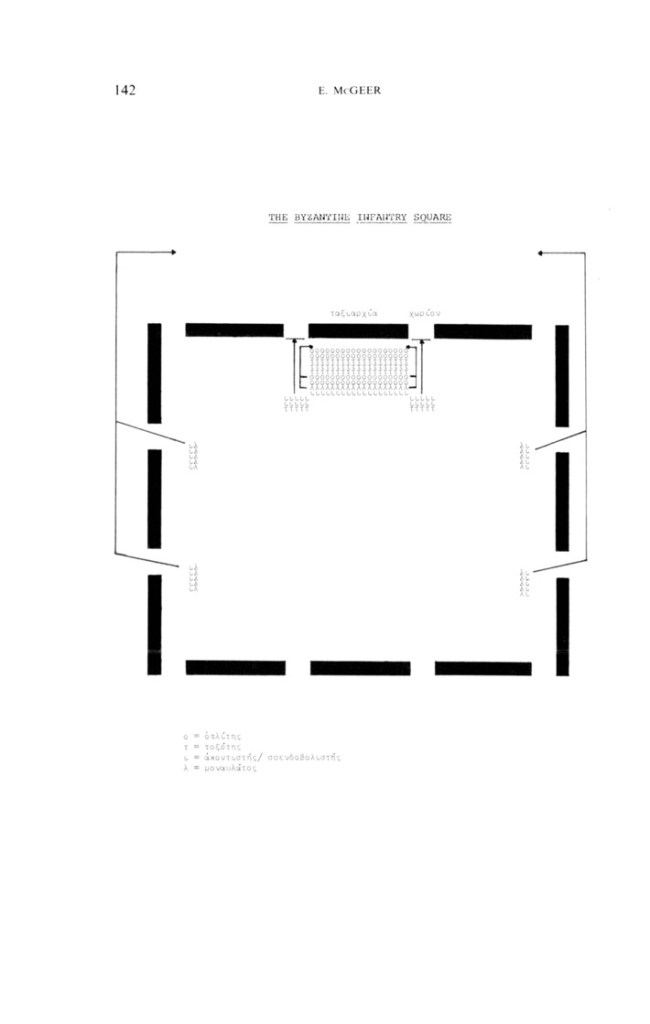
The following description of the infantry square will be understood more easily with reference to the accompanying diagram. The author first instructs that the infantry be deployed in a « double-ribbed » (τετράγωνος διττή, «called a τετράπλευρος by the ancients»), with three ταξιαρχίαι on each of the four sides (15). What exactly he means by « double-ribbed » becomes clear when he presents the battle order of the infantrymen in each ταξιαρχία. They stood one hundred men broad and seven men deep, that is, two lines of όπλϊται in front of three lines of τοξόται, backed in turn by two lines of όπλϊται, thus creating what the author calls an αμφίστομος παρά- ταξις, «a double-faced formation» (16). Such a deployment ensured that the rear lines of όπλϊται could protect their comrades’ backs by turning around to face any enemy who had managed to break into the square. Each line of one hundred men was commanded by a έκατόνταρχος standing in the middle, while two πεντηκόνταρχοι stood on the right and left wings of the line (17).
Intervals (χωρία) were allowed between the ταξιαρχίαι to permit twelve to fifteen cavalrymen at a time to ride through into or out of the square (18). Twelve such intervals could be created in the square, but if the enemy infantry far outnumbered the Byzantine, then the corners of the square could be closed off and only eight intervals would remain, two in each of the four sides of the square (19). It was the duty of the άκοντισταί, standing behind the ταξιαρχίαι to which they belonged, to watch over the intervals and rush forward to block them off whenever the enemy attacked (20).
The square offered the Byzantines important advantages as a battle formation in enemy lands. Facing four ways, it could not be outflanked or attacked from behind, always an urgent consideration when dealing with the Arabs. In providing immediate refuge for defeated cavalry, it prevented mass and prolonged flight which was usually the makings of real disaster for an army far from home. Furthermore, the author tells us that during battle the wounded and the exhausted could find shelter inside the square, while extra infantrymen could be assigned to bring water to the combatants to relieve their thirst, or stones and arrows to the slingers and archers so as to avoid these soldiers having to leave their places in search of more ammunition (21). Many of these factors suggest strongly that the author was well aware of the psychological advantages inherent in such a formation, not least the enhanced sense of collective security among men who know that their sides and backs are protected, that they can be saved if wounded and relieved if overcome with thirst or exhaustion. It must not be overlooked, either, that a square facing four ways prevents easy flight by its very shape. For men about to face an all-out cavalry charge on their position, the lack of alternatives was probably the only reason why many of them decided to stay and fight when they would much rather have run away. Deployed as we have seen them, how were the Byzantine infantry to join battle with the enemy?
Infantry versus infantry encounters are treated very briefly. If the enemy were not very sophisticated and simply attacked in a broad line, the άκοντισταί and the μοναυλάτοι on the two flanks of the square not directly engaged were to pour out round the enemy’s flanks in a semi-circular movement and crush their line between them (22). If the enemy infantry were also deployed in a square [as Leo tells us the Arabs often were (23)], then the άκοντισταί and the μοναυλάτοι inside the Byzantine square were sent to the aid of their comrades on whichever side of the square the enemy had attacked (24). These very sparse directions indicate that the author considered a purely infantry battle to be very unlikely, and, as a result, was far more occupied with infantry versus cavalry confrontations — both how to resist enemy cavalry with his infantry and how to destroy enemy infantry with his own cavalry, spearheaded by the mighty κατάφρακτοι.
It was when the enemy had defeated or scattered the Byzantine cavalry and intended to follow up on their success with an assault on the remaining force that the Byzantine infantry came into their own. The Arab cavalry posed two problems which the infantry square was designed to counter. The first problem was that of their light skirmishers [to whom our author refers as Άραβϊται (25)], who were mounted on very swift horses and used their great speed to ride round the square in hopes of luring the Byzantines into breaking ranks, whereupon they would suddenly wheel about to catch them off guard (26). But if these skirmishers were left at a distance or ignored, their effectiveness was much reduced, since they would never dare close with a strongly defended infantry formation, nor could they surprise the Byzantines with attacks from the flanks or rear. For their part, the Byzantines had no hopes of coming to grips with the elusive Arab raiders and thus could only remain in formation, undeceived by their enemies’ feigned attacks and withdrawals.
The second problem was posed by the more intimidating Arab regular cavalry, or even, as it appears, by their heavy cavalry, to whom the task fell to make a direct attack on the Byzantine infantry (27). As it became clear which side of the square the enemy planned to attack in strength, the Byzantines bolstered their lines accordingly. The two πεντηκόνταρχοι (one on the left wing of the line, the other on the right) in one of the two rear lines of όπλϊται led their fifty men forward through the intervals into the front lines of their ταξιαρχία, making them three deep in όπλϊται. At this point, the one hundred μοναυλάτοι in the ταξιαρχία also came forward through the intervals into the front lines, now four deep (28). This manoeuvre, taught to the soldiers in training, not only provided for the prompt reinforcement of the front lines where necessary, but also served to deceive the enemy as to the real depth of the front lines which they were about to attack. As I interpret the Praecepta, it would appear that the όπλϊται and the μοναυλάτοι anchored the butt ends of their spears against the ground and aimed the points at an angle into the chests of the enemy warhorses, creating, in effect, a «chevaux de frise» four men deep. The exceptionally thick and solid μοναύλιον was designed to withstand the impact of an enemy armoured cavalry charge, for as the author says, «even if the three-deep spears of the όπλϊται are smashed by the enemy κατάφρακτοι, then the μοναυλάτοι, being firmly set, stand their ground bravely, receiving the charge of the κατάφρακτοι and turn them away» (29). Once embroiled with the όπλϊται and μοναυλάτοι in front of them, the enemy cavalrymen were then set upon by the άκοντισταί who circled in from the flanks of the square not under attack (30). These light and thus more agile soldiers could take advantage of the restricted mobility of the enemy cavalrymen engaged at close quarters and pick them off one by one by striking them from behind or from their unprotected right sides.
The Arab cavalry ran up against this thicket of spears after riding through a hail of arrows launched by the nine hundred archers stationed behind the spearmen on any one side of the square. If indeed the όπλΐται and the μοναυλάτοι were crouched over their fixed spears, the archers would have been able to shoot over their heads all the more easily, even to within very short range as the enemy drew near. Most unfortunately, our author does not give any details as to how archers stood, how they were commanded, or what their rate of shot was expected to be in battle. But their close cooperation with spearmen in repulsing enemy cavalry must have been judged indispensable if one takes into account the vast number of arrows the army was instructed to have on hand. Each archer carried one hundred arrows himself and received fifty more from the store of arrows carried by the pack-animals in the army’s baggage train (31). This plentiful supply was doubtless intended to guarantee that the archers would not run out of arrows during battle, and we have already seen that extra men were detailed to keep up a steady supply to them during the fighting. It seems clear enough from this evidence that the Byzantine generals wanted a constant and efficient performance from their archers to take a heavy toll on the enemy cavalrymen well before they reached the infantry lines (32).
Such, then, was the system developed and presented by the author of the Praecepta in order to satisfy the defensive requirements of Byzantine expeditionary armies. He adapted a simple, symmetrical formation outlined in an earlier source to the types of infantrymen in his army, and gave each type of infantrymen one specific task to perform in this defensive system. The formation and tactics which he developed were intended to solve two main difficulties for Byzantine infantry facing Arab cavalry — the swift attacks and counterattacks of the light skirmishers and the concentrated attacks of the regular or heavy cavalry. But as long as the Byzantine infantry could force the Arabs to fight on their terms, by making them attack from directly in front against a concentrated and reinforced defence, then the chances of success were probably very good.
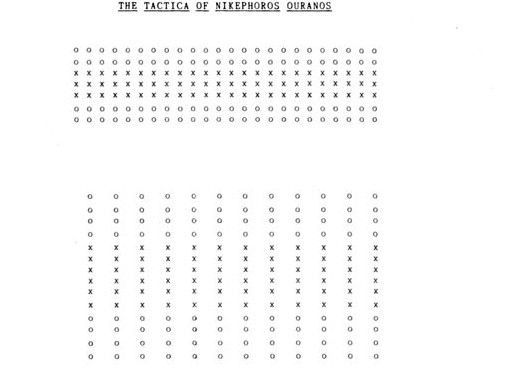
Later Byzantine strategists were not averse to making what changes were necessary to maintain the shifting balance between infantry and cavalry on the battlefield. Thirty years or so after the Praecepta was written, a second version of this work was written and included in the Tactica of Nikephoros Ouranos (33). Here we find a slight, but telling, adjustment in the system by which the Byzantine infantrymen deepened their lines before receiving the enemy charge. Instead of advancing one of the two rear lines of όπλΐται through the intervals into the front ranks; as we saw in the original Praecepta, the second version of this work by Nikephoros Ouranos (the victor at Spercheios in 996) instructs every second file of men in the ταξιαρχία to step sideways into the file beside it, thus making a file of men seven deep into a file of men fourteen deep (34). It will be observed from the diagram of this manoeuvre that the width of the ταξιαρχία is reduced by one file only. This adjustment was probably intended to secure two further advantages over the earlier system — that the Byzantine infantry could make their formation even deeper than before and that they could do so in less time. It is therefore tempting to conclude from this adjustment that as heavy cavalry came into greater use (as did the Byzantine κατάφρακτοι in the armies of Nikephoros Phokas and John Tzimiskes) the infantry were constantly obliged to find the means to stop them, resorting to deeper and deeper formations and to specialised soldiers such as the μοναυλάτοι, and that these countermeasures were periodically revised to keep pace with fresh developments.
The close attention to infantry tactics in the military manuals consulted here reminds us that the Byzantines by no means neglected this component of their army in the middle period. The use of infantry was essentially defensive — in battle, on the march and in protecting encampments or fortresses — but was nevertheless indispensable in support of cavalry (35). In a broader context, the development of infantry tactics from the Sylloge to the Praecepta to the Tactica of Nikephoros Ouranos strengthens the argument that in this period the Byzantines did attempt to combine theory with practice and to pass their conclusions on for further thought. It is no coincidence that by the end of the tenth century their position along the Arab frontiers was much stronger than it had been one hundred years before.
1. Cf. Book XI of the Strategikon of Maurice (ca. 600), entitled Περί των εκάστου έθνους έΟών τε και τάξεων, and Constitutio XVIII in the Tactica of Leo VI (ca. 900) : Περί μελέτης διαφόρων εθνικών τε και ‘Ρωμαϊκών παρατάξεων.
2. Cf. the remarks of A.D. H. Bivar on the Byzantine reaction to the skills, equipment and tactics of their eastern enemies in the early period at the conclusion to his article Cavalry Equipment and Tactics on the Euphrates Frontier, DOP 25, 1972, p. 273-291.
3. For a review of classical and Byzantine military writings, see A. Dain, Les stratégistes byzantins, TM 2, 1967, p. 317-393.
4. G. Dagron has studied the Byzantine reaction to the Arab danger from the time of Leo VI to the accession of Nikephoros II Phokas in : Byzance et le modèle islamique au xe siècle à propos des Constitutions Tactiques de l’empereur Léon VI, Acad. des Inscr. et Belles-Lettres, Comptes rendus, 1983, p. 219-243, and Le Traité sur la guérilla de l’empereur Nicéphore Phocas, Paris 1986, p. 139-160.
5. Στρατηγική έκθεσις και σύνταξις Νικηφόρου δεσπότου, ed. J.A. Kulakovsky, Zapiski Imperatorskoi Akademii Nauk, VIII, 9, St. Petersburg 1908 : Text, p. 1-21, commentary and index, p. 23-58.
6. Sylloge Tacticorum, quae olim Inedita Leonis Tactica dicebatur, ed. A. Dain, Paris 1938. Dain dated this work to the middle of the tenth century, which must be right, since there are references in the Sylloge to κατάφρακτοι and μεναυλάτοι, types of soldiers mentioned only after 950 or so in other military or historical sources. R. Vâri, who had previously argued for an earlier date for the work, approximately 904, made a review of the contents and sources of the Sylloge : Die sogennanten Inedita Tactica Leonis, BZ 27, 1927, p. 241-270.
7. Sylloge XLVII.1-5. The chapter is entitled Παρατάξεις στρατοϋ συμμίκτου κατ’ αυτούς [se. ‘Ρωμαίους], ένθα και πλεϊον άεί το πεζικόν. The chapter is introduced by the compiler’s interesting remarks that what follow are Byzantine tactics as opposed to those of classical armies already covered previously in the work: Too δέ στρατού συμμίκτου τυγχάνοντος, έκ πεζών δηλονότι και ιππέων, τρόπον έτερον τας παρατάξεις ποιοΰσι ‘Ρωμαίοι, και ού καθ’ ένα δήπου των είρημένων έν τε πεζικαΐς έν τε ίππικαϊς παρατάξεσιν.
8. Cf. Xenophon’s famous description of the Greek infantry marching in a square formation (Anabasis III.4.19-23). The Spartan king Agesilaus also put his infantry in a square while on the march (Hellenica IV.3.4) or when threatened by the Persian cavalry (Diodorus Siculus XIV.80).
9. Sylloge XLVII.19 : “Αρχονται μεν οΰν οι ιππείς τής μάχης πρώτοι… και τρεψάμενοι μέν τους πολεμίους διώκουσι άνα κράτος, τας πεζικάς κατόπιν έπομένας έχοντες τάξεις, ήττηθέντες δέ προς ταύτας έπαναστρέφουσιν αύθις…, δια τών διαλειμμάτων χωροΰντες εντός τών πεζικών έστήκασι τάξεων… Cf. the Byzantines’ use of infantry in a square to protect the cavalry in encampments: Praecepta, chap. V, Περί άπλήκτου; De Re Militari (ed. G.T. Dennis in Three Byzantine Military Treatises, Washington 1985, p. 245-335), chaps. I -VI. For the protection of cavalry while on the march : De Re Mil., chap. XX ; Tactica of Nikephoros Ouranos, chap. LXIV (ed. J.-A. de Foucault, Douze chapitres inédits de la Tactique de Nicéphore Ouranos, TM 5, 1973, p. 281-312).
10. Cf. the following passages on the construction of the heavy μοναύλιον (Syll. μεναύλιον) : Sylloge XXX VI 1 1. 3 : Τα μέντοι μεναύλια μή άπό πελεκητών έστωσαν ξύλων, άλλ’ άπό νεακίων δρυών ή κρανειών ή τών λεγομένων άρτζηκιδίων… Praecepta, p. 4, 11-13 : Τά δέ μοναύλια αυτών μή είναι άπό πελεκητών ξύλων άλλα άπό νεακίων δρυών ή κρανιών ή τών λεγομένων άτζηκιδίων.
11. Cf. the following passages on the equipment of the infantrymen and where the author of the Praecepta begins his list : Sylloge XXXVIII.4 : Προς τούτοις λωρίκια φορείτωσαν ή και κλιβάνια και ταϋτα ή σιδηρά ή κεράτινα, τούτων δέ μη όντων, καβάδια έχέτωσαν μετά βαμβάκης και κουκουλίου μέχρι γονάτων φθάνοντα, τα μανίκια μέχρι των αγκώνων έχοντα σχίσματα τε περί τας ώλένας προς το εκείθεν έκβάλλειν τάς χείρας, κρατείσθω δέ τα μανίκια δια κομποθηλύκων των ώμων όπισθεν ; Praecepta, p. 1, 16-20 : όφείλουσιν δέ έπιταγήναι και καβάδια κοντά μέχρι των γονάτων διήκοντα έχοντα δέ βαμβάκιν και κουκοϋλιν. τα δέ μανίκια αυτών είναι κοντά καί πλατέα έχοντα εις τάς μασχάλας σχίσματα προς το ραδίως όμοϋ καί ευκόλως τάς αυτών χείρας έκβάλλειν καί μάχεσθαι. τα δέ μανίκια αυτών όπισθεν εις τους ώμους ύπό κομποθεληκίων κρατεΐσθαι.
12. Praecepta, p. 3, 8-15. This thousand-strong ταξιαρχία was the standard infantry unit in the Byzantine army in the later tenth and early eleventh centuries. Cf. the very similar organization of the infantry force in the closely contemporary De Re Militari, chapter VI, Περί των δώδεκα ταξιαρχιών. For all other references to the ταξιαρχία in this period, see N. Oikonomidès, Les listes de préséance byzantines des IXe et Xe siècles, Paris 1972, p. 335-36 and notes 280-83.
13. For a review of the Byzantine panoply in the early and middle periods, see J.F. Haldon, Some Aspects of Byzantine Military Technology from the sixth to the tenth Centuries, Byzantine and Modern Greek Studies 1, 1975, p. 1 1-47. 1 have made a separate study of the terms μοναύλιον and μοναυλάτος in Δίπτυχα 4, 1986, p. 53-57.
14. Praecepta, p. 1, 3-4 : Πρέπον άρα καί όφειλόμενόν έστιν άπό τε ‘Ρωμαίων καί ‘Αρμενίων στρατιώτας έκλέξασθαι άνδρας όπλίτας… ; ρ. 2, 24 : … εί μέν είσίν άκοντισταί, είτε ‘Ρώς εϊτε έτεροι εθνικοί…
15. Praecepta, p. 2, 14-17, where καβαλαρικων must be omitted as a gloss. Among the classical tacticians who discuss the τετράπλευρος παράταξις are Asklepiodotos (XI.6) and Aelian (XXXVII.8-9).
16. Praecepta, p. 2, 33-35 ; p. 3, 9-14. According to the classical tacticians, the αμφίστομος formation placed file-leaders on the front and back ends of a file of men, with the provision that the file-leaders in the back would turn around to face any enemy attacking from behind, thus making a battle on two fronts (άμφίστομον ποιεΐσθαι την μάχην, Onasander ΧΧΙ.2). Cf. Asklepiodotos (III.5) and Aelian (XIII. 1-2). The Byzantines also used the same rationale in their cavalry formations as the author of the Strategikon explains (1 1.4).
17. Praecepta, p. 1, 9-11. Cf. Sylloge XLV.12.
18. Praecepta, p. 2, 17-19.
19. Praecepta, p. 2, 22-23.
20. Praecepta, p. 2, 19-31.
21. Praecepta, p. 3, 18-20 ; p. 4, 31 – p. 5, 2.
22. Praecepta, p. 4, 21-23.
23. Tactica XVIII. 1 18 : Τετράγωνον δέ και επιμήκη ποιοϋνται τήν οίκείαν παράταξιν…
24. Praecepta, p. 4, 23-26.
25. Praecepta, p. 8, 8. The Άραβϊται were probably Bedouin from the interior of the Arabian peninsula, whom the Byzantines appear to have considered distinct from the Arabs of Palestine or Syria. Cf. Leo, Tactica XVIII. 110 : Σαρακηνοί μέν ού ν “Αραβες είσι το γένος, παρά τήν εϊσοδον της Εύδαίμονος ‘Αραβίας ποτέ κείμενον. τώ χρόνφ δέ και προς τήν Συρίαν και Παλαιστίνην διασπαρέν…
26. Praecepta, p. 8, 8-14.
27. Cf. Praecepta, p. 3, 27-34, where the author expresses his concern that the enemy might well attack his infantry formation with heavy cavalry : … ‘ίσως έαν οι εχθροί… βουληθώσιν… και παρασκευάσαι καταφράκτους καβαλαρίους ώστε και αυτούς και τους ίππους αυτών ύπό καταφράκτων έν ασφάλεια τηρεΐν… Leo (Tactica XVIII. 115)) tells us that the Arab cavalry was just as well-equipped as the Byzantines were.
28. Praecepta, p. 3, 37 – p. 4, 7. This manoeuvre is sketched out in the diagram of the infantry square.
29. Praecepta, p. 4, 7-10.
30. Praecepta, p. 4, 16-18.
31. Praecepta, p. 2, 8-9, instructing each archer to carry one hundred arrows of his own, and p. 4, 27-34, in a passage where the author refers to the arrows supplied to the archers by the army (called βασιλικού σαγίται). The term βασιλικού refers to the equipment gathered by imperial requisition as opposed to what each soldier was expected to supply on his own. Cf. the De Cerimoniis (p. 657) : Ίστέον οτι έδέξατο ό στρατηγός Θεσσαλονίκης τοϋ καμεΐν σαγίτας χιλιάδας σ’…
32. Leo strongly recommended the use of archery against the Arab cavalry, especially in the initial stages of their attack. Cf. Tactica XVIII. 130, 135-136.
33. I am preparing an edition and translation of this section of the Tactica of Nikephoros Ouranos (f. 109-123 of the Monacensis gr. 452) to accompany a new edition of the Praecepta militaria. For a survey of the manuscripts, contents and sources of the Tactica, see A. Dain, La Tactique de Nicéphore Ouranos, Paris 1937.
34. Monacensis gr. 452, f. 1 10v : τότε δε αρμόζει μίσγειν και τους δύο όρδίνους των πεζών και ποιεΐν αυτούς ëvoc, οίον εις ορδινος ‘ίνα έμβη εις τον άλλον και οί επτά άνδρες ϊνα γένωνται δεκατέσσαρες και πυκνώσωσι την παραταγήν.35. Cf. Dagron’s remarks on the role of infantry along the Byzantine-Arab frontier in Le Traité sur la guérilla, p. 190-193.
Autore: Eric McGeer
Fonte: Revue des études byzantines


Rispondi