
TORPEDO BOMBERS TACTICS
If we were forced to fight a World War II carrier battle again, what key concepts, tactics, techniques, procedures, and technologies would give us a marked advantage over the adversary? As already stated in the introduction, seeking an answer to such questions goes beyond historical curiosity. Because all forms of warfare and combat revolve around similar themes and concepts, lessons from World War II carrier battles that relate to planning, timing, reconnaissance, command, and control could prove useful across multiple domains and eras of conflict. Thus, a detailed examination of World War II carrier combat should prove useful and interesting to historians and military professionals alike, regardless of their specific area of focus or occupational specialty.
However, before we can hope to gain a deeper understanding of the key ingredients of victory in carrier combat, we must first have a basic grasp of the fundamentals of carrier tactics. This introduction is intended to be very basic and, in some cases, must attempt to simplify concepts that are in reality far from simple. We therefore ask readers who are already very familiar with carrier combat to bear with us and forgive us for such simplifications and generalizations. In order to frame the study and get all readers and participants on the same page we must begin with broader brush strokes. At the same time, we expect that even experts in carrier tactics might find this introductory section interesting since even though we will be sticking to the basics, we will still attempt to highlight key tactical concepts and gain insight into their deeper significance.
Naval Combined Arms: Diver Bombers, Torpedo Bombers, and Fighters
As this article will show, the nature of carrier tactics involves unifying and synchronizing the efforts of various types of combat aircraft so that their combined lethality is greater than it would be if each type of aircraft were used in isolation. This is an approximate definition of “combined arms,” a term more commonly used to describe the integration of infantry, armor, artillery, and air support in land operations. However, even though many carrier attacks involve only aircraft that does not mean that the essential principle of combined arms does not apply. Just as tanks are more effective when employed in concert with infantry and artillery, dive bombers are more effective when employed in concert with torpedo bombers and fighters.
Before explaining how dive bombers, torpedo bombers and fighters work in coordination, it is best to first examine each type of aircraft and their respective tactics and attack profiles. As we will see, two key concepts apply to both the tactics of individual aircraft types and the integration of all three types. These concepts are simultaneity and survivability. To explain these concepts, we will begin by examining a common torpedo bombing technique: the anvil attack.
Torpedo Bomber Tactics: Simultaneity, Survivability, and the Anvil Attack
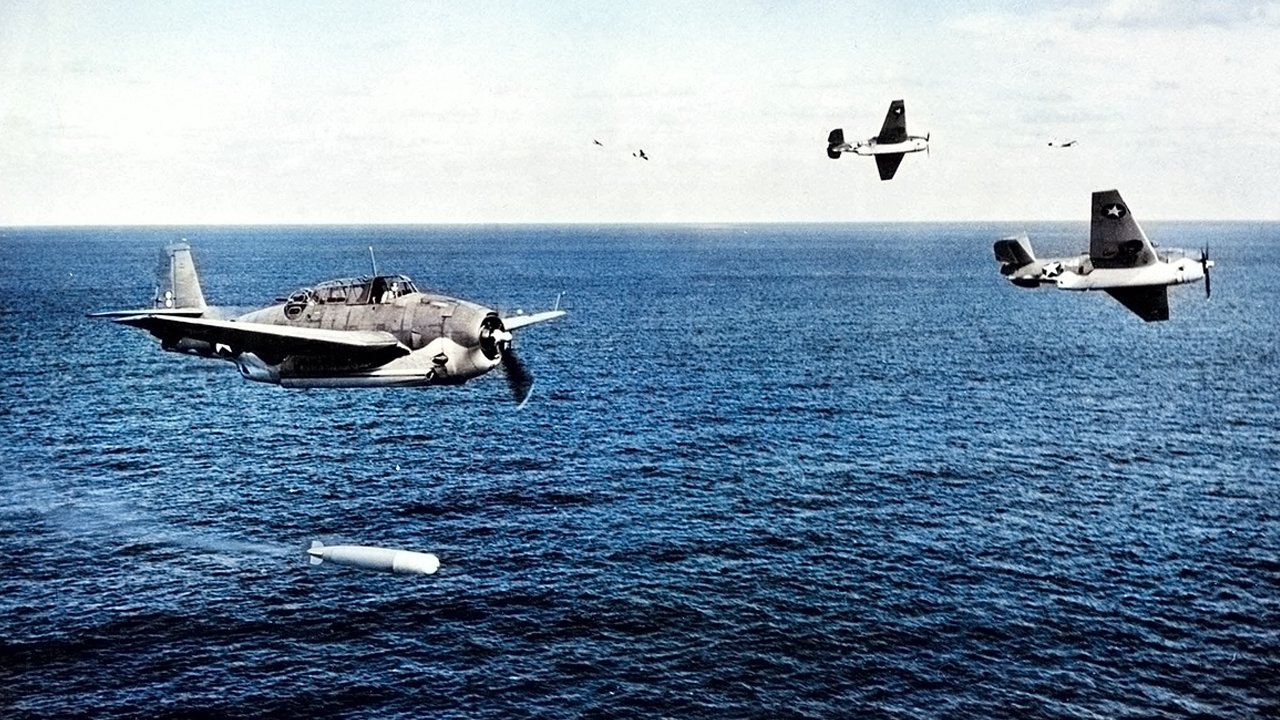
A torpedo bomber attacks a ship by flying towards the target and then dropping a torpedo into the water. Once hitting the water, the torpedo will activate and begin to run in roughly the same direction it was pointing when it was dropped. Ideally, the torpedo will continue to run until it collides with the target ship, striking the hull below the waterline. The damage caused by a torpedo is often more catastrophic than a bomb strike since the water surrounding the ships hull can compound the effects of the explosion and worsen the effects of damage, flooding the ship more quickly.
However, in order for the torpedo to run in the correct direction without malfunctioning, the torpedo bomber would have to fly quite low and slow on approach to the target. The precise altitude and speed would vary depending on the type of torpedo used but the general concept remained the same. In addition, to maximize the chance of a hit on a moving ship, the torpedo bomber would also have to release the torpedo fairly close to the target. Remember that during World War II, torpedoes did not benefit from the sophisticated, sonar guidance systems available today.
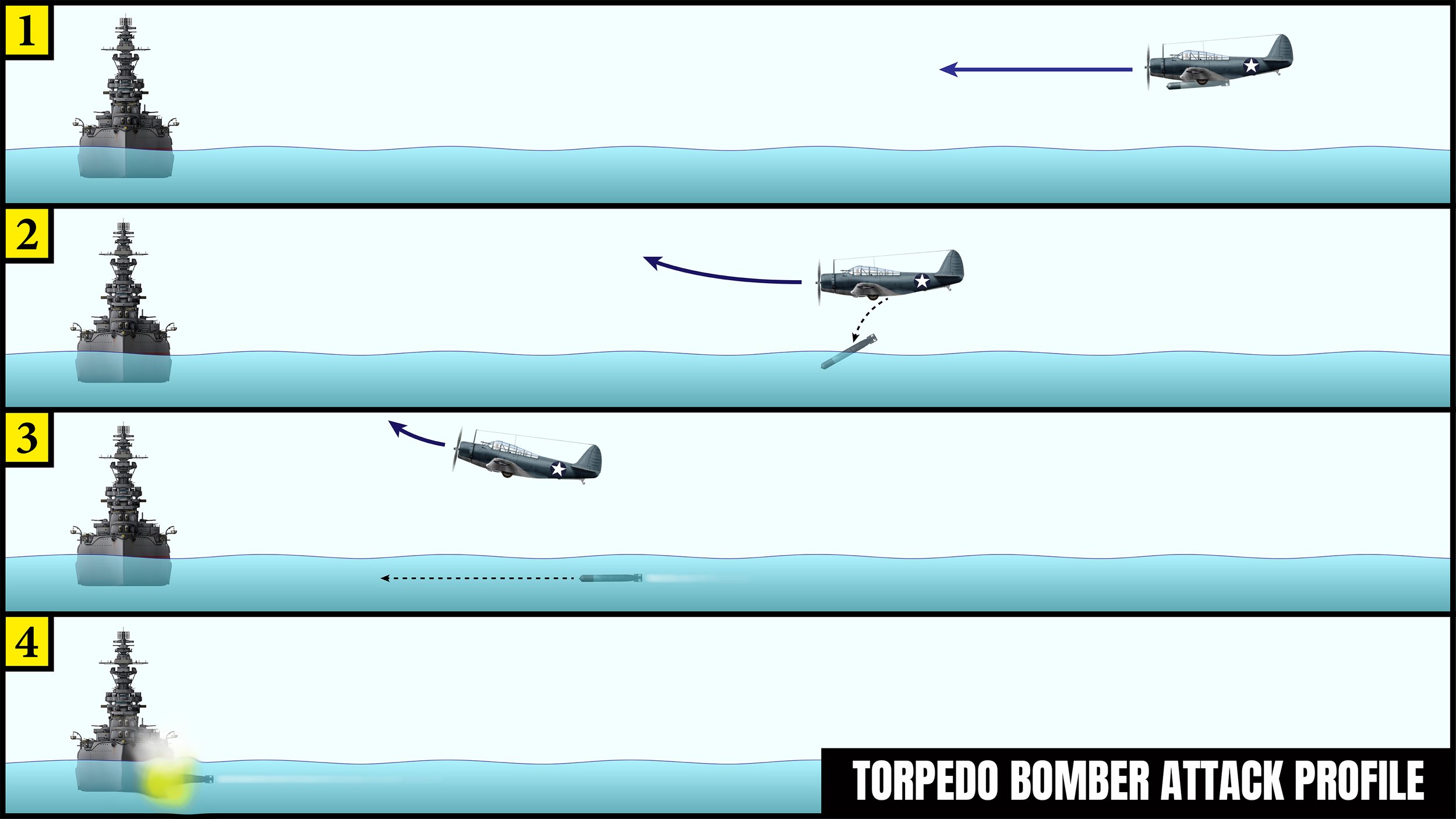
Thus, the torpedo bomber attack profile involved lining up with the target ship and flying low and slow, exposed to enemy fire for some distance until close enough to release the torpedo. This presented two main problems, the farther away the bombers dropped the torpedoes the more time the enemy ship would have to evade. The closer the bombers dropped the torpedoes the longer they would have to expose themselves to concentrated enemy fire. A common-sense tactical approach called the anvil attack mitigated these risks while maximizing the effects of a torpedo bomber attack.
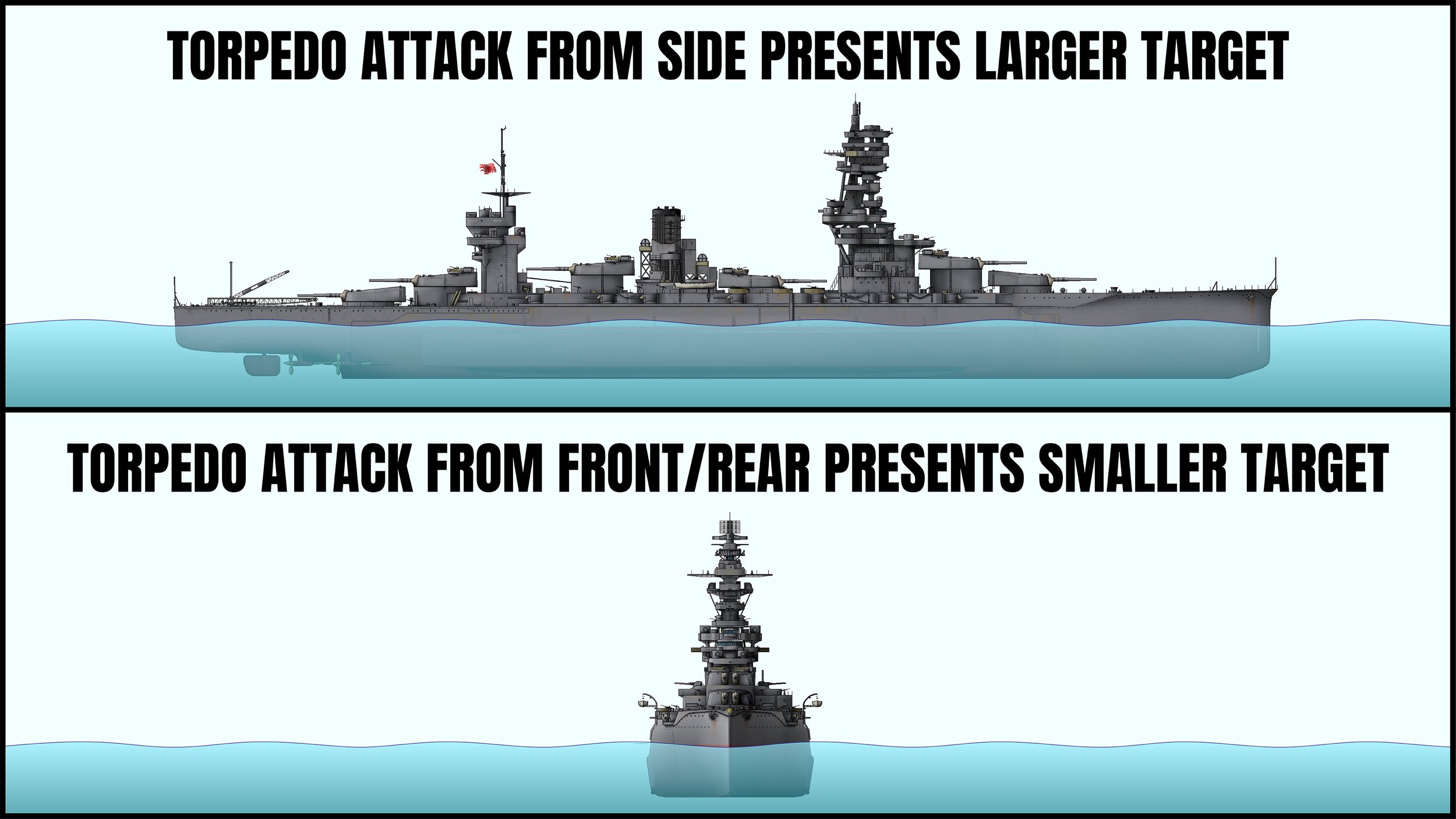
While it was possible for an entire formation of torpedo bombers to attack from a single direction, this approach made the two concerns mentioned above even more problematic. Attacking from a single angle made it easier for the target ship to evade and also meant that the attacking formation would be exposed to the maximum concentration of enemy guns and fighter aircraft. In many cases the most reliable way of evading a torpedo was to turn into the torpedo, presenting a smaller target. Torpedo bomber pilots would aim to attack the side of a ship since the full length of a ship presents a much larger target that is easier to hit. “Threading” torpedoes to hit a ship head on or from the stern is much more difficult since the target is smaller. By turning into a torpedo or away from a torpedo, the captain of the target ship could greatly reduce the chances that the torpedo would hit by presenting a smaller target.
The anvil attack calls for the bombers to split up and attack from two different angles (roughly 90-degrees apart). This approach put the target ship’s captain on the horns of a dilemma. By turning to evade one group of torpedoes the captain would be exposing the side of his ship to the other group. Thus, either way he turned, he would be increasing his exposure and there was no clear option for evasive action. The effectiveness of the anvil attack hinged on the concept of simultaneity. Obviously, if the two attacks came one after the other the combined effects of both formations just described would be negated. The enemy ship could deal with one formation, then maneuver to deal with the next. In conjunction with this simultaneity, the splitting of the torpedo bomber force into two elements increased the survivability of each individual aircraft by forcing the enemy gunners and fighters to disperse their effort, reducing the overall concentration on any one aircraft. Infantrymen spread out on the battlefield to make their formations less vulnerable targets. By splitting into multiple elements, torpedo bombers increase their survivability in a similar way.
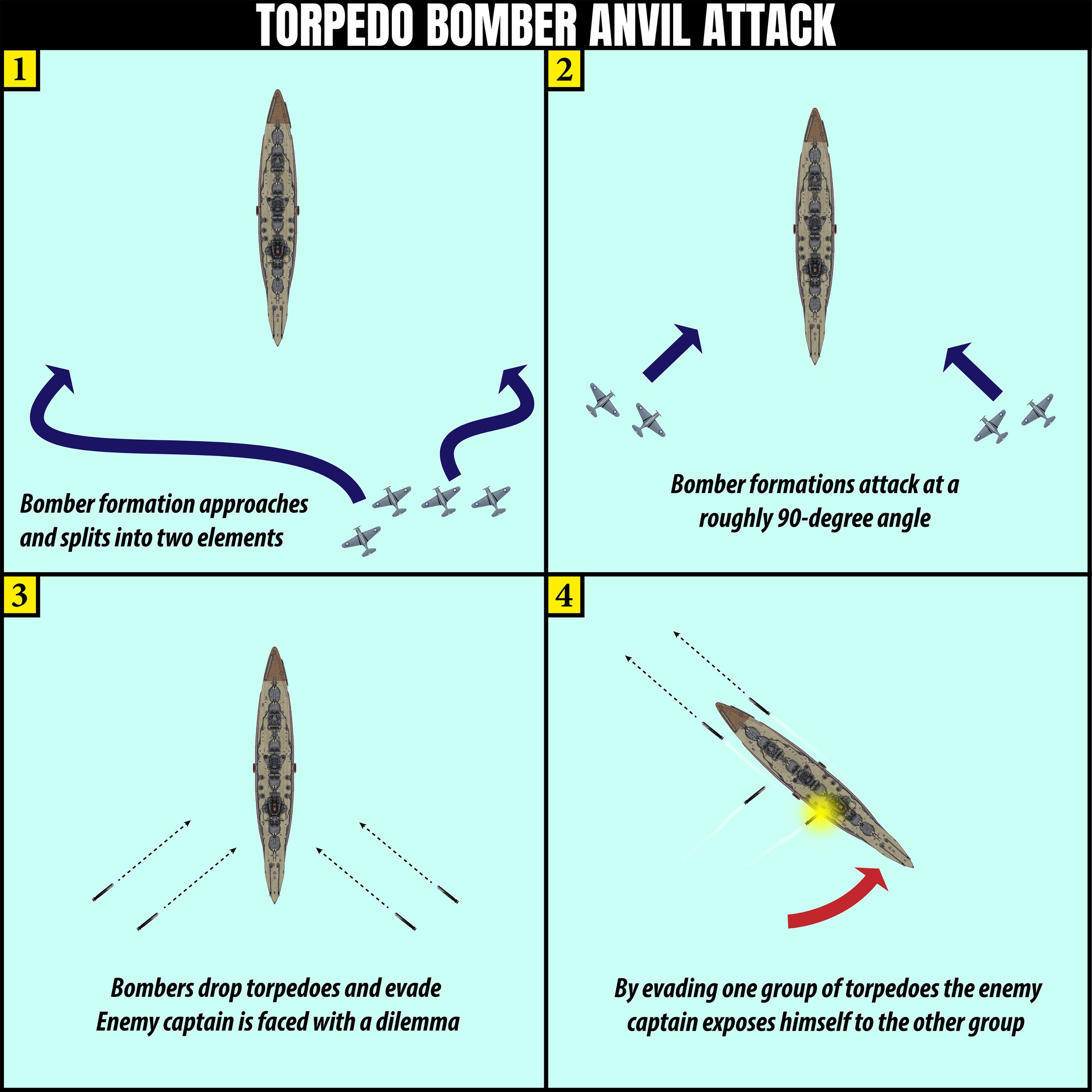
This focus on survivability is particularly important in the context of naval combat and carrier combat in particular. While infantrymen and tanks still use dispersion and attack from multiple angles to increase survivability, land forces also generally have the ability to reduce vulnerability by taking advantage of cover and concealment provided by the terrain. Torpedo bombers attacking a carrier have nothing to hide behind and are exposed to the full brunt of enemy guns. Thus, the only way they can protect themselves and increase survivability is by forcing the enemy to disperse his fire among multiple targets.
These core concepts of simultaneity and survivability will emerge again in the article where we will examine the fundamentals of dive bomber tactics. In addition, for those not already familiar with carrier tactics the bigger tactical picture will begin to emerge. Those familiar with carrier battles like Coral Sea, Midway, the Eastern Solomons, Santa Cruz and the Philippine Sea are likely already holding back comments or asking questions. After covering the fundamentals of dive bomber employment and fighter employment, we can then proceed to examining such cases to see how theory actually translated into practice in the heat of battle.
DIVE BOMBER TACTICS
In practice, carrier tactics and the use of carrier aircraft are essentially the concept of “combined arms” applied to naval warfare. The concept of combined weapons involves the unification and synchronization of the efforts of various types of weapons so that their combined lethality is greater than if each type of weapon were used in isolation. In carrier warfare, this means integrating the capabilities of dive bombers, torpedo bombers, and fighters into a decisive offensive action.
To understand how these different aircraft work together, it is useful to study each type individually, and the second part focuses on the tactics of dive bombers. However, to understand the purpose of dive bombing and its advantages and disadvantages, it is first essential to understand the main alternative to dive bombing: level bombing.
Interwar theories on level bombing
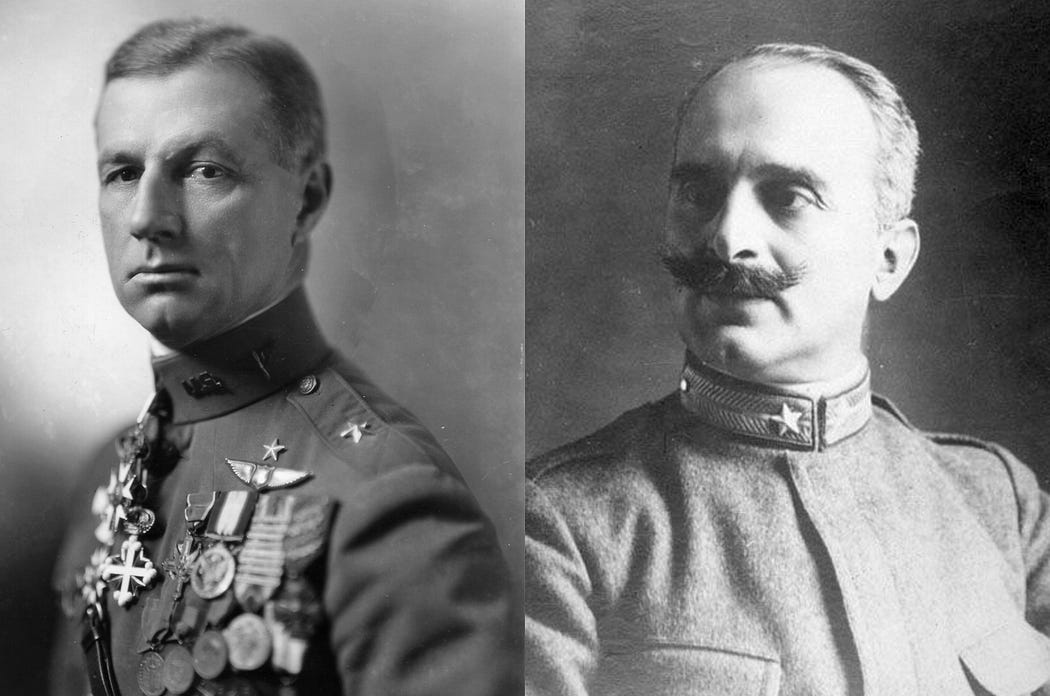
Level bombing is the tactical approach that is most familiar to the general public. It is difficult to watch a World War II documentary or newsreel without seeing an image of a large formation of B-17 or B-24 bombers with hundreds of bombs rippling from their open bomb bays. Level bombing executed by heavy bombers was the primary focus of interwar aerial theorists like the U.S. Army’s most vocal air warfare proponent, William “Billy” Mitchell (pictured below on the left) and Italian aerial warfare theorist and author Giulio Douhet (right).
Without adequate air warfare experience to prove otherwise, the theoretical assumption was that heavy bombers would be able to fly higher and faster than fighters and out of the range of enemy guns and could therefore reach and destroy any target. In the words of British politician Stanley Baldwin in his famous 1932 speech to Parliament, “The bomber will always get through.” This belief was shared by most proponents of air warfare. Some theorists believed that a few attacks on populated areas would induce such terror that politicians would immediately sue for peace. Others believed that bombers could entirely neutralize a country’s industrial capacity from the air, eliminating the need for other types of weapons and units.
Most relevant to this study, there was also a highly-controversial debate during the interwar years about whether air forces would render naval forces obsolete as well. While air warfare advocates like Billy Mitchell insisted that aircraft could sink a battleship, the principal naval leaders of the time considered such ideas ridiculous and heretical. However, Mitchell succeeded in authorizing a series of tests in the summer of 1921 that resulted in the sinking of the captured German Battleship Ostfriesland by air attack. This event stirred tremendous controversy and Mitchell’s advocacy for air power eventually led to his court martial in 1925.
While the controversial tests disproved myths about a battleship’s invincibility to bombs, the lack of realism incorporated into the tests’ design helped fuel misconceptions about how air attacks on warships would actually play out in real battle. The two main problems were that the Ostfriesland remained stationary during the attack and did not maneuver to evade. Second, there was no effort to accurately simulate or account for the effects of anti-aircraft. As a result, some observers and leaders came away thinking that air attacks on naval ships would be easier than they actually proved to be. These misconceptions persisted in many circles leading to the belief that level bombing was an effective approach for targeting warships.
Challenges and shortcomings of level bombing
In real combat, level bombing proved to be much more difficult than theory suggested. In simple terms, if the bomber drops its bombs when it is directly over the target, the bombs will not hit the target since they will continue to travel forward as they fall. Therefore, in order for level bombing to work there is the need for a mathematical equation to determine exactly how long before reaching the target the bomber should release the bombs in order for them to strike accurately. While such an equation might seem fairly straightforward in theory, it proved to be much more difficult to realize in practice.
Many factors complicate the equations for accurate level bombing. To offer a general summary for people without mathematical or physics backgrounds, the first complication is that once dropped, the bombs do not travel at constant speed but rather begin to decelerate because of wind resistance. The deceleration is also not constant and is affected by the bomb’s time of flight (a function of the bomber’s initial release altitude), wind speed, wind direction and other atmospheric conditions. Wind speed and direction can also cause significant lateral drift as the bombs fall.
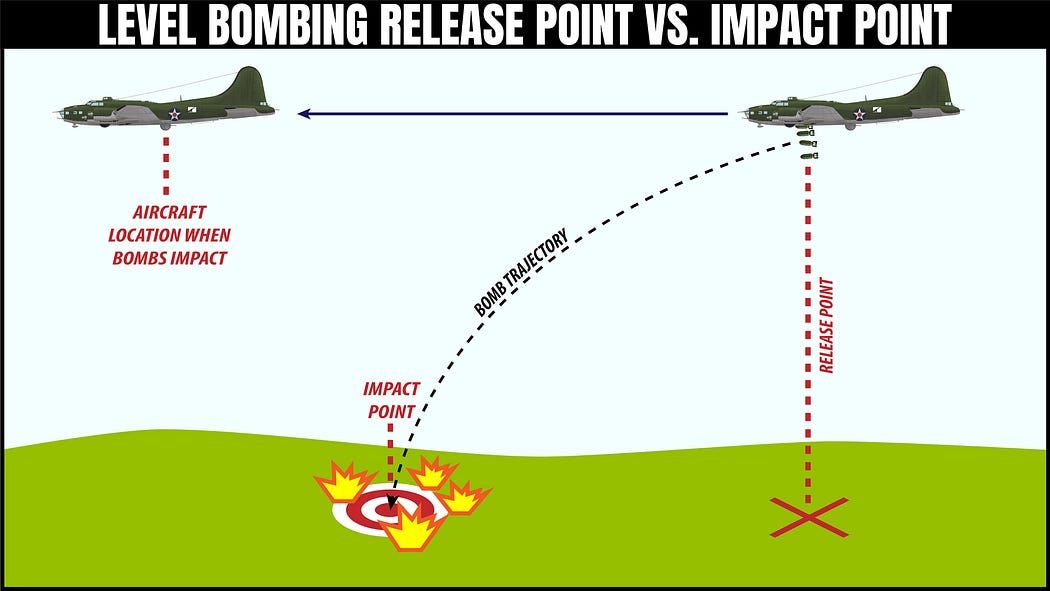
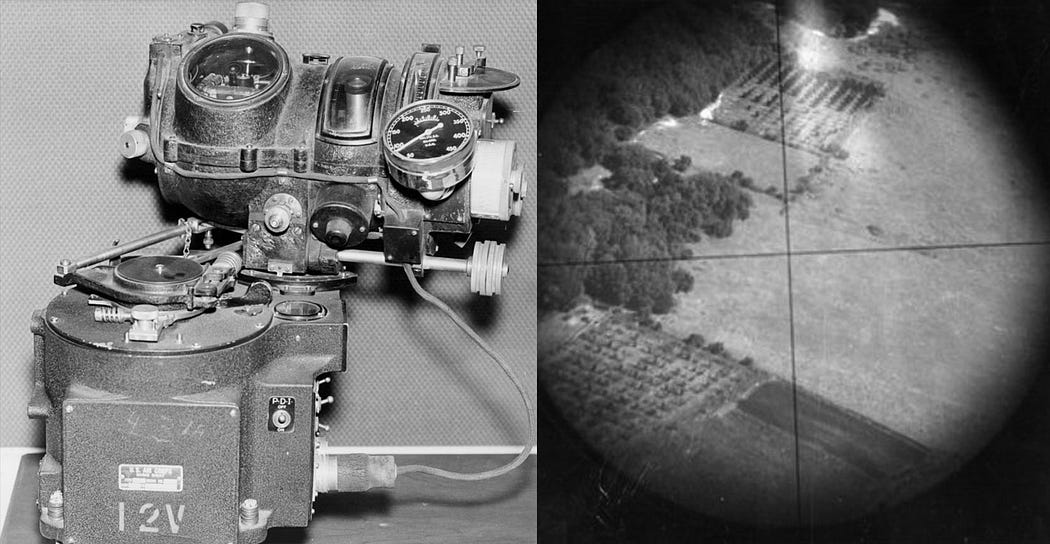
All of these factors become increasingly problematic the higher the altitude of the attacking bomber formation. This creates a dilemma since the survivability of the large, slow-moving bombers depended on high-altitude flight. If level bombers flew lower to make targeting less complicated, they would be more vulnerable to enemy anti-aircraft gunners and fighters. Thus, the actual accuracy and effectiveness of high-altitude, level bombing was marginal at best. Even the highly secretive and much touted Norden Bombsight (pictured below) which was designed to simplify and automate the bomb drop calculations achieved much poorer results than expected.
Finally, if such deficiencies of level bombing applied to attacking large stationary targets (like factories and industrial centers) in Europe, consider how much more difficult it would be for level bombers to successfully hit a much smaller, moving target actively maneuvering to evade. Further compounding the problem is the fact that wind patterns were typically less predictable and more disruptive in the Pacific Theater than they were in Europe. For all these reasons, attacking ships with level bombers was simply not effective and repeated failures early in the war confirmed this fact. A different way of dropping bombs on warships was needed.
DIVE BOMBER TACTICS
Luckily for the U.S. Navy, level bombing was not the only tactical approach available at the start of World War II. Dive bombing called for smaller, more maneuverable aircraft, carrying a lighter bomb load (usually a single bomb) to dive on a target ship and release the bomb at close range. In an era before precision-guided munitions (PGMs), dive bombing was the most accurate way to deliver bombs on target. Why was it easier to hit a small, moving target with a single bomb dropped from a single dive bomber, than it was to hit the same target with multiple salvos of bombs dropped from a formation of level bombers? The main answer lay in the simplified physics of the targeting calculation and the proximity to the target at the release point.
First, in terms of the equation, as already discussed, if a level bomber released its bombs when directly over the target, the forward momentum of the aircraft would cause the bombs to continue to drift past the target. The flight path of the dive bomber changed the equation. Consider what would happen if the dive bomber flew directly downward towards the target. If the bomber were to release the bombs along such a flight path there would be virtually no effects of drift caused by aircraft momentum. The bomb would continue to travel straight down just like the dropping aircraft, striking a point directly below. Furthermore, the increased downward speed of the bomb would reduce the effects of wind and shorten the bomb’s flight time.
While dive bombers typically did not dive straight down, the very steep angle of their dive effectively produced the same result. A bomb dropped in a nearly vertical dive offered dramatically simplified targeting calculations. In general terms, the dive bomber pilot could essentially aim the aircraft directly at the target ship and have a reasonable chance of a hit. This was a much less complex task to perform than trying to time the release of a bomb from level flight so the bomb would drift precisely to the right place at the right time.
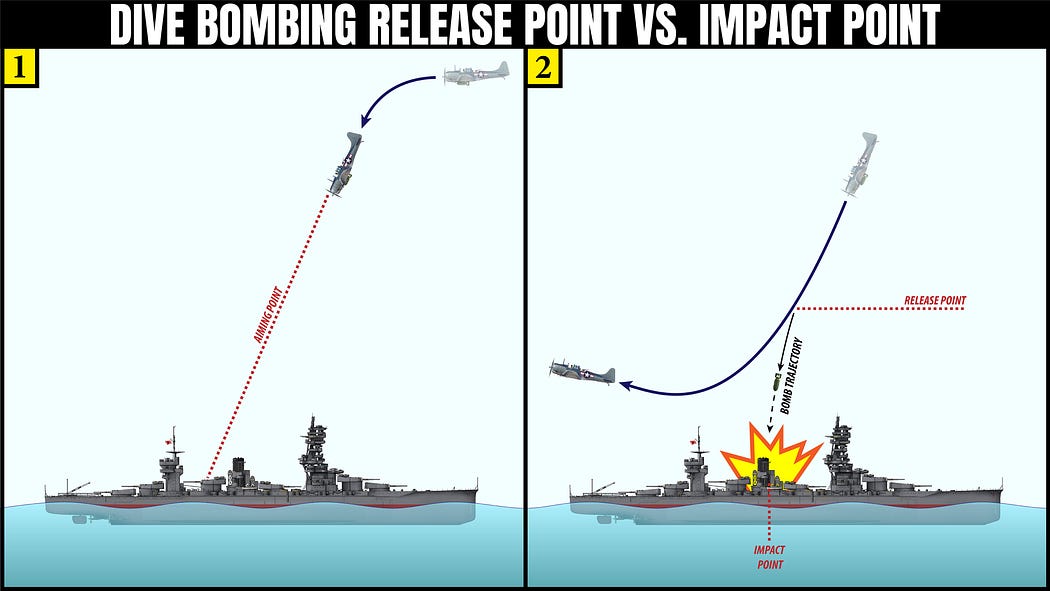
The second factor that greatly increased the accuracy was the fact that the dive bomber released the bomb at much lower altitude and closer to the target. Since the bomb had a shorter distance to fall, all of the complicating factors previously discussed were reduced. However, we already stated that level bombers depended on high-altitude flight for survivability and were very vulnerable at lower altitudes. So how did dive bombers mitigate this risk?
Dive bomber tactics: increased accuracy
To start with, dive bombers increased their survivability through speed and by minimizing the time window of their exposure to the enemy guns. In order to drop bombs accurately, level bombers needed to fly comparatively slow, in a straight line over the target. This gave enemy gunners and fighter aircraft ample time to target and attack the bomber formation. Conversely, the force of gravity allowed dive bombers to achieve great speed in a dive. Faster-moving targets were harder to hit and also raced through the enemy’s engagement zone quickly, exposing themselves to enemy fire for a shorter period.
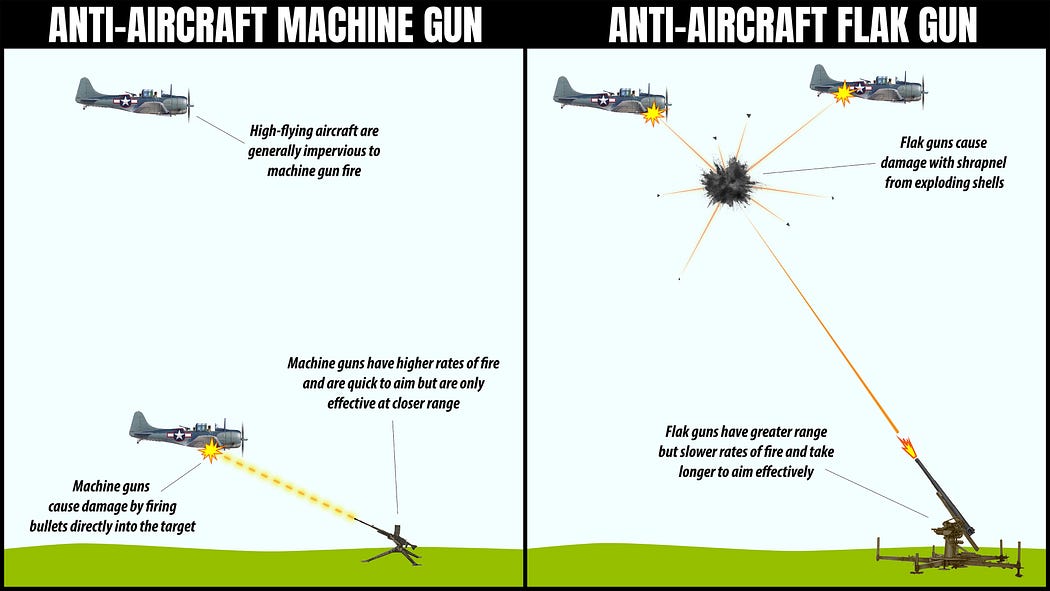
However, to fully understand why dive bombers had greater survivability requires at least a basic understanding of some of the fundamental principles of anti-aircraft gunnery. There are essentially two ways for guns mounted on a ship to shoot down aircraft. The first involves firing a machine gun or other rapid-fire gun at the aircraft so that the bullets from the gun physically strike the target. However, hitting a fast-moving aircraft with a bullet is not easy and achieving any probability of success demands a gun with a rapid rate of fire. In short, you need to launch a lot of bullets at the target in a very short period if you expect to hit anything. High rate of fire is also important since it typically takes multiple hits to bring down an aircraft.
However, when designing guns of any kind there are a number of unavoidable tradeoffs. A higher rate of fire will always reduce the caliber (size) of the projectile you are able to fire and by extension reduce the overall range and power of the weapon. The large artillery guns that are the most powerful and fire the farthest by necessity have the slowest rates of fire. This results from a number of factors including the heat generated by the propellent, the resulting problem of barrels overheating, and the time it takes to effectively and safely load large projectiles.
On the opposite end of the spectrum, smaller-caliber weapons (like machine guns or sub machine guns) can achieve very high rates of fire without encountering such problems. However, as just mentioned such guns are by definition less powerful and have shorter range than their larger counterparts. In terms of our discussion on anti-aircraft weapons, this means that using rapid fire weapons like machine guns for air defense is only effective at short range, against low-flying aircraft. In addition, the smaller caliber of the rapid-fire rounds means they cause less damage and are less dangerous. Therefore, while machine guns of various caliber are used in air defense, effective target engagement (especially at higher altitude) requires another type of weapon: the flak gun.
Flak guns fire a much larger projectile and can engage at greater range and altitude. However, by necessity the larger the projectile and greater the range, the slower the rate of fire. As already mentioned, high rates of fire are necessary to increase the probability of a hit since the chances of an individual projectile striking a moving aircraft are slim. Thus, if flak guns have a slower rate of fire, how can they hope to hit anything?
The answer is that the shells from flak guns are not designed to physically hit the target. Rather, flak guns fire an explosive shell that detonates to propel deadly shrapnel outward in all directions. It is the fragmentation effect of the shrapnel that rips through the target aircraft and causes damage. Flak is often depicted in war movies and appears as seemingly harmless puffs of black smoke that are “missing” the aircraft flying by. In reality, each one of those puffs is launching a cloud of lethal (and invisible) shrapnel in all directions.
The next question is “how to the shells know when to detonate?” Prior to the advent and deployment of the proximity fuse or variable time (VT) fuse in early 1943 which allowed shells to detonate automatically when a target was near, the only way was to set the detonation altitude before the shell was fired. The technology for the proximity fuse was a closely guarded allied secret and the Japanese never successfully employed proximity fuses in their anti-aircraft artillery. Thus, Japanese gunners had to manually adjust the detonation altitude of their shells so they would explode within lethal range of U.S. aircraft. If detonation settings were incorrect, the shells would detonate too low or too high, greatly reducing the risk of a critical hit.
Understanding these characteristics of Japanese flak guns makes it clear why dive bomber tactics led to increased survivability. When engaging level bombers, flak gunners had time to determine the ideal detonation altitude and could continue to fire shells that would explode at the correct altitude within the bomber formation. The fact that dive bombers changed altitude so rapidly made it much more difficult for enemy flak guns to effectively zero in on the bomber formation and further reduced the time window of effective fire.
Diver bombers were also less vulnerable to enemy fighters since it is easier to engage a larger, comparatively slow-moving, and less-maneuverable level bomber than it is to chase a dive bomber through a high-speed dive and a subsequent, rapid low-level or climbing escape. However, in the past two articles on torpedo bombing and dive bombing we have yet to address the fighter threat directly. Maximizing the “combined arms” effect of the carrier strike package required adding additional friendly fighter coverage/support to the mix. This final element will be the topic of our next article on Fundamentals of Carrier Tactics.
Autore: Staff
Fonte: Warfare Mastery Institute


Rispondi