
The Test of Battle and Further Development of Doctrine.
The Anglo-French Entente spring offensive of 1917 began with a serious German defeat at Arras, but that was its high point. Subsequent British and French tactical gains and captures of men and matériel bore no relationship to the plans for a breakthrough, the hopes of the soldiers or the casualties suffered. The German high command was naturally delighted by this success. Seventh Army, facing the French assault, wrote that ‘Defensive battle’ had made an outstanding contribution to victory. In particular, it had guaranteed a uniform approach before and during the battle, without restricting commanders’ freedom of action. 50th Infantry Division, which had made an only partly successful counterattack on 16 April, commented that commanders and men felt themselves absolutely the superior of the enemy, even if the objectives had not been completely reached; the feeling of having a certain freedom of movement in tactical procedures also cheered everyone up. Many other units were equally positive.[45].
It is worth looking in more detail at one action during the Entente spring offensive, by 3rd Bavarian Infantry Division, since Army Group Rupprecht and OHL viewed it as a model application of the new tactics. The division was deployed for 15 days at Arras. Its commander, General Karl Ritter von Wenninger, had replaced Moser as head of Army Group Rupprecht’s divisional command course. He therefore had at least a theoretical understanding of the new tactics when his own division went into action on 11 April in the chaotic circumstances, including lack of fixed defences, caused by the British success when the battle started.[46]
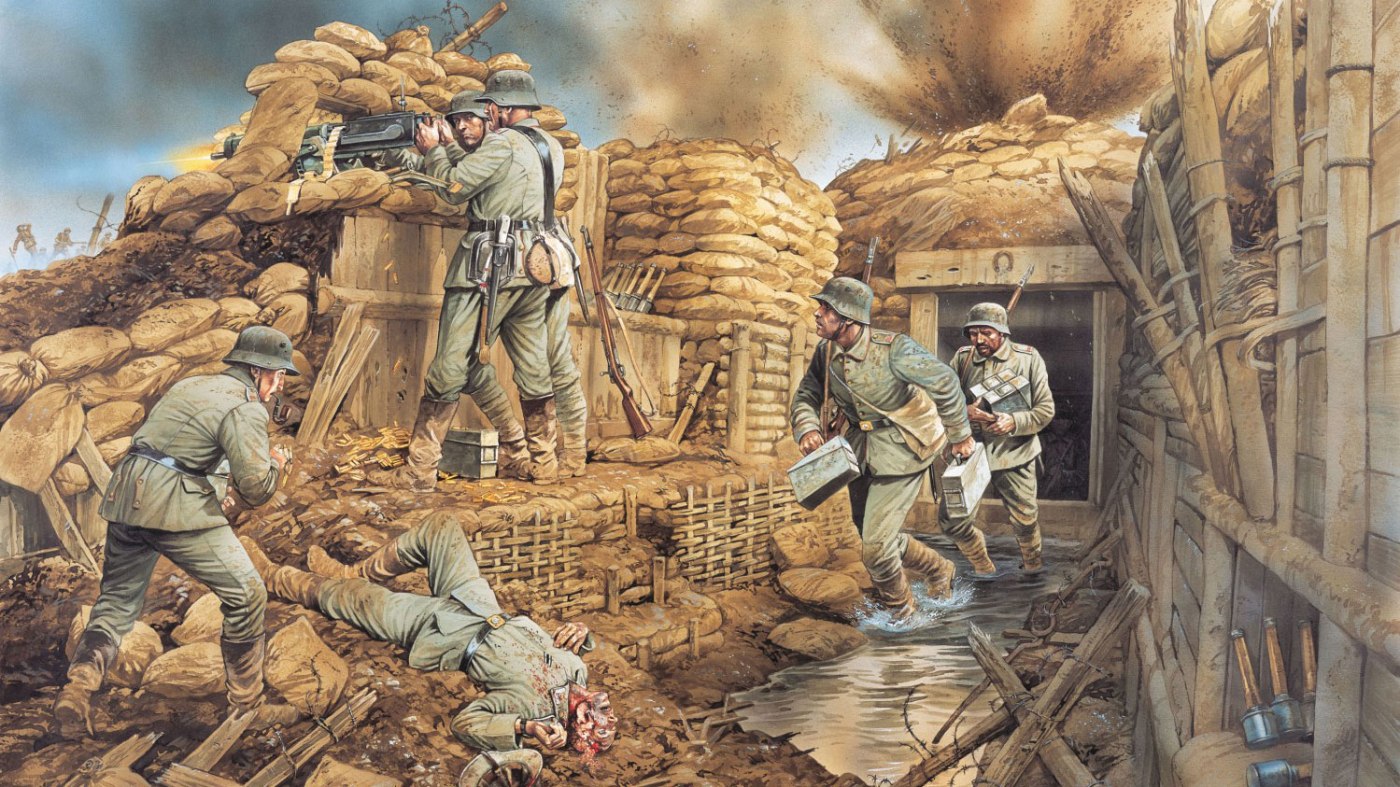
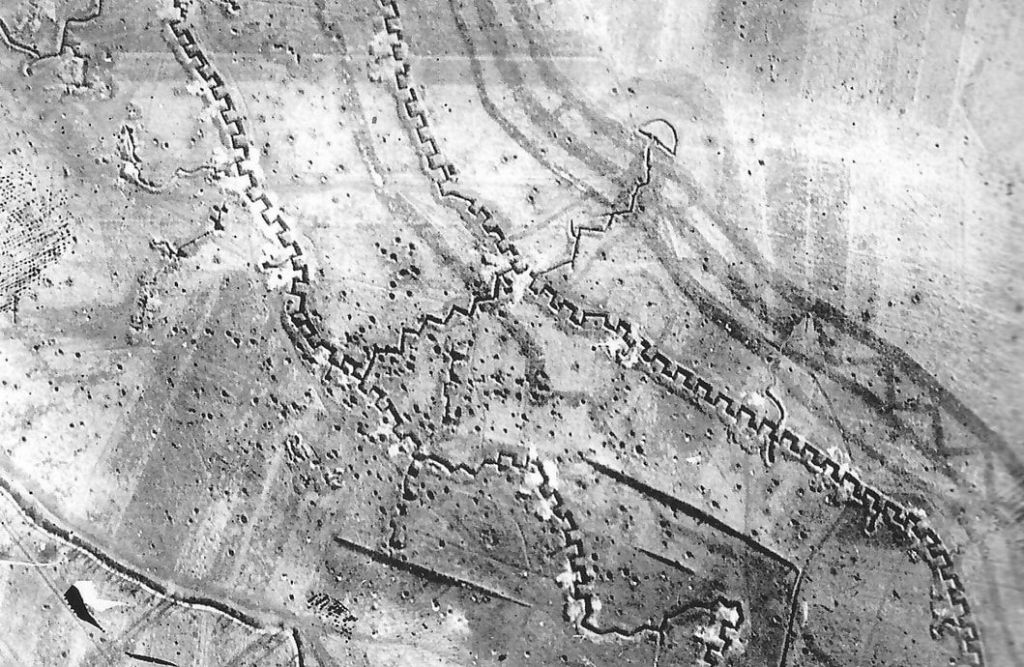
Wenninger initially ordered the construction of a traditional continuous front-line trench, backed by machine-gun nests with all-round barbed wire protection. His subordinates protested that this would be too visible from the air and could be easily destroyed. Wenninger let himself be persuaded to fight instead using the shell-hole positions created by the bombardment, and he later conceded that his subordinates had been right. He commented that the division in effect fought a defensive battle in the open field and on the basis of the new doctrine. A key element of the defence was the deep zone [Tiefenzone] between the thinly held front line and the second or main combat line [Hauptkampflinie] some 500–1000 metres behind it. In this zone were concealed the immediate supports and reserves as well as most of the machine guns and trench mortars. The zone was backed by a third line two kilometres to the rear, the whole forming the ‘first position’ [I. Stellung]. The Wotan-Stellung (called the Drocourt–Quéant Switch by the British), still under construction, would form a second position three to four kilometres further back.
As the British artillery could not easily identify the important points of resistance, it was forced to divide its fire and it could often not directly support its infantry. The immediate counterattacks which 3rd Bavarian Infantry Division had practised were extremely effective against the British infantry, which often surrendered freely. The defence was aided by the British infantry’s lack of skill, and by the rigid nature of British artillery fire which could usually be avoided. Despite the huge volume of British shelling, the division’s casualties were little more than a third of what it had suffered on the Somme. Summing up, Wenninger believed that the new tactics saved lives and raised morale.
Of course not everything had gone as well as this. The disaster on the first day of the Battle of Arras had sparked near panic in the German command followed by a search for the alleged culprits and, more productively, for lessons learned.[47] OHL deduced and promulgated the initial lessons from Arras by 12 April. There were three: divisions whose combat capability had already suffered had not been replaced in time; the artillery had not been active enough during the British bombardment; and in particular reserves had been kept too far behind the front. Army Group Crown Prince, about to face the French assault, began to apply these lessons immediately.[48]
Circulation of lessons learned continued during the offensive. 3rd Bavarian Infantry Division’s action was used as an example of best practice. On Army Group Rupprecht’s orders, in early May Wenninger gave a talk on ‘mobile offensive defence’ followed by a demonstration on the ground. About 1500 officers attended, including both army and most corps and divisional commanders from Second and Sixth Armies.[49] The talk aroused wider interest, and the printed version was requested by, among others, Fritz von Below, still commanding First Army and now facing the French on the Aisne.[50] In his talk, Wenninger stressed that he was describing the experiences of only one division in one set of circumstances; this could not be generalised to cover all situations. However, Army Group Rupprecht had the bit between its teeth. It submitted a report describing the division’s experiences in detail and recommending further development of tactics. Even the ‘Defensive battle’ principle of conducting the fight around rather than in the front line did not go far enough given the new power of the enemy artillery. The battle should be fought in a still more mobile fashion, over a greater depth; more use should be made of shell-hole positions and less of properly constructed defences.[51]
This is a clear example of the bottom-up influence of experience on doctrine: 3rd Bavarian Infantry Division’s regiments had persuaded it to change its procedures, and the resulting success persuaded the army group too. However, what happened next shows the limitations of this process. Asked for its views on Army Group Rupprecht’s proposals, Army Group Crown Prince commented maliciously that the initial defeat at Arras had forced the defenders back into open and unfortified terrain. The more mobile method of fighting then adopted made sense in those circumstances but should not be seen as generally valid. If Army Group Crown Prince had used the same method, it would have had to abandon the two crucial positions in its area. The defensive battle must be for possession of the forward position, not least because units must know what ground they were to hold.[52]
Despite the efficiency with which lessons were deduced from the initial defeat at Arras and then applied, there were concerns about the after-action reporting system and throughout 1917 steps were taken to tighten it up. On 25 April, Army Group Rupprecht complained that some reporting on the initial defeat at Arras had still not arrived. By then the second phase of the battle had taken place, and the army group ordered that once relieved divisions were to report quickly and concisely on points which it specified in detail.[53] Later in the month, OHL commented that units were protesting about being swamped with material. After-action reports should only be directly circulated if necessitated by urgent or local circumstances. OHL would summarise and issue reports worth broad circulation. This would also avoid units having to adapt to new tactical orders, some contradicting regulations, each time they changed sector.[54] Over the summer, OHL moved to synthesise lessons learned from the spring offensive, issuing four doctrinal documents of ascending weight. It began with short instructions in early May while the battle was still in progress, followed a month later by a substantial ‘Special manual’. This departed from the traditional German approach to doctrine, which was understood as less rigid and more open to the exercise of judgement than in the British army.[55] OHL now insisted that to ensure uniformity the manual was to be regarded as binding. Together, these two documents stated that the defeat of the spring offensive had proved the principles in ‘Defensive battle’ and ‘Field fortifications’; however, the principles had not yet become second nature to the army and various points needed improving.
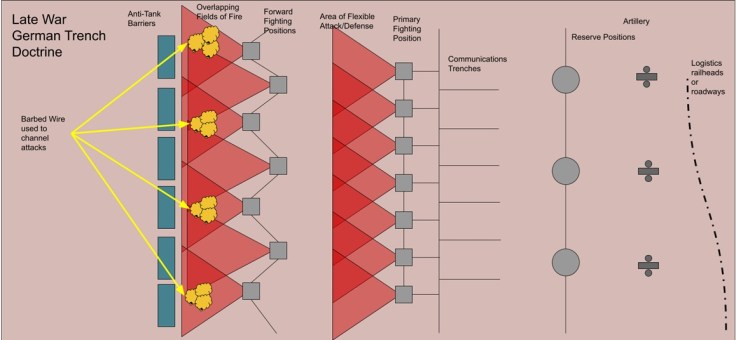
OHL adopted a middle position between the two army groups’ views on how to develop tactics. The defence should generally be mobile and aggressive. Only in very rare cases did the front line have to be held under all circumstances. Thin manning of the front and deployment in depth were correct but must be backed by reserves and, when needed, counterattack divisions [Eingreifdivisionen – the first use of this term in official doctrine]. These divisions must be close enough to intervene quickly but not so close that they became fought out from excessive casualties. Forward lines should usually be treated as advanced positions [Vorstellungen]. But it was impossible to renounce all defensive construction and fight a purely fluid battle. Fixed defences, especially to the rear, were important for economising on manpower in ordinary trench warfare and were crucial to proper command and supply arrangements in major battle; also, they forced the enemy to make time-consuming preparations to deal with them.[56]
The final step in updating doctrine was the publication of new editions of ‘Field fortifications’ in August and ‘Defensive battle’ in September. The latter was a major re-write, half as long again as its March predecessor. The section on artillery still occupied about a third of the total. The biggest changes related to the infantry and air force. The infantry section included important new instructions on the establishment of a lightly-held forward zone [Vorfeldzone], and in particular the difficult question of how toughly it was to be defended. More stress was laid on the need to fight a mobile battle in the whole depth of the defensive position. Other new content covered counterattack divisions, the increasing role of communications and the light-machine gun, introduced much more widely in the army since the spring battles. The section on the air force more than doubled in length and now included instructions on gaining air superiority. Finally, greater emphasis was put on training as the cornerstone of a unit’s quality.[57].
The Germans won another important defensive victory at Third Ypres in autumn 1917. The new tactics have been viewed, especially in the older historiography, as a prime reason for German defensive successes in 1917. There seems little doubt that despite some continuing dissent (see below), they were broadly welcomed as helping to reduce casualties and raise morale. The Entente were impressed too: the British official history commented favourably on the German army’s management of battle, especially the constant flow of reserves, and skilfully conducted counterattacks.[58]
There are two objections to this view of the new tactics as the decisive factor in these German successes. First, they were only part of the story. Western Front battles were complex, operational-level actions and many factors explain their outcomes, including effective logistics and intelligence. Equally significant was enemy performance: French and British operational and tactical abilities were clearly not adequate to achieve a breakthrough.[59] Second, the new tactics were no panacea, and there was almost no way of preventing the success of properly conducted Entente ‘bite and hold’ attacks with limited objectives. This was not a new problem, but it became increasingly difficult as the Entente adapted to German tactics in the continuous Western Front process of introducing or reacting to tactical and technical innovation.
Between June and November the Germans suffered six heavy local defeats.[60] At each of these battles there were problems relating to some of the core elements of mobile defence, especially withdrawal and counterattacks. The obvious remedy to Entente tactics was to withdraw before the assault. The withdrawal to the Hindenburg Line was a successful example at the strategic level which pre-empted part of the Entente spring offensive. ‘Defensive battle’ allowed for withdrawal rather than attempting to retain unfavourable positions, and indeed Sixth Army evacuated the untenable Lens salient in June.[61] But withdrawal had been considered and ruled out before three of the six defeats mentioned, Messines, Verdun and Malmaison. One common factor was mission command: the two army groups concerned had advocated pre-emptive withdrawal but let themselves be convinced by local objections based on a variety of practical and emotional reasons.[62] The two army groups’ failure simply to issue orders for withdrawal shows how mission command could become weakness of command.
A linked problem was the question whether to hold or abandon the Forward Zone. The September edition of ‘Defensive battle’ stated clearly that temporary evacuation of positions was allowed, as long as they were completely recaptured by the end of the battle. However, it also stated, rather less clearly, that local commanders had to decide in every case how toughly to defend the Forward Zone; this was recognised to be a particularly difficult decision.[63] Some senior officers continued to oppose the whole idea of flexible defence. General Gerhard Tappen, a divisional commander at Third Ypres, commented that the new tactics caused what he bitterly called the ‘victorious retreats’ of 1917–1918. They showed the troops that enemy fire could be escaped by withdrawal. Also, if the Forward Zone was given up it either had to be recaptured, often with heavy casualties, or established further back to regain the defensive depth lost by the withdrawal.[64] An integral part of mobile defence was counterattack to recapture ground temporarily lost or given up. In the spring fighting, automatic counterattacks from the rear had often worked, and throughout 1917 local efforts could be very successful. But as Entente barrages became thicker and longer, large-scale counterattacks from the rear became increasingly difficult to mount: this was a concern to Army Group Crown Prince as early as 24 April.[65] At Verdun in August and at Third Ypres in the autumn, counterattacks from the rear arrived late and suffered heavy casualties. The alternatives were to avoid the enemy barrage by moving the counterattack units forward before it started, or by reverting to the older tactic of holding the front line more thickly. But both these methods led to the premature exhaustion of the counterattack troops as well as heavy casualties; and the front positions were overrun anyway.[66]
Conclusion
Although contemporaries referred to the ‘new’ German tactics of 1916–1917, most of the constituent parts had evolved gradually from the beginning of trench warfare and especially during the battle of the Somme.[67] The tactics were new in the sense that there was a new codification of existing best practice into doctrine, rather than the introduction of something radically different from what had gone before. The doctrine was promulgated by the publication of manuals such as ‘Defensive battle’ which explained to the army what actually constituted best practice. After-action reports, though important, were no substitute. Wenninger was not alone in commenting that his division’s action represented one experience in one particular situation. Standardisation of procedures throughout the army was crucial to all-arms co-operation, and this could only be achieved by doctrine. Doctrine was anyway ultimately based on experience, including after-action reports. It was not necessarily particularly behind events, as manuals could quickly be supplemented by interim amendments and special instructions which were then incorporated into subsequent editions.
Doctrine was therefore more than a static paper exercise. There was a continuous cycle of action, after-action reports, discussion, synthesis into and promulgation of doctrine, followed by training at different levels and then the beginning of the next cycle.[68] Throughout 1917 OHL increasingly took control of this process, by ending broad circulation of after-action reports and by insisting on the binding nature of doctrine. This contributed to limitations on mission command, which were partly a consequence of trench warfare and partly the result of increasing micro-management by Ludendorff at OHL. Nevertheless, there was still plenty of scope for human factors to play a role. Officers such as Höhn and Moser who drafted doctrine and led training on it were carefully selected to lend credibility to the process. However, as a fallible human organisation, the German army’s record in implementing doctrine was patchy. Enemy adaptation was one reason for this, but another was forgetting lessons already learned: indeed, some tactical mistakes which the army had cured in 1917 recurred during the final campaign of the war in 1918.[69] So doctrine was key to German performance but could never be perfect or perfectly implemented.
Note:
- GLAK, 456 F1/523, Army Group Crown Prince to OHL, ‘Zusammenstellung einiger Lehren aus der Doppelschlacht Aisne-Champagne’, Ic Nr. 2880, 8 June 1917; 50th Infantry Division report, ‘Erfahrungen der 50. Inf. Div. aus dem Angriff der Franzosen am 16. April 17’, [no reference or date]. GLAK, 456 F1/523 is the main collection of Seventh Army after-action reports on the Nivelle Offensive. KAM, AOK 6 Bd. 419 has the Sixth Army reports on Arras.
- This account is from 3rd Bavarian Infantry Division’s after-action report, KAM, AOK 6 Bd. 419, ‘Erfahrungen aus den Kaempfen bei Arras’, 6 May 1917.
- Jonathan Boff, Haig’s Enemy: Crown Prince Rupprecht and Germany’s War on the Western Front (Oxford: Oxford University Press, 2018), pp. 159-161 argues that the lessons-learned process after the initial defeat at Arras lacked objectivity and sought to throw blame on individuals rather than the new defensive tactics. See also Jack Sheldon, The German Army on Vimy Ridge, 1914–1917 (Barnsley: Pen & Sword Military, 2008), Chap. 8.
- Weltkrieg, XII, p. 291.
- BA/MA, Otto von Below papers, N87/61, Otto von Below unpublished manuscript, ‘Lebenserinnerungen. V: Frankreich’, 7 May 1917.
50KAM, AOK 6 Bd. 419, Sixth Army to Wenninger, Ia Nr. 32877, 9 July 1917 - GLAK, 456 F1/523, OHL to Western Front army groups and armies, I. Nr. 54446
geh. op., 6 May 1917. - GLAK, 456 F1/523, Army Group Crown Prince to OHL, Ia/Ib Nr. 2605, 8 May
1917. - KAM, AOK 6 Bd. 419, Army Group Rupprecht to its armies, Ic No. 2881 geh., 25
April 1917. - HSAS, M660/038 Bü 17, f. 45, OHL circular, II Nr. 57804 op., 16 June 1917
- Strohn, Defence of the Reich, p. 14.
- HSAS, M660/038 Bü 17, f. 38, OHL circular, II Nr. 54472 op. , 5 May 1917; Chef des Generalstabes des Feldheeres, Sonderheft zum Sammelheft der Vorschriften für den Stellungskrieg. Vom 10. Juni 1917 (GHQ: Druckerei des Chefs des Generalstabes des Feldheeres, 1917).
- Chef des Generalstabes des Feldheeres, Vorschriften für den Stellungskrieg für alle Waffen. Teil 8: Grundsätze für die Führung der Abwehrschlacht im Stellungskriege. Vom 1. September 1917 (Berlin: Reichsdruckerei, 1917) (hereafter ‘Abwehrschlacht’ September 1917). Engelmann compares the March and September editions of ‘Defensive battle’ in detail.
- Captain Cyril Falls, Military Operations: France and Belgium, 1917, Vol. I: The German Retreat to the Hindenburg Line and the Battles of Arras (London: Macmillan, 1940), pp. 553-5.
- Cowan, ‘Genius for War?’, pp. 259-61.
- Messines (June), Verdun (August), Menin Road (September), Polygon Wood (September), Broodseinde (October) and Malmaison (October). Cambrai (November) is excluded as a special case.
- ‘Abwehrschlacht’, March 1917, 6b; Below, ‘Lebenserinnerungen’, 19 and 21 June 1917
- Hermann von Kuhl, Der Weltkrieg 1914–1918, 2 vols (Berlin: Wilhelm Kolk, 1929), II, pp. 113-114; BA/MA, N58/1, Graf Friedrich von der Schulenburg-Tressow unpublished manuscript, ‘Erlebnisse’, p. 160.
- ‘Abwehrschlacht’, September 1917, 6c and 39.
- BA/MA, RH 61/986, Gerhard Tappen unpublished manuscript, ‘Meine Kriegserinnerungen’, p. 62. See also Stachelbeck, ‘Lessons learned’, pp. 134–135. 65. GLAK, 456 F1/249, Army Group Crown Prince to Seventh Army, 1a 2431, 24 April 1917.
- Nick Lloyd, Passchendaele: A New History (London: Viking, 2017), Chaps. 10-12
- Ralf Raths, Vom Massensturm zur Stoßtrupptaktik. Die deutsche Landkriegtaktik im Spiegel von Dienstvorschriften und Publizistik 1906 bis 1918 (Freiburg: Rombach, 2009), pp. 203-18 suggests that many of the changes stemmed from pre-war thinking. 68For parallels and differences with the British army’s learning processes, see Aimée Fox, Learning to Fight: Military Innovation and Change in the British Army, 1914–1918 (Cambridge: Cambridge University Press, 2018).
- Boff, Winning and Losing, Chaps. 6 and 8 and pp. 246-7
Autore: Tony Cowan
Fonte: ‘The Introduction of New German Defensive Tactics in 1916-1917’, British Journa! for Mi!itary History, 5.2 (2019), pp. 81-99.
Approfondimenti:
Categorie
Tags


Rispondi