
In 1919, three major naval powers—Great Britain, Japan, and the United States—faced two major challenges: integrating new technology into their doctrines and organizations, and coping with reduced naval expenditures and arms treaties that carne as a postwar reaction to armaments spending. In effect, money available for naval development and construction was declining at precisely the moment it was needed to adapt new weapons and equipment to naval use. Though World War I had ended, naval rivalry had not, and officers in all three navies understood that their organizations needed to progress technologically and tactically. To do so, each navy would have to innovate and foster tactical and doctrinal change while surviving on limited funds. In this article we will examine the way the three navies responded to the challenges and opportunities posed by one major new technology, airpower. Of the three major navies, only two—the U.S. and Japanese—fully developed airpower at sea, despite the fact that it was the Royal Navy which led ín this field in 1919. Through a comparison of the naval aviation policies of these three navies, we also will examine a basic and deeper issue: the relationship of organizational structure and behavior to technical and tactical innovation in complex military organizations. Put another way, how do some military bureaucracies innovate successfully? We will argue that innovation depends on a clearly articulated demand for a particular tactic or weapon; procedures to evaluate experience with, and alter, the innovation; and organizational advocacy. A comparison of these three navies—British, Japanese, and American—sheds some light on this important and interesting subject.
The navies of Japan, Great Britain, and the United States were chosen for analysis because they faced a common problem—defining the role of aviation in warfare. In aviation, the menu of options was large and military budgets were limited. There was no question in the three navies that aviation merited serious, long-term investments. World War I experience, shared by the Royal Navy with the U.S. Navy and observed by Japanese officers, had shown the value of airships and blimps, seaplanes, land-based multiengined bombers and scouts, and aircraft carriers. Younger officers with aviation experience pressed superiors to make commitments in several areas simultaneously. Superiors, faced with reduced resources and the demands of aviators—as well as of submarine advocates—had to decide how to organize naval aviation. On their decisions would turn the outcome of much of World War II at sea.
The Royal Navy: Ups and Downs
At the beginning of 1918, the strength of the Royal Naval Air Service (RNAS) was approximately 3,500 aircraft (over 1,000 of them were seaplanes) and several dozen large airships, maintained and flown by nearly 55,000 officers and enlisted personnel stationed at over 100 bases in England and Europe.’ Royal Naval Air Service leaders were optimistic about the use of airpower to defeat their adversaries. A 200-piane raid on the German fleet in Wilhemshaven was planned in early 1918 but was never staged. Nevertheless, RNAS organization, training, and equipment deeply impressed both U.S. Navy air units and Japanese Navy observers. By 1919, the Royal Navy had its first aircraft carriers and seaplane tenders, with three additional carriers being converted or under construction. But the British lead, commanding though it seemed to its allies and postwar rivals, was already slipping.
The roots of postwar RNAS decline stretch back to August 1917 when the War Priorities Committee, chaired by Jan Smuts, recommended that existing British Army and naval air assets be merged under the control of a separate air ministry. The committee’s report, which was very influential, argued: “Unlike artillery an air fleet can conduct extensive operations far from, and independently of, both Army and Navy. As far as at present can be foreseen there is absolutely no limi t to the scale of its future independent war use. And the day may not be far off when aerial operations with their devastation of enemy lands and destruction of industrial and populous centers on a vast scale may become the principal operations of war, to which the older forms of military and naval operations may become secondary and subordinate. “2
In April 1918, the naval and army air arms were separated from their services and combined in the Royal Air Force (RAF). The RA F’s first operational chief, General H.M. Trenchard, was later appointed head of the Inter-Allied Independent Air Force. In February 1919, General Trenchard was made chief of the air staff, a post he held for ten years. He was an aggressive competitor for scarce resources, shielding the fledgling RAF from efforts by the army and Royal Navy to regain the air assets they had given away under the stress of war. Trenchard’s doctrine of airpower played on the mismatch between British resources and imperial defense commitments. As he argued in 1921,
a) the primary function of the Air Force in the future would be the defence of the British Isles from invasion by air from the continent of Europe. This defence would largely take the form of a counter-offensive from the air
b) certain responsibilities at present assigned to the Navy and the Artny could be more economically and just as adequately carried out by Air units . . . .
(c)… there should be more use made of the Air Force as an independent anni used not as an auxiliary, but as a substitute for naval and in military forces.3
In short, the RAF could do what the other services had been doing but do it cheaper.
Trenchard’s argument persuaded civilian policymakers, who approved the centralization of decision making in the RAF for aircraft design, maintenance, procurement, pilot training, and development of doctrine. This organizational arrangement had two consequences for the Royal Navy’s Fleet Air Arm (FAA) and evolving carrier aircraft force. First, because the FAA had little or no say in the policy governing flying boats or land-based aircraft employed for naval reconnaissance, it became very much a carrier force. Second, it took years to develop a cadre of senior Royal Navy officers with flight experience. When the RAF was created in 1918, all the RNAS pilots were transferred to RAF units. By 1926, the Royal Navy had persuaded the RAF that seventy percent of serving FAA pilots should be naval officers, but RAF pilots were entitled to one-half of the wing and squadron commander positions on Royal Navy aircraft carriers. As a result, a Royal Navy officer did not command a Fleet Air Arm flight (part of a squadron) until 1927. That same year, the U.S. Navy set aside carrier commands for officers qualified as pilots or observers. As Till noted, “Whereas by 1926 the U.S. Navy had one vice-admiral, three rear-admirals, two captains and 63 commanders who received flying pay, the Royal Navy had only one rear-admiral and a few commanders and junior captains by the start of the Second World War. “4 Till concluded that FAA procurement suffered because the RAF—responsible for all aircraft procurement—showed I little concern for the particular problems of naval aircraft design; the Royal Navy’s approach to carrier aircraft tactics was often flawed (for example, the Royal Navy did not assume that its fighters would have to face land-based opponents); and the system of aircraft procurement did not automatically feed the Navy’s operational experience into the RAF’s design process.5 The Royal Navy complained that because the RAF was not quick to produce aircraft to the specifications the Navy presented, the aircraft were obsolete when delivered. The RAF countered by charging that the specifications submitted by the Royal Navy were often impossible to realize given the general shortage ofprocurement funds. Both sides expressed reasonable points of view, but as Till also noted, both overlooked the need to experiment in a situation where there were many options and little information to judge among them: “the quality of naval aviation was much bound up with the quantity of aircraft involved . . low numbers made it difficult for the British to launch massed attacks of the kind used by the U.S. and Japanese navies to convince the skeptical that air power could revolutionize war at sea. Having too few aircraft, the FAA was less able to make the dramatic impressions required . . . “6
The Royal Navy was caught in a vicious cycle: not through planes meant accepting utility types; the poor performance of these FAA planes could not demonstrate a need for greater numbers of better aircraft and thus reduced the status of the FAA as a fighting arm. These conditions which made flying for the Royal Navy a less attractive career option, also meant less talented officers went into the FAA, further reducing its effectiveness, and making its demands for more and better aircraft seem unjustified. One small but devastating consequence of the FAA ‘s inability to obtain high performance aircraft was the acceptance of an ineffective arresting gear on Royal Navy carriers. Early arresting devices often damaged aircraft and led to a search for alternate methods of landing aircraft. Experiments in the early 1920s showed that by steaming into the wind at high speed, carriers could safely recover aircraft without using an arresting gear system. However, recovery of aircraft by steaming into the wind was slower than by using an arresting gear and gradually Iost effectiveness as aircraft weights and landing speeds increased. The absence of an arresting gear system meant that British carriers could not demonstrate their true military potential as platforms for mounting larger strike missions with high performance aircraft.
Royal Navy officers, however, were not without their share of blame for failing to exploit the potential of naval aviation. As Till discovered, after 1919, “no deep study of the future role of naval aviation was undertaken because no specific Naval Staff institution or officer was directly responsible for providing one.”7 Before 1931, for example, the Royal Navy carriers stationed in the Atlantic and Mediterranean were customarily assigned to scouting forces or tied to battleship formations. Their role was strictly auxiliary to the Royal Navy’s gunnery and reconnaissance units. The Navy also had a misplaced faith in the effectiveness of antiaircraft gunnery and no confidence at all in bombing accuracy until the late 19305.8 Thus, Royal Navy officers overestimated the power of defenses against carrier aircraft and misestimated the strike value of their own planes. Further, the Royal Navy, secure in its lead in naval aviation, had stopped exchanging technical data on air operations, tactics, and aircraft and carrier design with the U.S Navy in the early 1920s. I is ironic that, for some years, the American naval officers felt they were lagging in the development of carrier aviation when, in fact, they were moving ahead. By 1929, the gap between the two navies was apparent t to professionals on both sides when the U.S. Navy, with Royal Navy observers present, first used large carriers in the strike role in full-scale fleet exercises. The Royal Navy had more carricrs (in 1930, the ratio was 5 to 2, not counting the experimental carriers on cacli sidc) but could not launch a larger, stronger aerial force. The strengths of U.S Navy aviation provoked action by the Royal Navy to identify and address its weaknesses.
In 1931 the First Lord of the Admiralty acted to strengthen the FAA by creating the position of Rear Admiral (Aircraft Carriers) and appointing to it R.G.H. Henderson, an officer of vision, energy, and persuasiveness. Given a mandate to refine and develop carrier tactics, the new command began to experiment with carriers operating in pairs. When FAA plans returned from missions, they were lowered from carrier flight decks to hangar decks for rearming and refueling. This process took time and made a lone carrier vulnerable to attack. By pairing carriers, the new command drastically reduced this vulnerability and actually frecc1 more planes for strike missions.9 Exercises also showed the need for larger numbers of strike aircraft if carriers were to do more than simply scout for and protect the Royal Navy’s battleships.10 The organizational result of those exercises was a renewed demand from within the Royal Navy to regain full control of carrier aviation, and some officers were eager to gain control of Coastal Command aircraft as well. Beginning in 1936, the Royal Navy pressed hard to gain full, as against shared, control over the FAA from the RAF. This cabinet level issues involved senior civilian and military officials in both the Air Ministry and the Admiralty. After a long debate, the Air Ministry finally accepted the recommendation of a special review committee and, in 1938, the Royal Navy gained rea’ control over procurement, staffing, and training of the FAA.il 13ut this administrative change was almost too little, too late. Roskill, for example, noted that the new naval air arm lacked officers at the level of commander and above, as well as enlisted technical specialists.12 The U.S. Naval Attache was, in Roskill’s words, “right on the mark” when he reported in April 1938 that the FAA was not nearly as effective a force as the rest of the British Navy.13 At the same time, the records suggest that in areas such as ship and aircraft design, there was al ready open and useful cooperation between Air Ministry and Admiralty specialist. Carrier Ark Royal, designed in 1935 and a contemporary of the U.S. Navy’s Enterprise, was a successful ship and was referred to by her Royal Navy designer as “a good example of coordinated defense.”” Carrier aircraft designs were not nearly so successful, but the reason had less to do with the level of interservice cooperative than with the scarcity of manufacturing resources; the modernization of the RAF’s Fighter Command had higher priority.
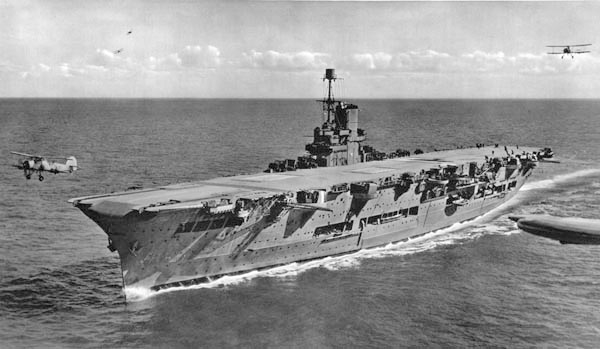
HMS Ark Royal
Though Roskill and Till have suggested that prewar exercises employing carriers, aircraft catapulted from battleships and cruisers, and RAF planes assigned naval missions, produced very mixed results, the fact remains that Royal Navy fleet aviation eventually performed impressively during World War II. The problem was that prewar experience led the Navy away from a conception of aircraft carriers as strike weapons and toward a doctrine which stressed how carriers could support gunfire ships. Such support would include spotting, scouting, attacks on enemy units at anchor (where Royal Navy battleships could not reach them), and torpedo assaults on the enemy battle line to force it to face a decisive showdown with the Royal Navy’s battleships. As Friedman observed, the impact of prewar exercises was reflected clearly in Royal Navy carrier designs: Illustrious, which followed Ark Royal, carried less than half the latter ‘s air complement but was armor sufficient enough to accompany battleships into areas where it would be threatened by enemy land-based aviation.15 Much more of Illustrious’ tonnage was put into passive defense measures than was put into contemporary U.S. Navy and Japanese carriers. This approach, which made sense in the Mediterranean, was a mistake in the Pacific because Japanese carriers had so many more strike aircraft with significantly greater ranges than their British counterparts, that they could swamp British combat air patrols and antiaircraft guns before British aircraft could launch an effective attack.

HMS Illustrious
In sum, Royal Navy aviation suffered early in World War II because during the interwar years there was only a modest development effort and no organization to identify doctrinal errors. What saved the British Navy was that its European enemies had done even worse. Faced by Japanese airpower at sea in 1942, however, the British Navy was sound) defeated. Under the pressure of war, the Royal Navy quickly embraced the escort carrier, night operations, and advanced aircraft. Naval aviation, though not seen as the premier arm of the Royal Navy in 1939, was able to take that role eventually because senior officers—even those not trained as aviators—reevaluated doctrine and recognized the importance of carriers. By 1943 the Royal Navy also began to get sufficient quantities of pilots and planes.”16
The Imperial Japanese Navy: Fits and Starts
Officers in the Imperial Japanese Navy were quick to comprehend the potential of naval aviation. The Imperial Navy units which besieged the German naval base at Tsingtao in 1914 employed seaplanes carried by a merchant ship converted for scouting and bombing.17 The first naval air group was created in 1916; the first aviation experimental station was set up in 1918, and it constructed its first wind tunnel the next year.18 In 1919, in its annual maneuvers, the Imperial Navy deployed its whole force of seaplanes as effective scouts.19 In spring of 1921 the RAF and Royal Navy cooperated in dispatching a special mission to Japan to assist the Imperial Navy in modernizing its aerial forces and training programs. Both the Commander in Chief, Combined Fleets and the Chief of the Imperial Navy’s General Staff took a strong interest in using British assistance to (as Ferris put it) “leap from 1914 to 1919 in a single bound.”20 The British mission advised the Imperial Navy on the completion of its fìrst carrier (Hosho, launched in 1921) on flight training procedures and on contemporary aircraft design.
By the end of 1921, Imperial Navy seaplanes were spotting gunfìre and shielding their battleships from enemy aircraft.21 The Japanese Government established the Advisory Committee for Aeronautics in 1923 and an aeronautical! laboratory in Tokyo Imperia] University in 1924.22 The Imperia! Navy financed airframe and engine advances. By 1928, Mitsubishi was producing about 100 aircraft annually and Aichei Tokai, nearly 70 seaplanes and flying boats.23 In 1926 the Japanese Naval Air Service had almost 250 planes, “perhaps a third of which were seaplanes and flying boats. ft also had some 90 training aircraft, around 200 obsolescent aircraft of various models in reserve, and over two dozen foreign models for design copying purposes.”24 This total of approximately 540 planes compared with a figure of about 890 for the U.S. Navy and less than 150 for the Royal Navy, although the Royal Navy had more than double the number of planes on carriers at sea than either of its rivals.
In October 1927, the Imperial Navy’s annual maneuvers were deliberately designed to test the potential of major land- and sea-based air squadrons to affect the outcome of a decisive fleet confrontation. The converted battle cruiser Akagi was maneuvered as a carrier even though it was not yet complete. The influence of these exercises on Japanese naval aviation was significant. One source has credited them with provoking a major reorganization of Imperial Navy aviation.23 Another source has suggested that the success of the Japanese Army’s air organization was, in fact, the spur to change within the Imperial Navy.26 Whatever the cause, in 1928, Imperial Navy aviation, which had been organized as part of the Navy’s Controller office, was made a separate bureau, “directly responsible to the Minister of Marine.”27 The bureau’s first director was Admiral Y. Yamamoto (not the Isoroku Yamamoto who commanded the Combined Fleet in 1941) who had won the annua! maneuvers the previous autumn. By 1929 Admiral Y. Yamamoto was commanding all carrier and most land-based naval aviation. Later that same year he was appointed chief of the Combined Fleet.28
The creation of a separate aviation bureau was crucial to the progress of Imperia! Navy aviation for two reasons. First, before 1928 aviation had been organized around the various naval aviation stations which, in turn, were under the authority of the chiefs of the major naval districts.29 The 1928 reorganization placed the various branches of naval aviation under one central administration with clear budget authority. In the bureau, the major design, procurement and training issues could be resolved. The result was further Imperial Navy-wide interest in aviation. At the end of 1930, for example, Navy fleet exercises emphasized the use of naval aircraft in a varie ty of roles, including carrier forces a attacking defended targets on land. Second, naval aviation was the Navy’s hedge against the naval arms limitation agreements. At the London Conference of 1930-31, the Japanese delegation requested that the parties to the Washington agreements of 1921 agree to a change in the battleship tonnage ratio from 10 to 6 in favor of the United States and Britain, to a less favorable ratio of 10 to 7. The U.S. and British delegates refused to accept the new ratio, so the Imperial Navy mounted several) efforts to overcome this apparent imbalance: one was a submarine building program; the second was the expansion of land-based naval aviation.31
Japanese naval officers returned from London committed to enlarging their navy’s aviation programs. At the end of 1931, Imperial Navy leaders decided to overcome the U.S. Navy’s lead in numbers (1,200 vs. less than 800) and quality of aircraft. As part of this effort, the Imperial Navy’s bureau of avia tion adopted, in 1932, an “Aviation Technology Independence” program to force the rapid development of the Japanese aircraft industry.32 The responsibility for this program was given to Captain (later Admiral) Isoroku Yamamoto who had been appointed Chief of the Technical Division of the Imperial Navy’s aviation bureau after his return from the London conference. At Yamamoto’s urging, the Imperial Navy sponsored a competition for design of a long-range twin-engined bomber capable of carrying a large torpedo. As the designer of the famous Zero fighter noted in his memoirs, the catch-up program worked. Japanese aircraft bested Chinese opponents after war between the two countries broke out in 1937.” In 1935, I. Yamamoto was made head of the Imperial Navy’s aviation bureau, and in 1936, after the Japanese delegation walked out of the second London naval disarmament conference, he was ordered to more than double aircraft procurement in the next two years.34
The Imperial Navy’s aviation department was developing fast. Sadao cited a 1936 Japanese Naval War College “Study of Strategy and Tactics in Operations against the United States,” and an Aviation Headquarters document from 1937 which argued that “since control of the western Pacific would be decided by land-based planes, ‘the ratio of fleet strength between Japan and the United States would hardly come into the picture.'”33 Such papers, though they did not represent the mainstream of Japanese maritime philosophy, do show that the Naval Aviation Department had examined doctrine and strategy critically during the years since 1930. There also had been much technical progress, though the Japanese aircraft industry continued to have difficulty producing powerful engines. In the fall of 1937, the aviation bureau issued specifications for an air superiority fighter that was “one step beyond” existing navy fighters in performance and endurance. The new plane was part of a trio of new, high-performance aircraft which were ordered together to give Imperial Navy units capability equal to any foreign competitors.36
Japanese technical and doctrinal advances were not fortuitous; they were the result of an institutionalized analysis of ideas and technology within the navy and within major manufacturers such as Mitsubishi. Aircraft and ship designers received data from maneuvers and from actual combat through the Aviation Bureau. The powers of the bureau were sufficient for it to compel designers to develop the advances which its leadership knew were necessary. Japanese manufacturers were ready to produce quality aircraft; they had the necessary number of designers, engineers, and skilled machinists. The Japanese Army and Navy had each decided that relatively large and continuing orders had to be placed to develop the aircraft industry. Doctrinally, however, the Imperial Navy was not committed to aviation (especially carrier aviation) as its main combat force. Aircraft, like submarines and torpedo-carrying destroyers, were assigned the roles of whittling away U.S. Navy strength in the Pacific, and shielding Imperial Navy battleships in the crucial showdown of the opposing surface fleets. Despite the Imperial Navy’s adherence to the doctrine of the decisive fleet action, Japanese naval aviation made great progress before 1940. It was number two in the world in terms of overall naval aviation strength in that year and drastically superior to its likely opponents in the western Pacific.
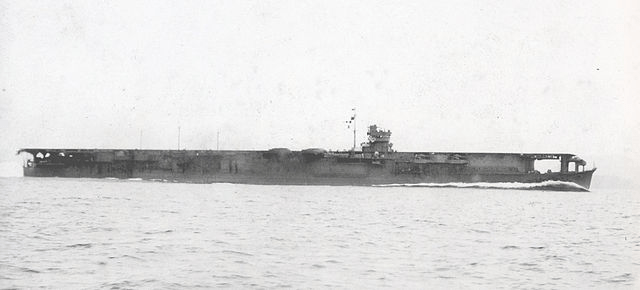
IJN Soryu in 1938
The U.S. Navy: A Model of Organizational Evolution
In January 1914, when the Navy established its first pilot training school, U.S. Navy aviation consisted of 9 officers, 23 enlisted men, and 7 aircraft.37 By the end of World War l, U.S. Navy aviation forces had increased to approximately 7,000 officers, 33,000 enlisted personnel, and over 2,100 aircraft.38 This fantastic growth was followed by a rapid decline because of demobilization. By the early summer of 1919, the number of officers in naval aviation was down to 580 (370 were aviators) and the number of enlisted men had fallen to 4,879 (3,479 had aviation ratings).39 But war experience had demonstrated the value of aircraft in naval roles; from the Navy’s perspective, the issue was not whether tu =brace aviation, but where to put its very scarce postwar resources. In March 1918 the Office of the Director of Naval Aviation was made a part of the staff of the Chief of Naval Operations (CNO). Though the director had regular access to the CNO, his authority, as well as that of the CNO himself, was limited by the U.S. Navy’s bureau system. The bureaus were semiautonomous agencies which supplied the operating forces with ships, guns, supplies, engines, medical and dental care, and important personnel services (training manuals, transfer processing, retirement, etc.). The bureaus were not under the control of the CNO because his office did not control their budgets, and their influence within the Navy was substantial—especially the Bureau of Ordnance Engineering, Navigation (personnel), and Construction and Repair (ship design and construction). Navy aviators returning from Europe pressed the CNO to request the Secretary of the Navy to propose to Congress that a new bureau be created for aeronautics. He refused but the Navy ‘s General 13oard, a standing committee of senior officers who advised the Secretary of the Navy on ship designs and o their important matters, decided to hold extensive hearings covering a number of aviation issues in 1919. Included in these hearings was whether the U.S. Navy should follow the path already taken by the Royal Navy, that is, handing over its air assets to an independent air Lerce.
The 1919 hearings before the General Board, conducted confidentially and classified Secret, are revealing and significant. They show that very senior officers, such as the Commander in Chief of the U.S. Fleet, supported the creation of a well-financed Navy air service with both seaplanes and aircraft carriers. The hearings also show that, though the aviators who testified often disagreed with one another about the shape of Navy aviation in the future, they were nearly unanimous in their advocacy of a separate bureau of naval aviation. In the course of its hearings, the General Board canvassed all the major tactical) and organizational problems confronting naval aviation and every some of the technological problems of employing aircraft at sea. The proper role and authority of a bureau of aviation were discussed, and alternative ways of procuring planes and then testing them were weighed. At the end of its hearings and deliberations, the board prepared a nemo to the Secretary of the Navy. A number of its “Conclusions and Recommendations” were significant and influential, including the following:
(a) … fleet aviation must be developed to the fullest extent, Aircraft have become an essential art of the fleet. A naval air service must be established, capable of accompanying and operating with the fleet in all waters of the globe . .
(g) Fleet engagement of the future will probably be preceded by air engagements. The advantage will lie with the fleet which wins in the air . . . airplane carriers for the fleet [should] be provided in the proportion of one carrier to each squadron of capital ships . . .
(j) Development of ali types of aircraft . and fleet aviation are the most important work for the immediate future. Construction should be kept as low as possible but for experimental and development work, a liberal appropriation should be included in each yearly program.”
With this official endorsement and encouragement, the advocates of a new Navy bureau of aviation began a campaign to generate support for their proposal both within and outside of the Navy. The General Board at first hesitated to back a major organizational change because it wanted to retain its control over ship—and now also aircraft—designs. The Board members wrestled with the task of specifying the military characteristics for aircraft all through 1920, but discovered that the procedures they had employed successfully in reviewing ship designs and in imposing strategic principles on the bureaus concerned with ship design, ship construction, and naval weapons did not work when applied to aviation. Board deliberations were marked by complaints by the members: they did not know enough about planes or about flying to have the confidence to set aircraft characteristics; they could not anticipate the military potential of large, long-range airships; they did not want to recommend that Congress authorize carriers which would not operate future aircraft types. The Board was severely handicapped by the lack of aviation experience in the fleet. Its efforts were also impeded by the lack of a single design bureau or office for aircraft. In order to exercise competently its responsibilities in the field of aircraft design, the Board either would have to create an organization which could pool the expertise of the bureaus or give the authority to set aircraft designs and characteristics to a new bureau.41
With support from within Congress, from the Harding administration, and from technical specialists in the Navy and the National Advisory Committee for Aeronautics, the Navy ‘s aviators finally got their bureau in August 1921.42 But that was just the beginning of a long struggle by the new Bureau of Aeronautics (BUAER) to consolidate and expand its position. As in Great Britain, there was a major controversy over whether there should be a separate air service. The story of this controversy, centered on the career of Brigadier General William Mitchell of the Army, is long and well-documented.43 What matters here is the impact of the controversy on U.S. Navy aviation. I3UAER’s first chief, Rear Admiral W.A. Moffett, used the congressional hearings, press debates, and official investigations to quiet Navy aviators who wanted more autonomy within the Navy and those Navy officers who where hostile to aviation. He walked a tightrope between being “too Navy” and “too air-minded.” He understood that he had to fight off the pressure for a separate air force while simultaneously strengthening his bureau’s influence and status within the Navy. Moffett’s papers reveal he well knew that in warding off the campaign of Mitchell for a unified air service, he could also build the influence of his new organization.
Moffett, a Medal of Honor winner and superb administrator, but not a qualified pilot, wrote much of Navy General Order No. 65 which translated the legislation authorizing BUAER into specific regulations. The order defined the new bureau’s authority as “all that related to designing, building, fitting out, and repairing Naval and Marine Corps aircraft,” as well as the preparation of the bulk of the budget for naval aviation procurement, training, and support structures (airfields, shops, and hangars).44 The bureau also had “authority to recommend to the Bureau of Navigation and the Commandant of the Marine Corps” how pilots would be selected, assigned, and promoted.45 Finally, the order directed BUAERto supply the CNO with all the information he might need regarding “all aeronautic planning, operations, and administration.”46 In one stroke, Rear Admiral Moffett had created a new organization with more potential authority than the existing Navy bureaus, but the statement of that authority left room for interpretation; it was couched in language which made possible either an assertion of authority or a retreat from it.
Moffett had no intention of retreating. Very quickly, he developed a five-year plan for Navy aviation with a focus on getting aviation units to sea. He also sought allies within the Navy to support his pian. One such ally was the well-known and respected Admiral W.S. Sims, then President of the Naval War College. Sims was trying to use the simulations staged at the college to play out the possible roles of Navy aviation. Moffett wanted and needed the guidance and prestige which such simulations provided.41 He got it. As a result, Moffett’s formal pian had more than the authority of the new bureau. It rested on a developing consensus about the role of naval aviation and the means to fulfill that role. As Moffett argued to the CNO and Secretary of the Navy, BUAER needed “a definite program that extends several’ years ahead of each year’s aeronautic appropriation. “48 He also recognized the need to create a career path for Navy aviators and a means of preventing the aviation community from becoming too fragmented and too isolated from the rest of the Navy. The statement set the basic goals for BUAER: a 1,000-piane production program to promote the U.S. aircraft industry; the training of aviators as officers (because, in flying against an enemy, each aircraft become an independent command); the authority to draw the best graduates of the Naval Academy into aviation; and a program of professional development which would expose Navy aviators to
all the branches of their special-carrier aviation, large seaplanes, and floatplanes carried by cruisers and battleships. This last would not only keep aviators from dividing into different camps, it would also serve to signal the regular line Navy officers that aviation was linked closely to their activities.
Moffett also created or supported the creation of several’ Navy boards which thrashed out BUAER’s conflicts with other Navy organizations, particularly the Bureau of Navigation. He was able, through the investigations and subsequent recommendations of these various boards, to reserve command of carriers and seaplane tenders for aviators, squash the concept (accepted by the Royal Navy) of the multipurpose plane for carriers, and fight off the justified criticism of the General Board that BUAER was encroaching on its authority.
Rear Admiral Moffett was an astute bureaucratic politician. He built alliances with members of Congress, with Navy colleagues, and with journalists, and he cultivated wealthy patrons. Until his death in the crash of the airship Akron in 1933, he shielded Navy aviation programs from outside criticism while promoting the image of Navy aviation as dynamic, powerful, and exciting. His goal was to create an effective organization which was linked with and supported by a political, journalistic, Navy, and industrial constituency. Shielded from political focus, development and innovation could proceed rapidly.
Though Moffett tenaciously held on to his post as BUAER’s chief, he delega ted authority to his assistants and respected the prerogatives of the commanders of fleet aviation. In 1926, for example, Captain J.M. Reeves took command of the experimental carrier Langley, then based with the fleet’s main battle force on the West Coast. Reeves had spent 1925 at the Naval War College. His experience with the college’s simulations of a Pacific war (established when Admiral Sims was president) had convinced Reeves that carriers, in order to become effective strike weapons, had to carry more planes and launch, recover, and service them faster. Over the opposition of Langley’s aviators, he increased the carrier ‘s aircraft complement from 12 to 42, and under his direction, landing and launching intervals were slashed. While Reeves was her captain in, Langley’s crew also developed an effective crash barrier (to stop planes which missed the arresting gear wires), as well as procedures for moving large numbers of planes safely around a crowded flight deck. None of these very important innovations were ordered or anticipated by Moffett, but he gavc Reeves his strong and encouraging support—support which Reeves wanted and needed in his climb to the post of Commander in Chief, U.S. Fleet.49
Naval aviation also benefited from the Navy’s commitment to a rational examination of doctrine through analysis. Officers who did not like aviation, but who nonetheless were good professional, had to accept the evidence that aircraft spotting was essential to very long-range daytime gunnery, that carrier aircraft were growing more powerful and effective from year to year, and that long-range seaplanes were a great aid to fleet reconnaissance. It was the evidence of Royal Navy operations, for example, that led senior U.S. Navy officers serving in the European theater in World War I to support aviation in testimony to the General Board in 1919. Similarly, in 1926, Captain Reeves o organized both a stunt and a demonstration. He promised the admirals commanding the battleships and battle force of the U.S. Fleet that he could spring a surprise attack on their forces on a day of their choosing. Lattgley’s aviators had practiced dive-bombing from high altitude, and Reeves wanted a convincing demonstration of the new technique’s effectiveness. He got it, to the glee of his aviators and amazement of his superiors; his demonstration, and others of a less sensational nature, converted the admirals and widened the circle of aviation’s supporters. Something similar occurred in 1929 when the large, converted battle cruisers, Saratoga and Lexington, first participated in the annual fleet problems. An unorthodox nighttime high-speed run by Saratoga, escorted only by a light cruiser, followed by a surprise dawn air attack by Saratoga’s air group on the locks of the Panama Canal, was a striking success.51 The fleet problems themselves had been developed in the early 1920s as a means of testing scenarios worked out by the War College and by the staff of the CNO. Through the 1920s and 1930s, the annual problems were to serve as a valuable testing ground for aviation concepts and procedures. Their value was a function of the shared commitment of Navy officers to a sensible assessment of available operational data.52
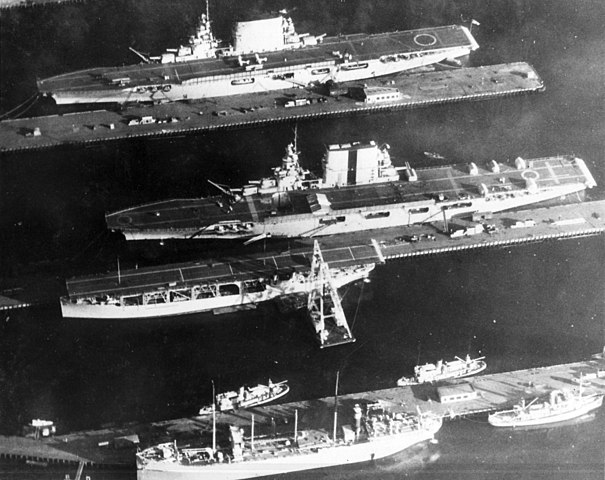
USS Langley, Saratoga and Lexington anchored at Puget Sound NyD, 1929
It would be a mistake to claim that BUAER made no errors in the years before World War II. Rear Admiral Moffett, for example, was a strong supporter of large, long-range airships which carried aircraft for reconnaissance. Operationally, the two which were produced were a failure, and the airship program was eventually overtaken by the increasing range and reliability of seaplanes and land-based bombers.53 In 1931 the Navy and the Army agreed that the Army’s heavy bombardment air units would carry the responsibility for coast defense. Rear Admiral Moffett defended the action by saying that it freed Navy assets for work with the fleet. Essential to his argument was the assumption that Navy seaplanes could both scout and perform well as high-altitude level bombers, but war experience quickly showed that no seaplane could function effectively as a high-level bomber. There were other errors, both in doctrine and tactics—for example, it took war experience to prompt the switch from the three-aircraft fighter element to the two-aircraft (leader and wingman) combination still in use today. Yet the BUAER organizational structure, procedures, and norms created before World War II allowed the Navy to develop and then expand a quality naval air service. Indeed, the effectiveness of BUAER was best reflected by its ability to produce a huge quantity (by comparison with Great Britain and Japan) of qualified pilots, mechanics, and plane handlers. The foundations of aerial victory in 1944 were laid down in the 1920s and 1930s.
Organization and Innovation
The organizational histories of the aviation components of the Royal Navy, the U.S. Navy, and the Imperial Japanese Navy between World War I and 1940 are case studies in innovation and adaptability. There is, obviously, a lack ofdata on both the Royal Navy and Imperial Japanese Navy programs; in the latter case, the data are fragmentary; in the case of the Royal Navy, the existing data are not very accessible.51 The danger is that the inferences drawn will be taken from the U.S. case, and that the U.S. case may not be representative. However, the parallels between the U.S. Navy and Imperial Navy are strong, and the Royal Navy counterexample is strikingly clear. In addition, the cases corroborate claims widely supported in the literature on organizations.
First, the cases show that the “lack of an effective continuing advocative constituency, for whatever reason, is clearly a major inhibitor to the adoption of innovation.”55 As Powell has noted, “most [technological] progress is made through a series of incremental steps.”56 Once introduced, a new concept or tactic or weapon needs to be refined and improved and accepted by the users. Without continuing support and testing, progress cannot be maintained.7 Naval aviation in the 1920s and 1930s provides classic illustrations of this point. Carrier fighter speeds, for example, increased steadily for the aircraft of all three navies during this period, from an average of about 125 knots in 1928 to nearly 300 knots in 1940. Service ceilings for fighters also jumped from approximately 22,000 ft. in 1928 to almost 34,000 ft. in 1940. Carrier strike aircraft (dive bombers and torpedo planes) characteristics also improved dramatically.” By 1940 the criticism that carrier planes could not carry enough ordnance or fly fast and far enough—a criticism quite justified in 1930—was no longer valid. All three navies found that, though it made sense tactically to have lots of carriers, the growth in the size and weight of strike aircraft (coupled with arms treaty restrictions on overall carrier tonnage) compelled them to construct small numbers of large carriers—so that only during the war did they get the numbers of carriers which prewar exercises had suggested they needed. In effect, it took war experience to show that prewar claims were correct, and the navies with strong aviation bureaus—the U.S. Navy and Imperial Japanese Navy—were better at evaluating early war experience then the Royal Navy, whose Fleet Air Arm had always been overshadowed by the RAF.
A second proposition which is supported by the case studies is that solving complicated technological problems requires the exploration of a diverse set of approaches. Heavy commitments to only one approach are dangerous in early stages of the development of a technology.59 Through the 1930s, land-based fighters grew larger, heavier, and faster; monoplanes replaced biplanes, and engine power began to surge. Carrier fighters, however, faced one problem that the land-based aircraft did not: the need to reduce landing speeds so that pilots could land safely on a small deck. A t the same time, naval aviators had to assess their chances of clashing with land-based fighters; evidence (in the Imperial Japanese Navy ‘s case, actual] combat experience in China) suggested that the chance was increasing. Designers were faced with pressure to increase fighter speed and maneuverability. There werc two options: Push the existing design philosophy to the limit, or go off in a new direction. The Imperial Navy chose the first alternative, while the U.S, Navy opted for the second.
The difference in these choices can be expressed numerically in the wing loadings (85 percent of takc-off weight divided by wing area) of Imperia] Navy and U.S. Navy aircraft, as follows:

The A6M2 is the famous Zero with the maneuverability of a biplane and the climb rate of a monoplane. The price paid for this combination—a weak airframe and no armor protection for the pilot—was quite serious in the long run, but the Imperial Navy had little choice because it chose not to gamble that Japanese aircraft manufacturers could produce the facilities and skilled personnel to turn out large numbers of really powerful engincs.61 In effect, the Imperial Navy pushed one design strategy to its limits. The U.S. Navy, on the other hand, moved from one strategy to another, as the numbers comparing the F3F and F4F show. The drawback was that the F4F Wildcat was outmaneuvered by the Zero. The benefit was that laser U.S. Navy fighters, such as the F6F Hellcat and F4U Corsair, had engines and performance better than their Japanese contemporaries, such as the Mitsubishi A7M2 of 1944. The U.S. Navy had a stronger industrial base and used it, gradually developing planes superior to that of the Imperia] Navy. Given the threat of war in 1940, the BUAER decision to contract for a new generation of large-engine propeller-driven fighters was risky but reasonable given the organization’s mission and its evaluation of the U.S. aircraft industry. For the Imperial Navy such a risk did not appear technically feasible. For the Royal Navy, by contrast, taking the risk was not organizationally possible.
This assertion leads to a third proposition: That continuing advocacy is insufficient in itself for successful innovation.62 The organization must be able to gain experience with the innovation and alter its methods on the basis of that experience.63 The Royal Navy was never able to conduct the analysis which so stimulated Imperial Navy and U.S. Navy aviation because there was a shortage of money for naval aviation until the late 1930s, and British military policy during most of the 1920s and 1930s lacked focus and direction.ó4 The consequences for the Fleet Air A rm were severe: not enough aircraft, drastic personnel shortages, senior commanders without aviation experience, and inadequate tactical doctrine. Only after the Norwegian campaign of April 1940 was the FAA able to understand its major tactical and material problems.
Beyond the need for an institution, such as a bureau, which draws resources to the innovation and shields it from controversy and criticism, the cases show that a new agency and its leaders used the following characteristics:
- a toleration of failure and a willingness to experiment;
- patience with the rate of change combined with a vision of the future which forces change;
- balance between the demands of partisans of different sets of priorities, particularly in peacetime, when lack of sufficient money to meet all the legitimate demands for it compels senior officers to make essentially political decisions about how that money is distributed
- an understanding of the need for accurate information about the performance of new equipment and the success of new, techniques; and
- a willingness to analyze this information.
Landau has argued that organizations need means of conducting “pre-audits–and “post-audits.” The preaudit is an error-prevention strategy, such as a simulation. The post audit is an error-correction strategy, for example, the annual fleet problem of the U.S. Navy. The utilization of both pre- and post audits is more likely when an organization’s leaders have the five characteristics just listed.66 Royal Navy officers concerned about naval aviation in the interwar years were often dissatisfied with the results of maneuvers and exercises. They felt they were not learning enough or learning the right things. Further, before 1938 there was no good system of preaudits for the Fleet Air Armi. Flect exercises and war games featured aviation ín a close supporting role to the Royal Navy’s battlefleet, a practice quite contrary to that of the U.S. Navy and Imperial Navy. Our argument is that naval aviation flourished where, behind an affective shield against haphazard external interference, there existed an organization which could conduct pre- and post audits and then turn what it had learned into the specifics of airplane design and aircraft tactics. Naval aviation flourished to the extent that institutions external to it, but with influence over it, were supportive, and there existed an ongoing cycle of simulations, tests, and change. Rear Admiral Moffett of the U.S. Navy was effective because, first, he gained support outside his organization; second, he had a firm grasp of the organizational and tactical issues which his organization would have to solve to be successful; third, he cultivated an organizational atmosphere which encouraged experimentation and decentralized decision-making. But Moffett could not have succeeded in isolation. Most of his allies were convinced of the importance of naval aviation before they even dealt with him. Recall the General Board hearings of 1919 where U.S. Navy aviation gained a degree of legitimacy which seven years of bureaucratic conflict could not shake. Moreover, Moffett also had the help of some of the sharpest young officers in the U.S. Navy, as well as a continuous stream of talent—Naval Academy graduates eager for the risks and adventure of flying. This contrasts with the British case where there was no clearly articulated demand for high-performance strike aircraft, procedures to evaluate naval aviation experience were ineffective, and high-level bureaucratic conflicts demoralized and distracted (and even drove away) the younger officers so desperately needed by the neglected FAA
In the Japanese case, what aided Imperial Navy aviation in the short run may have seriously harmed it over the long term. Following the lead of the Japanese Army, the Imperial Japanese Navy’s air force was established as a special “Naval Air Establishment” in 1932 with its own budget and separate planning and operations staffs. While there appeared to be a clearly articulated demand for high performance naval aircraft in the Imperial Navy, they did not engage in the type of criticism and analysis employed within the U.S. Navy to identify strategies errors. Organizationally, the Imperial Navy appears ro have been something of a collection of fiefdoms. Separate aviation and surface and submarine communities rarely interacted at lower organizational levels. integration of doctrine and tactics, such as it was, was accomplished at higher levels, but the higher command echelons were themselves divided into an operational (fleet) staff and an Imperial Navy general staff in Tokyo, and officers did not move freely from one group to the other.ó7 There was little discussion—let alone cooperation—between Japanese Army and Navy aviation;68Japan had no equivalent of the U.S. Joint Army-Navy Board on Aeronautics (created in 1919). Indeed, a combined Army-Imperial Japanese Navy command of air units with naval missions was not established until 1944.69 We do not argue that their reasons completely explain the troubles of the Imperial Navy. The Japanese case is complicated by their Navy’s adherence to an inappropriate doctrine (the decisive fleet action), so that the effects of doctrine and a poorly integrated organization are difficult to separate.
Innovation in military institutions is often portrayed as a heroic process, with an insightful and energetic, and usually junior reformer set against seniors who have achieved prominence by accepting traditional procedures and ideas and so look upon change as a threat. Such reformers have indeed affected modern navies.70 The cases reviewed here, however, illustrate, in our view, the importance of organizational characteristics to innovation. When organizational members resist facing reality, their ability to analyze and solve problems is attenuated. Organizations cannot innovate or foster innovation effectively over the long-term where the organizations’ cultures and/or structures permit their members to avoid facing reality.7‘
Outstanding organization leaders understand the relation among innovations, analysis, vision, and effectiveness and they act to foster it. They also understand that internal leadership must be complemented by external alliance-building. These inferences are not new to the literature on complex organizations, but we believe that the cases reviewed in this paper give them further support.
Note
- Geoffrey Till, Air Power mid Ihr. Royal Navy, 1914-1945 (London: Jane’s Publishing Co., 1979), pp. 29, 85
- H. Montgomery Hyde, British Ai► Policy Between the Wars, 1918-1939 (London: Wm. Heineman, 1976), p. 31. For extensive documentation of this period, see S.W. Roskill, ed., Documenrs Relating to the Naval Air Service (London: Navy Records Society, 1969), v. 1.
- Hyde, p. 100.
- Till, p. 45. Pages 38-41, 42, and 44-45 discuss the personnel problems which hindered FAA development.
- Ibid., chap. 4.
- Ibid., pp. 86-87.
- Ibid., p. 127; see also Roskill’s Introduction to Documents Relating to the Naval Air Service.
- Stephen Roskill, Naval Policy Between the Wars (Annapolis: Naval Institute Press, 1976), v. 2, p. 196; see also Till, p. 77.
- Roskill, Nasal Policy Between the Wars, pp. 199-200; see also Till, p. 77.
- Till, p. 87-90.
- Roskill, Nasal Policy Between the Wars, chap. 13.
- Ibid., p. 406.
- Ibid., p. 408.
- Ibid., p. 205.
- Norman Friedman, U.S. Aircraft Camera (Annapolis: Naval Institute Press, 1983), pp. 215-217.
- Till, pp. 55-59; see also Roskill, Naval Policy Between the Wars, p. 264; also consulted for this section were (1) the CONFIDENTIAL Naval Staff history of British naval aviation and (2) CONFIDENTIAL tactical reports prepared within the Royal Navy during the 1930s. Both sets of reports arc held by the Classified Operational Archives of the U.S. Navy, Washington Navy Yard, Washington, U.C.t7. Toshikazu Ohmae, “Japanese Naval Aviation,” U.S. Naval Institute Proceedings, December 1972, p. 70.
- Ibid.
- John Ferris, “A British ‘Unofficial’ Aviation Mission and Japanese Naval Developments, 1919-1929,” Journal of Strategic Studies, September 1982, p. 418.
- Ibid., p. 424.
- Entries 13397 and 14173, Office of Naval Intelligence files, F-10-c, National Archives.n. Military Intelligence Division Reports, 2085-663 and 2085-631, Record Group (R.G.) 165, National Archives.
- Ferris, p. 433.
- Ibid., p. 434.
- Ibid., pp. 434-435.
- Military Intelligence Division Reports, 2085-667, R.G. 165, National Archives.
- Ferris, p. 435.
- Ibid.
- Military Intelligence Division Reports, 2085-747, R.G. 165, National Archives.
- Ferris, p. 435.
- Asada Sadao, “The Japanese Navy and The United States,” in Dorothy Berg and Shumpei Okamoto, cds., Pearl Harbor as Histo►y (New York: Columbia University, 1973), pp. 225-259.
- Jiro Horikoshi, Eagles of Mitsubishi: The Story of the Zero Fighter (Seattle: University of Washington Press, 1981), p. 15.
- Ibid., p. 150.
- Toshikazu Ohmae, “Development of the Japanese Navy, Concerning Strategical Conception, War Preparations and Operations,” March 1955, p. 40, in the Special Collection of the Navy Department Library, Washington Navy Yard, Washington, I).C.; see also, Hiroyuki Agawa, Tire Reluctant Admiral (Tokyo: Kodansha, 1979), pp. 71, 105.
- Sadao, pp. 237-238.
- Horikoshi, p. 150.
- Naval Air Systems C and, United Slates Aviation, 1910-1970, NAVAllt 00-80P-I (Washington: U.S. Govt. Print. Off., 1970), p.9
- Ibid., p. 35.
- “U.S. Naval Administration in World War II: BUAER, Vol. 1,” Typewritten Manuscript, Navy Department Library, Washington Navy Yard, Washington, I).C., pp. 34-35.
- Memo, from General Board to the Secretary of the Navy, “Future Policy Governing Development of Air Service for the United States Navy,” G.B. No. 499, Serial 8887, 23 June 1919. The following “Hearings before the General Board of the U.S. Navy” (stenographic records) were also examined: 18 January, 5 March, 10 March, 27 March, 17 April, 25 April, 6 May, 12 May, and 9 June 1919. The hearings and memo are in the U.S. Navy’s Classified Operational Archives, Washington Navy Yard, Washington
41, “Hearings before the General Board of the U.S. Navy,” 12 January and 1 November 1920, U.S.Navy Classified Operational Archives, Washington Navy Yard, Washington, D.C. - Clifford Lord, “The History of Naval Aviation, 1898-1939,” pt. 3, unpublished mannscript, Naval Aviation History Unit, Office of the Deputy Chief of Naval Operations (Air), 1946, Navy Department Library, Washington Navy Yard, Washington, D.C., pp. 827-843.
- Charles Melhorn, Two-Block Fox, The Rise of the Aircraft Carrier, 1911.1929(Annapolis: Naval Institute Press, 1974), pp. 69-73; for an excellent discnssion of Mitchell’s methods and ideas, see A.F. Hnrley, Billy Mitchell: Crusader for Air Power N.Y.: Franklin Watts, 1964); see also Edward Arpee, From Frigates to Flat-Tops (Lake Forest, Illinois: the author, 1953).
- United States Naval Aviation, 1910.1970, p. 48; for details abont Moffett’s career, see T. Hone, “Navy Air Leadership: RADM W.A. Moffett as Chief of the ➢ureau of Aeronautics,” in Air Leadership (Washington, D.C.: Office of Air Force History, 1986), pp. 83-118.
- Ibid.
- Ibid.
- Lieutenant G.H. Moffett, U.S. Navy (Ret.) granted us access to Rear Admiral Moffett’s papers (hereafter cited as Moffett Papers) in the Naval Academy Library, Annapolis, Md. The letter to Admiral Sims is dated 28 February 1922.
- Memo from Chief, BUAER, to the Secretary of the Navy via the CNO, “Naval Aeronautic Policy,” 10 August 1922, Moffett Papers, para. 4.
- Melhorn, p, 113; also J,D. Hayes, “Admiral Joseph Mason Reeves, USN” Naval War College Review, November 1970, pp. 52-53; there is also a revealing letter from Reeves to Moffett, 4 October 1928, in Moffett Papers.
- Hayes, p. 53.
- Records covering Fleet Problem IX are in National Archives publication M964 which covers the Confidential Correspondence of the Secretary of the Navy, File A16-3.
- T. Hone and M. Mandeles, “Managerial Style in the interwar Navy: A Reappraisal,” Naval War College Review, September-October 1980, pp. 88-101; see also M. Vlahos, “Wargaming, an Enforcer of Strategic Realism: 1919-1942,” Naval War College Review, March-April 1986, pp. 7-22.
- Akron cost $5,375,000; Macon was far more reasonable at $2,450,000 because of lessons learned with Akron. However, Akron logged only 1,696 hours over 73 flights before crashing. Macon flew 1,798 hours on 54 flights. Carrier Ranger had cost $12.5 million to build. See U.S. Navy Dept., Bureau of Supplies and Accounts, Naval Expenditures, 1933(W ashington: 1934), p. 275; see also Garland Fulton, “Some Features of a Modern Airship—U.S.S. Akron,” Transactions of the Society of Naval Architects and Marine Engineers (New York: Society of Naval Architects and Marine Engineers, 1931), v. 39, pp. 135-154.
- The interesting reports on Royal Navy naval aviation (cited in note 17) held by the U,S. Navy’s Classified Operational Archives are still restricted, even though both sets of reports are forty years old. The authors tried and failed to persuade the British Governtnent, through its embassy, to release them.
- Alan Powell, “To Foster Innovation in Naval Ships,” Naval Engineers Journal, April 1982, p. 256.
- Ibid., p. 255.
- Our position is quite similar to Sir Karl Popper’s description of science, wherein “science is one of the very few human activities . . . in which errors are systematically criticized and fairly often, in time, corrected. This is why we cats say that, in science, we often learn from our mistakes, and why we can speak clearly and sensibly about making progress there. In most other fields of human endeavor there is change, but rarely progress.” See Karl R. Popper, Conjectures and Refutations: The Growth of Scientific Knowledge (NewYork: Harper Torchbooks, 1968), pp. 216-217.
- Norman Friedman, Carrier Air Power (New York: Rutledge Press, 1981), Appendix 2, pp. 172-191.
- See Richard R. Nelson and Richard N. Langlois, “Industrial Innovation Policy: Lessons from American History,” Science, 18 February 1983, pp. 814-818; Mark D. Mandeles, “The Air Forces’s Management of R&D: Redundancy in the 13-52 and ➢-70 Development Programs” (Ph.D. diss,, Indiana University, 1985).
- Friedman, Carrier Air Power, Appendix 2, pp. 172-191.
- Martin Caidin, Zero Fighter (New York: Ballantine, 1969) presents a different view. Caidin’s sources, including Jiro Horikoshi, tnaintain that the weaker characteristics of the Zero were set after Imperial Japanese Navy pilots with experience in China demanded (in 1939) that more emphasis be placed on maneuverability, pp. 38-39,
- See James M. Utterback, “Innovation in Industry and the Diffusion of Technology,” Science, 15 February 1974, pp. 620-626; Robert K. Yin, “Life Histories of Innovations: How New Practices Become Routinized,” Public Administration Review, January-February 1981.
- Martin Landau, “Oti the Concept of a Self-Correcting Organization,” Public Administration Review, November-December 1973, pp. 4-12; Aaron Wildaysky, Speaking Truth to Power (Boston: Little, Brown,1979), chaps. 2 and 9
- John Gooch, “The Chiefs of Staff and the Higher Organization for Defence in Britain, 1904-1984,” Naval War College Review, January-February 1986, pp. 56-57; and see David French, ‘”Official but not History?’ Sir James Edmonds and the Official History of the Great War,” RUSE, March 1986, pp. 58-63. Although French details resistance to criticism within the British Army, there is little reason to suppose that the ethos of the Royal Navy was any different.
- See Landau; see also D.K. Allison’s study of Sidewinder missile development in “U.S. Navy Research and Development since World War II,” in M.R. Smith, ed., Military Enterprise and Technological Change (Cambridge, Mass.: MIT, 1985), pp. 289-328.
- See James Brian Quinn, “Technological Innovation, Entrepreneurship, and Strategy,” Sloan Management Review, Spring 1979, pp. 19-30.
- Sadao, p. 633, note 53.
- Sadao, pp. 244-245, 256-257.
- The Japanese Air Forces in World War II (London: Arms and Armour Press, 1979), pp. 106-107.
- See Vincent Davis, The Politics of Innovation, Patterns in Navy Cases (Denver: University of Denver, 1967), and E.E. Morison, Admiral Sims and the Modern American Navy (Boston: Houghton Mifflin, 1942).
- See James Brian Quinn, “Strategic Change: ‘Logical Incrementalism,'” Sloan Management Review, Fall 1978, pp. 7-2
Autore:Hone, Thomas C. and Mandeles, Mark D. (1987) “Interwar Innovation in Three Navies: U.S. Navy, Royal Navy, Imperial Japanese Navy,” Naval War College Review: Vol. 40: No. 2, Article 9.
Fonte: Naval War College Review
Categorie
Tags
 militartis.com
Lascia un commento