
The crisis of the battle of the Somme forced the German army to introduce new tactics.[1] By the start of the battle, German defensive methods had moved away from the pre-war system of establishing and holding one strong line. Doctrine issued in October 1915 called for the construction of at least two positions, far enough apart to force the enemy to mount a separate operation to attack each.[2] Experience at Verdun had indicated that manning the front thinly reduced casualties. However General Fritz von Below, commanding the main Army fighting the battle of the Somme, insisted on defending the front line to the death if need be, and on counterattacking to regain any ground lost[3].With these tactics the Germans indeed prevented an Entente breakthrough, but at great cost. Some senior officers complained that the casualties incurred were out of all proportion to the successful defence or recapture of the ground concerned.[4] The German army was able partially to reverse the initial Entente superiority in the artillery–infantry–aviation combined-arms battle, but problems remained.
The stress of the battle led to changes at the operational (as we would now call it) and tactical levels. On average, infantry divisions had to be relieved after two weeks of fighting. In late August a self-standing Army Group Rupprecht was established, mainly to handle the flow of reserves needed for these reliefs. The constant movement of divisions also led to changes in the control of the battle. The German army had gone to war with the corps, a formation of two divisions, as its main battle unit. The frequent divisional reliefs made this system unworkable, and the fixed link between corps and divisions was broken. Corps headquarters increasingly became static controllers of Gruppen [Groups] through which divisions rotated. Divisions became responsible for the close and short-term battle. But they could not handle the deep battle, or the long-term co-ordination of the defensive structure needed for their sectors. Gruppen provided continuity in space and time by running the local framework of fixed defences, supporting arms – especially extra artillery and aviation forces – and supply networks into which the divisions fitted.
Tactical changes included the gradual shift from prepared defences, which were too easily located and destroyed, to improvised shell-hole positions. Most units welcomed this change as restoring their initiative and saving casualties. Others disliked it because it complicated artillery support, co-ordination with neighbouring units and control. As the battle continued, increased emphasis was placed on thinning the front-line garrison, defence in depth and retaining sufficient strength for counterattacks. An immediate counterattack [Gegenstoß] was to be made by any troops available before the enemy had consolidated after their initial assault. If this failed, a prepared counterattack [Gegenangriff] should be made. It proved necessary to reissue 1915 guidance that a Gegenangriff should only be undertaken if the ground lost was tactically important; and that enough time must be allocated for proper preparation.
Operational and tactical adaptation enabled the German army to survive the Entente offensive on the Somme, but by the end of 1916 it was in a bad way. It had suffered some 1.2 million casualties during the year and a total of nearly four million since the beginning of the war. Following a number of failures by divisions, OHL [Oberste Heeresleitung, Supreme Army Command] became concerned about the army’s declining quality: in November it called for regular assessments of the battle-worthiness of every division.[5]
Developing and Implementing New Doctrine
Robert T. Foley has suggested that circulation of unit after-action reports [Erfahrungsberichte] was the main driver of tactical change at this period.[6]The German army had originally developed this system in peacetime to draw lessons from manoeuvres.[7] Given the advantages of speed and immediacy, the system developed extensively, and during the battle of the Somme it was indeed the main means of making relevant experience broadly available. There was, however, an obvious drawback. As we saw, divisions might have different views on an issue. Circulating these views made a wide range of experience available, but also risked sowing confusion and complicating co-ordination of the battle. The declining level of expertise in divisional staffs aggravated this problem.
One partial solution was mediation of such differences by the various levels of command above the division. Although no longer responsible for direct control of the battle, Gruppe commanders did oversee training of divisions in their areas. First Army, handling the most active part of the Somme front, issued incoming divisions with folders containing standing orders on tactics and administration; each order had a reference number and could easily be replaced by an updated version. The Army commander or chief of staff supplemented these orders with oral briefing on arrival.[8] General Max von Gallwitz, an army group commander on the Somme in July and August, passed on the experience he had just gained from several months at Verdun.[9]
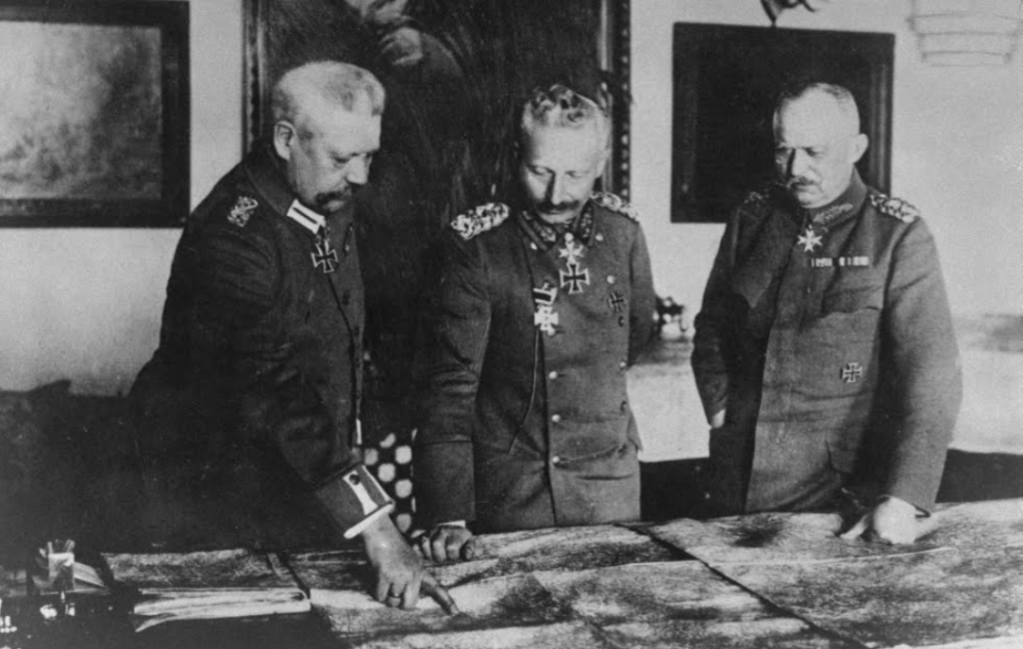
But despite such efforts disagreements on tactics continued. Some of them, especially on a less rigid form of defence, emerged at an important conference of senior staff officers held by Hindenburg and Ludendorff in early September, shortly after they took command at OHL. Later in the month, OHL issued interim instructions as a temporary measure to bridge the differences of opinion. These stressed holding the front thinly and defending it by counterattack and defence in depth. They also emphasised the need for counter-battery work, while avoiding the linked but thorny question of control of heavy artillery. Army Group Rupprecht reported in late September that First and Second Armies had different approaches to this, the former centralising heavy artillery control on Gruppen, the latter devolving it to divisions. Views differed too on how to handle defence in depth and the two forms of counterattack.[10]
In order to eliminate the damaging friction caused by these continuing disagreements and to ensure uniform training of commanders and units, OHL pushed forward a large-scale revision of defensive doctrine. This did not emerge from a vacuum. Even before Hindenburg and Ludendorff arrived, OHL had begun to supplement and update the doctrine issued in October 1915 with a new series of manuals entitled ‘Regulations for trench warfare for all arms’ [Vorschriften für den Stellungskrieg fùr alle Waffen]. Under Hindenburg and Ludendorff, OHL expanded the series. It was intended to contain all the information needed to understand the different arms of service and all-arms co-operation. By the start of the spring battles in April 1917, manuals had been published or updated covering command in trench warfare, construction of field defences, infantry and artillery co-operation with aircraft, communications, trench mortars and close combat weapons[11].
The most important of these manuals were Part 8 in the series, ‘Principles for the conduct of the defensive battle in trench warfare’ [Grundsätze fùr die Fùhrung in der Abwehrschlacht im Stellungskrieg, hereafter ‘Defensive battle’], issued on 1 December 1916; and to a lesser extent Part 1a, ‘General principles of field fortifications’ [Allgemeines ùber Stellungsbau] of 13 November, a revision of an earlier manual. Three further editions of ‘Defensive battle’ were issued, in March and September 1917 and again in September 1918, as well as a ‘Special manual’ [Sonderheft] in June 1917 and numerous other amendments. ‘Field fortifications’ was updated in August 1917 and August 1918.
The issuing of successive editions of ‘Defensive battle’ is important, because scholars have not always sufficiently recognised the major differences between them. This has tended to give the impression of tactical development which after initial resistance was smoother and more uniformly accepted in the army than was actually the case. It also blurs the gap between doctrine and what happened in reality. For instance, G. C. Wynne cited many specialised defensive terms in the opening discussion of the new tactics in his influential If Germany Attacks, but very few appear in the first or second edition of ‘Defensive battle’.[12]
Tactical experts and historians regard ‘Defensive battle’ as a turning point, so it is odd that none have worked on the actual first edition of December 1916. The officer who produced a research paper comparing different editions of ‘Defensive battle’ for the central German military history organisation, the Reichsarchiv, was unable to find a copy of the first edition. He relied instead on a draft written by General Maximilian Ritter von Höhn, one of the officers involved in drawing up the new doctrine. The German official history ‘Weltkrieg’ based its description of ‘Defensive battle’ on the second edition of March 1917.[13] Anglophone scholars have relied on this edition too as it was the first to be captured and translated by the British.[14] At least one copy of the first edition does in fact exist.[15] By comparing this with the Reichsarchiv research paper and the second edition, we can examine the evolution of doctrine in some detail. Work on the first edition began in September 1916 under the direction of Oberstleutnant [Lieutenant-Colonel] Max Bauer of OHL. ‘Weltkrieg’ gives most of the credit for producing the final draft to his subordinate Hauptmann [Captain] Hermann Geyer, adding that Höhn had played a temporary role as a consultant. Bauer himself accorded Höhn a larger role since he had written the text which provided the basis for the final document.[16]
Hòhn’s involvement is important in understanding the dynamics of the drafting process. He was a field artillery officer in the Bavarian army, with experience of commanding heavy artillery. Having trained as a general staff officer, he was posted twice to the Great General Staff in Berlin. He commanded 6th Bavarian Infantry Division from 1913 to early 1915 and then became Third Army Chief of Staff. He was well thought of, and had an ability to process and apply lessons learned. He was removed from his Third Army post in September 1915 after recommending withdrawal in the initial stages of the French offensive. The Army commander thought he had been scapegoated.[17] Hòhn’s next appointment, as commander of 2nd Guard Infantry Division, bears this out: for a Bavarian to command a Prussian Guard division was a unique distinction.[18] In summer 1916 he took command of 6th Bavarian Infantry Division again and led it through both Verdun and the Somme. The division was heavily engaged when on 25 September Höhn was urgently summoned to OHL, initially simply to discuss artillery–air force co-operation.[19]
Hòhn’s secondment to OHL at this critical moment is one sign of the importance attached to drafting the new manual. His experience and strengths clearly qualified him for this work. OHL presumably hoped he would lend credibility to the process. Bauer and Geyer had little combat experience, and there was a danger that the manual would be seen as mere theory; there would shortly be mutterings about the young theoreticians around Ludendorff and the excessive paperwork they caused.[20] The German army prided itself on its practical approach to problem-solving: ‘Situations which arise in war are so varied and change so quickly that it is impossible to lay down binding rules… Formulas fail’.[21] OHL may well have seen Hòhn’s up-to-date experience commanding a division as a way of selling the new doctrine to other senior officers. Although we do not have a copy of Hòhn’s draft, we can deduce its overall thrust from the Reichsarchiv study. The draft contained all the basics of what we now know variously as mobile defence, elastic defence or defence in depth (though these terms do not occur in the first two editions of ‘Defensive battle’). The main points were that the division assumed tactical control of the all-arms battle, which was to be fought around rather than in the front line. The forward lines were to be thinly manned, and defence was to be in depth. Temporary withdrawal from the forward lines was permissible provided that by the end of the battle the original positions had been recaptured. If positions had been lost, commanders should consider whether recapturing them was worth the cost in men and matériel. The divisional artillery commander assumed control of all artillery allocated to the division.

The finalised first edition of ‘Defensive battle’ included all these points but added further explanation. It also gave more explicit instructions on conducting the infantry battle and on artillery fire. Importantly, unlike Höhn’s draft it described in detail the role and operations of the air force; it added new sections on training, railways and roads; and it gave a fuller description of logistics. Two significant points emerge from this analysis. First, whereas Höhn’s draft was in effect a traditional operational manual, the finalised edition was an instruction on how to conduct modern defensive battle. Second, although commentators at the time and present-day writers describe the resulting tactics as new, both Höhn’s draft and ‘Defensive battle’ show much continuity with what had gone before. The October 1915 instructions had begun the stress on deployment in depth.[22] Above all, ideas on mobile battle and artillery organisation had evolved steadily during the Somme. ‘Defensive battle’ was new doctrine in the sense that there had been no agreed principles on how to conduct such a battle. We should therefore see it as codification of existing practice rather than a radically new departure. It was also new in that its focus was on the all-arms battle at divisional level. The pre-war army was well aware of the principle of all-arms battle, but no specific regulations on it had been issued nor had it been adequately instilled by training.[23]
Units were soon referring to ‘Defensive battle’ to explain, simplify and supplement their orders.[24] However there was also resistance to the new tactics. Hindenburg later explained the risk in making tactical changes during war. There was the usual problem of overcoming conservatism and misunderstanding which made even peacetime changes problematic; in addition the more flexible tactics placed heavier demands on the courage and skill of the troops, at a time when the quality of the army had declined.[25] Ludendorff described a furious controversy in OHL over precisely this point. When he visited Western Front headquarters in mid-January 1917, he found that in general ‘Defensive battle’ was warmly welcomed but that the section on withdrawal was disputed. Resistance by senior officers to the more mobile infantry defence was significant enough to be mentioned in ‘Weltkrieg’.[26]
Two of the main resisters were Fritz von Below and Oberst [Colonel] Fritz von Loßberg. As commander and chief of staff of First Army, which had been in the most active area of the Somme battle, they had the latest army-level experience of defensive battle. Their views could therefore not be ignored, and OHL circulated their after-action report in January 1917. Much of it agreed with ‘Defensive battle’. But in the important area of temporary withdrawal from the front line, the two documents directly contradicted each other, with First Army repeating its Somme order that defenders must resist to the death if need be.[27] Furthermore, the new regulations on infantry training issued in February 1917 also insisted that infantry squads were to hold out to the last man.[28]
So a major report and a new piece of doctrine both contradicted an important part of ‘Defensive battle’. This contradiction has been seen as deliberate testing of ‘Defensive battle’ at Ludendorff’s request, and a sign of the intellectual flexibility of the German army.[29] Just possibly it reflects the different levels of the two doctrinal manuals – ‘Defensive battle’ was for all-arms commanders at divisional level, the infantry regulations for that arm alone up to regimental level. By the end of the year, OHL was instructing that giving up ground where necessary was a concept for commanders only; troops should simply be told to prepare to hold it.[30] But in wartime circumstances when simplification of methods was a priority, the differences between ‘Defensive battle’, First Army’s report and the infantry regulations were a potential source of doubt and confusion. Geyer later wrote that First Army’s line on rigid defence had seriously impeded the German conduct of war.[31]
The other significant area of dispute was the devolution of control of the battle from corps to divisions, including the main responsibility for artillery. We know that among the resisters on artillery devolution were Major Georg Wetzell, head of OHL’s operations section, and the commanders of Seventh Army and XIV Corps.[32] We do not know which other corps commanders resisted this devolution, but we can see striking personnel changes at this period. When Hindenburg and Ludendorff took over OHL in August 1916, 18 of the 40 corps commanders in place at the outbreak of war still held their original jobs. Between then and the opening of the Entente spring offensive in April 1917, 13 of them – one-third of the corps commanders on the Western Front – moved to other jobs or were sacked. We cannot tell if this was a deliberate clear-out, but the removal of so many of the original corps commanders was certainly convenient in terms of breaking any resistance to the new tactics.[33]
OHL knew that to make the new doctrine reality, it needed to be inculcated by training. Shortly after ‘Defensive battle’ was issued, OHL ordered the establishment of courses to test the tactics and to train the division-level officers who would implement them.[34] The first course was piloted by Army Group Rupprecht in February 1917. Soon after, a similar course was introduced in Army Group Crown Prince. Courses lasted for a week and consisted of classroom explanation with practical demonstrations on an exercise ground. 60–100 officers attended each course. They were mainly divisional and brigade-level commanders and staff officers from Western Front units; but officers from the Eastern Front, OHL, Ministry of War, the Navy and allied armies also attended.[35] The courses acted as a link between current practice and doctrine. Students were expressly encouraged to discuss their experiences and make proposals about the new tactics. Courses were adapted as experience accumulated. In particular, at about the time they started, the Germans captured a French order explaining the tactics of the forthcoming offensive. Teaching students how to defeat these then became the main subject on the course. OHL students, including Geyer, could keep up to date with best practice as they were developing doctrine.[36]
It is clear that these courses were important to OHL. In Army Group Rupprecht, a reinforced infantry division demonstrated the tactics. The choice of the first course leader, General Otto von Moser, was also significant. From his pre-war and wartime career, he had experience in explaining theory, commanding troops of different qualities in different situations and winning a recent defensive action on the Somme. Like Höhn he added credibility to the new doctrine and was soon given a corps command, a sign of high-level approval of his work.
Four courses had been held in the Army Group Rupprecht school by the opening of the Battle of Arras, and three in Army Group Crown Prince by the start of the Nivelle Offensive. 500–600 officers may have been trained by mid-April 1917. This output was impressive, but two questions arise about the practical effect of these courses by the time the Entente offensive began. First, the subject matter was complex and the courses short. Moser commented that the new defensive tactics placed much higher demands on divisional commanders, because they now carried the main responsibility for the battle. Many of them had only recently assumed command. They had previously led single-arm brigades, which tended to instil a certain narrowness of vision. Moser stressed during the courses that divisional commanders must constantly concern themselves with all-arms co-operation and training.[37] They were aided by their general staff officers, but there were concerns as to their lack of experience too.[38]
This leads to the second question: even assuming the students absorbed the course content, to what extent were they able to make use of their new knowledge in the short time before the Entente offensive began? The first course ended on 16 February, and the bombardment for the battle of Arras began on 4 April, only seven weeks later. Subsequent courses had even less time before battle. Nor were they taking place in a vacuum. Fighting continued on the Somme in February. Even more important, preparation for and implementation of the withdrawal to the Hindenburg Line took up a great deal of mental energy and time until it was successfully completed on 18 March. Evidence from later in 1917 suggests that months after the courses began the new tactics were still not being completely implemented.
It was clear that the army would require considerable training if it was to adopt the new tactics successfully. OHL and army groups attempted to ensure that divisions got at least three weeks’ training time.[39] But the same events which took up the attention of commanders as well as assignments to labour on defences and the severity of the winter all disrupted the programme. 50th Reserve Division reported that its training for the new tactics had been undesirably limited. 17th Reserve Division was still issuing orders based on the old tactics as late as 28 March, just two weeks before it faced the British attack at Arras.[40] At the other end of the scale, 3rd Bavarian Infantry Division had been practising automatic counterattacks for months. Three divisions had acted as demonstration units for the command courses, and a fourth had just started.[41] These stints were generally short but at least gave the divisions a practical understanding of the new tactics which they would shortly employ in battle. The official verdict was that a considerable number of divisions on the Western Front and a few of those arriving from the east did receive a block of three weeks for rest and training.[42]But there were clearly substantial differences between divisions.
On 1 March 1917, OHL issued an updated version of ‘Defensive battle’. Its title called it a reprint of the December edition. But it included important changes and considerable extra detail, and was therefore actually a second edition. Input for its drafting came from teams of experienced officers and from Moser’s command course. Moser’s point about the inexperience of many divisional staffs in all-arms warfare may explain the extra length of the new edition. Much of this comprised added clarification of the principles involved. The edition included more guidance on how artillery and infantry should conduct the defence, with greater emphasis on immediate counterattacks. It was couched more in the form of orders than the recommendations in Höhn’s original draft – possibly reflecting greater confidence that the principles it was expounding were correct.[43]
Given the resistance to the new tactics, the most important changes in content related to control of artillery and withdrawal. The second edition confirmed the subordination of most artillery to divisions by further restricting corps control and the role of senior corps artillery officers. On withdrawal, both first and second editions authorised moving to the side, rear or forwards to escape enemy fire or attack, provided the original position was subsequently reoccupied. The second edition expressed a strong preference for moving forward, with detailed reasons, and stressed that higher-level commanders were not to hold ground rigidly. On deciding whether to evacuate a position permanently, the first edition had placed the responsibility on division, or in urgent cases brigade or regiment commanders. The second edition moved the responsibility upwards, to army or corps; and divisions could decide only in the most urgent cases. This shift illustrates trench warfare’s erosion of the traditional mission command, in which commanders explained their intention and allocated missions but left subordinates free to decide how to execute the mission. And we should probably see changes to both forms of withdrawal as a means of placating resistance to the new tactics.[44]
Note:
- This section draws heavily on Robert T. Foley, ‘Learning War’s Lessons: The German Army and the Battle of the Somme 1916’, Journal of Military History, 75/2 (2011), pp. 471-504. For a recent account of German tactical development, see Anthony Cowan, ‘Genius for War? German Operational Command on the Western Front in Early 1917’, Ph.D. thesis (King’s College London, 2016), Chap. 7.
- Bundesarchiv-Militärarchiv (BA/MA), PHD7/1, OHL circular, ‘Gesichtspunkte für den Stellungskrieg’, Nr. 7563 r., October 1915, pp. 2-3.
- Hauptstaatsarchiv Stuttgart (HSAS), M660/038 Bü 16, Second Army order, Ia Nr. 575 geh., 3 July 1916 and First Army order, Ia Nr. 1438 geh., 22 October 1916.
- Jakob Jung, Max von Gallwitz (1854–1937): General und Politiker (Osnabrück: Biblio Verlag, 1995), pp. 74-5, quoting senior Bavarian officers
- Cowan, ‘Genius for War?’, pp. 44-46.
- Foley, ‘Learning War’s Lessons’, p. 504.
- Christian Stachelbeck, ‘“Lessons learned” in WWI: The German Army, Vimy Ridge and the Elastic Defence in Depth in 1917’, Journal of Military and Strategic Studies, 18/2 (2017), p. 127.
- Generallandesarchiv Karlsruhe (GLAK), 456 F1/525, First Army report, ‘Erfahrungen der 1. Armee in der Sommeschlacht 1916. I: Taktischer Teil’, 10 (hereafter ‘Erfahrungen der 1. Armee’). HSAS, M660/038 Bü 16 has examples of the Army’s orders.
- Foley, ‘Learning War’s Lessons’, p. 481, n. 32
- Reichsarchiv, Der Weltkrieg 1914 bis 1918: Die militärischen Operationen zu Lande, Vol. XII: Die Kriegfùhrung im Frùhjahr 1917 (Berlin: E.S. Mittler, 1939), pp. 29 and 32¬37.
- Weltkrieg, XII, pp. 38-39; BA/MA, PH3/28, folio [f.] 22, OHL to Third Army, II Nr. 38642 op., 3 November 1916 and Bauer to Army Group Crown Prince, 13 November 1916
- G. C. Wynne, If Germany Attacks: the Battle in Depth in the West (Brighton: Tom Donovan, 2008; first edition London: Faber, 1940), pp. 102-109.
- BA/MA, RH61/291, Oberstleutnant Engelmann unpublished research paper, ‘Grundsätze fùr die Fùhrung in der Abwehrschlacht im Stellungskriege’, n.d., p. 1 (hereafter ‘Engelmann paper’); Weltkrieg, XII, p. 38.
- General Staff (Intelligence), SS. 561: The Principles of Command in the Defensive Battle in Position Warfare (Army Printing and Stationery Service, 1917).
- HSAS, M660/037 Bü 44, Chef des Generalstabes des Feldheeres, Vorschriften fùr den Stellungskrieg fùr alle Waffen. Teil 8: Grundsätze fùr die Fùhrung in der Abwehrschlacht im Stellungskriege. Vom 1. Dezember 1916, (hereafter ‘Abwehrschlacht’, December 1916).
- Weltkrieg, XII, p. 32 fn. 2; Oberst Bauer, Der große Krieg in Feld und Heimat, 3rd edition, (Tübingen: Osiander’sche Buchhandlung, 1922), pp. 118-119
- Generaloberst von Einem, Erinnerungen eines Soldaten 1854–1933 (Leipzig: K.F. Koehler, 1933), pp. 182 and 185.
- Fritz von Loßberg, Meine Tätigkeit im Weltkriege 1914–1918 (Berlin: E.S. Mittler, 1939), p. 167.
- Bayerische Hauptstaatsarchiv Abteilung IV: Kriegsarchiv, München (KAM), HGr. Rupprecht neue Nr. 31, OHL to Army Group Rupprecht, 2 No. 35708 op., 25 September 1917.
- Max von Gallwitz, Erleben im Westen, 1914–1918 (Berlin: E.S. Mittler, 1932), p. 158.
- Kriegsministerium, D.V.E. Nr. 53. Grundzüge der höheren Truppenführung vom 1. Januar 1910 (Berlin: Reichsdruckerei, 1913), p. 9.
- BA/MA, PHD7/1, OHL circular, ‘Erfahrungen aus den letzten Kämpfen’, Nr. 17411 Op., [n.d.], p. 26.
- Hew Strachan, The First World War, Vol. I: To Arms (Oxford: Oxford University Press, 2003), pp. 238-239.
- GLAK, 456 F1/374, Seventh Army to its Gruppen, ‘Vorbereitungen für die Abwehrschlacht’, Ia Nr. 155/Dez. 16, 28 December 1916.
- Marshal von Hindenburg, Out of my Life (trans. F. A. Holt) (London: Cassell, 1920), pp. 262-263.
- General Erich Ludendorff, My War Memories 1914–1918 (London: Hutchinson, 1919), p. 387; BA/MA, Geyer papers, RH61/924, f. 32, OHL memorandum, ‘Gesamteindrücke der Westreise’, 21 January 1917; Weltkrieg, XII, p. 32.
- ‘Erfahrungen der 1. Armee’, p. 63.
- Kriegsministerium, Ausbildungsvorschrift für die Fußtruppen im Kriege (A.V.F.) (Berlin: Reichsdruckerei, 1917), pp. 178 and 226.
- Foley, ‘Learning War’s Lessons’, p. 503; Wynne, If Germany Attacks, p. 111.
- Jonathan Boff, Winning and Losing on the Western Front: The British Third Army and the Defeat of Germany in 1918 (Cambridge: Cambridge University Press, 2012), p. 167.
- Matthias Strohn, The German Army and the Defence of the Reich: Military Doctrine and the Conduct of the Defensive Battle, 1914–1939 (Cambridge: Cambridge University Press, 2011), p. 55.
- Bauer, Der große Krieg, p. 119; GLAK, 456 F1/374, Seventh Army to OHL, Ia Nr. 61, 10 December 1916; Gallwitz, Erleben im Westen, p. 152.
- Figures calculated from author’s database.
- Otto von Moser, Feldzugsaufzeichnungen 1914–1918 als Brigade-, Divisionskommandeur und als kommandierender General, 3rd edition, (Stuttgart: Belser, 1928), p. 266.
- Weltkrieg, XII, p. 59; Moser, Feldzugsaufzeichnungen, pp. 271-276
- HSAS, GU117 Bü 362, General Karl Ritter von Wenninger, ‘Französisches Durchbruchs-Verfahren’, lecture to the fourth divisional command course in Valenciennes, 28 March–3 April 1917, p. 7, and ‘Einleitender Vortrag des Kursleiters’, lecture to the fifth divisional command course in Valenciennes, 14–16 April 1917 (hereafter ‘Einleitender Vortrag’), pp. 2-4.
- Moser, Feldzugsaufzeichnungen, pp. 270-271. Christian Stachelbeck, Militärische Effektivität im Ersten Weltkrieg: Die 11. Bayerische Infanteriedivision 1915 bis 1918 (Paderborn: Schöningh, 2010), p. 182 quotes a divisional commander and his general staff officer commenting that the material on the Army Group Crown Prince course was actually rather simple.
- Hermann von Kuhl, Der deutsche Generalstab in Vorbereitung und Durchführung des Weltkrieges, 2nd edition (Berlin: E.S. Mittler, 1920), p. 187.
- Weltkrieg, XII, p. 55.
- KAM, AOK 6 Bd. 419, 50th Reserve Division, I Nr. 1764/17, 8 June 1917; BA/MA,PH10-II/97, 76th Reserve Infantry Regiment order, I/1444, 10 March 1917 and 17th Reserve Division, Abt. I Nr. 815 geh. and 816 geheim, 28 March 1917.
- ‘Einleitender Vortrag’, p. 2.
- Weltkrieg, XII, pp. 55-56.
- Stachelbeck, Militàrische Effektivitàt, p. 164 fn. 564; Moser, Feldzugsaufzeichnungen, pp. 271-272; Engelmann paper, pp. 1-2.
Autore: Tony Cowan
Fonte: ‘The Introduction of New German Defensive Tactics in 1916-1917’, British Journa! for Mi!itary History, 5.2 (2019), pp. 81-99.
Approfondimenti:
Categorie
Tags
 militartis.com
Lascia un commento