
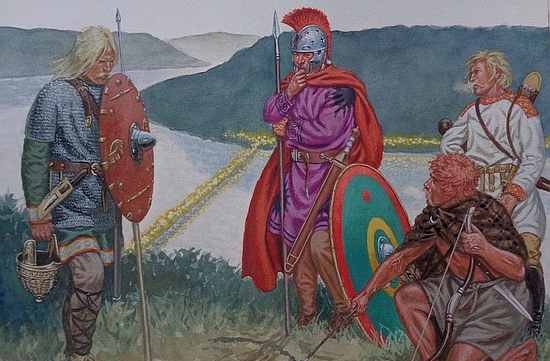
Until the 4th century AD, the entire Roman army could be called a border army, since most of it, starting from the time of Augustus, was located along the borders, and there was a clear tendency to attach individual legions and cohorts to certain border provinces. That is, we can say that the border guard system began to take shape in the first centuries of the Empire and, as Tacitus testifies, this system was defensive in nature, manifested in the readiness to preserve existing borders rather than expand them. This led to the fact that legions and auxiliary units responsible for preserving a certain section of the border settled on the ground, camps turned from temporary camps into permanent fortresses, and the entire army could rightfully be called a border army.
The essence of the border deployment of military units was the fastest possible response to barbarian breakthroughs of the border or the prevention of such breakthroughs. High mobility was ensured not so much by the legions themselves as by vexillations – special-purpose detachments temporarily allocated from the legions. It was assumed that in response to a barbarian breakthrough of any section of the border, the military command of the province would have time to pull together a sufficient number of troops from neighboring border fortifications to the site of the breakthrough to repel the enemy. At the same time, of course, a simultaneous offensive on several sections of the border was not envisaged. In the first centuries of the Empire, such a system justified itself, since the barbarian tribes, suppressed by the foreign policy of conquest of the Roman emperors, did not show dangerous activity, but already under Marcus Aurelius, features of a crisis began to appear in the Roman military and defensive system. The pressure on the borders of the Empire increased and the once reliable defense of the state began to crack at the seams. Septimius Severus attempted to adapt the Augustan system to modern conditions and make it capable of repelling enemy attacks on one section of the frontier without significantly weakening other sections. To this end, he built and strengthened fortifications in Africa, on the Rhine, the Danube, and on other frontiers throughout his reign. Seeing Parthia as the most dangerous enemy, he reorganized the eastern frontier, creating a new province of Mesopotamia and garrisoning it with two of the three new legions he had raised.
The province of Syria was significantly restructured, and the number of troops in Italy, which constituted the strategic reserve of the Roman army, was more than doubled. Like Augustus and Hadrian, Septimius based his frontier strategy on defense rather than offense. For a time, he succeeded in stabilizing the borders of the Empire, and his activities served as an example for Diocletian, who faced the crisis of the late 3rd century. With the same difficulties. The latter even surpassed Severus in the scope of his actions. He also paid close attention to strengthening the border fortifications, building new roads and fortresses, and reorganized many border provinces, placing a garrison of two legions in each, for which he had to almost double their number. But, in addition, Diocletian initiated the creation of a reserve system – a field army. The basis of this new type of troops was the personal guard of the emperor, whose task was not just to protect the royal person, but also to directly participate in military operations, since at that time all significant military campaigns were carried out under the personal leadership of the Augusti and Caesars. Military practice clearly demonstrated the full value of such a reserve, so that under Constantine the process of active formation of units of the field army began. In 325, this process finds its legal registration, when by a special decree of the emperor, units of the field army are officially dissociated from the units stationed at the border.
The field troops were recruited primarily from the border army, especially since many years of experience in using vexillations had already been gained. The strongest and most combat-ready detachments, individual soldiers who stood out for their strength and height, were selected for the field army. In the same way, when recruiting new recruits, the strongest recruits were enrolled in the field army, while the border units received inferior material. As a result of these measures, the border army turned into a second-rate army, retaining a certain combat capability, but significantly inferior in strength and importance to the field army.
The large number of military units occupying different places in the hierarchical ladder of military service is generally a characteristic feature of the late Roman army. Alongside the old legions and auxiliary troops, separate independent detachments now appeared, differing in their function, composition and status. The principle of forming units according to the type of weapon or a certain type of activity became widespread, so that entire units of archers, slingers, scouts, pipers, vanguard fighters, carriers, guards, etc. appeared on the military arena of the 4th century . The number of such units reached 20% of the entire personnel of the army.
Another feature of the late Roman army is the growing role of the cavalry, which is organizationally separated from the legions and turns into an independent tactical unit. Here it is necessary to recall that until the 4th century AD the Roman army was not distinguished by a strong cavalry. The Romans were poorly trained in horse riding, rode poorly, often tying themselves to the horse, preferred to dismount in battle and looked at the horse mainly as a means of transportation. Organizationally, the cavalry was part of the legion, but, at least until the beginning of the 3rd century , the riders did not form separate detachments, but were assigned to separate centuries. In the legion, the cavalry performed mainly the function of mounted couriers, but in battle or on the march it acted as a combat unit, sometimes together with the cavalry of auxiliary detachments. In the legion’s battle formation, the cavalry was positioned in small detachments in three ranks either behind the infantry or on its flanks.
The emperors tried to compensate for the shortcomings and weaknesses of the Roman cavalry itself by using barbarian cavalry, which was part of the auxiliary detachments. As long as the Roman infantry, due to its discipline, regular training and superior organization of the standing army, had an advantage over the enemy forces, such an organization of troops suited the emperors perfectly. But as soon as the legions, the main striking force of the Roman army, began to lose their advantage over the enemy infantry, the situation changed dramatically. The outcome of the battle was now decided by the cavalry, and in this component of military organization the Roman Empire was significantly inferior to its opponents and, first of all, to the excellent horsemen of the Germanic tribes and the famous heavily armed cavalry of the Persians. In addition, faced with pressure from the barbarians along the entire length of the Rhine and the Danube, the Empire was no longer satisfied with local garrisons, which were unable to cope with their duties due to the large number of enemies. The difficulties of recruiting and the extended front forced the emperors to compensate for the numerical disadvantage of their forces by their greater mobility. In the infantry, this was expressed in the appearance of lightly armed mobile detachments, which Hadrian was the first emperor to use to cover gaps in the defense of the limes. In the cavalry, this process was expressed first in the organizational formation of the legion’s cavalry into turmae – cavalry detachments of 32 people each under the command of a decurion, and then, under Aurelian, in the creation of legion cavalry detachments separate from the infantry, which received a certain independence in combat.
The emerging trend of gradually replacing heavily armed infantry with lightly armed troops and cavalry led in the second half of the 3rd century to the creation of an entire cavalry army. The core of this cavalry was the elite force of unarmored horsemen from Dalmatia, whose military prowess was unanimously praised by later writers. At the same time, in response to the constant threat of a breakthrough of the Syrian limes by the Sassanids, heavy cavalry was also developed, the so-called cataphracts, whose characteristic feature was the presence of heavy defensive armor for horse and rider and a long lance as the main offensive weapon.
During Diocletian’s large-scale military reform, considerable attention was paid to the further development of the cavalry. In the West alone, the number of horse squadrons was doubled. In the East, at least five craft workshops were built to manufacture weapons and armor for these units. Constantine introduced a special tax to provide horses for military needs and, by providing special benefits, encouraged recruits who brought two horses or a horse and a slave.
The cavalry units that were formed were not homogeneous; they differed from each other in ethnic composition and weapons. Here, the characteristic feature of the entire late Roman military organization was manifested: to fight against the enemies of the Roman Empire with their own weapons. Such copying of enemy weapons was far from always justified and often led the Romans to heavy defeats.
By the beginning of the 5th century, the total number of Roman cavalry, at least the field army, was 27-30 thousand people and it firmly established the status of an elite branch of the military. In the hierarchical list of military units compiled at that time, cavalry units always rank first. Serving in the cavalry was considered a matter of personal prestige.
The Diocletian-Constantine military reform and the major restructuring of the Roman armed forces associated with it (the creation of a separate field army, the organizational structure of border units, the separation of cavalry from infantry) could not but affect the structure of military command. The most general expression of the changes was the complete separation of military and civil authority in the border provinces, as well as the disappearance of the rank of centurion. And if the first is perceived as an undoubtedly positive phenomenon that allowed for an increase in the level of troop management, then the second is often associated with a general crisis in Roman military art, a radical departure from the old principles of military organization. Such a point of view seems overly dramatized. The main reason for the disappearance of the rank of centurion is not the rejection of the traditions of Roman military training caused by the barbarization of the army, but the unification of command positions for most units of the late Roman army. In terms of composition, weapons, and numbers, the legions became on the same level as auxiliary detachments. Numerous military units actually differed little from each other. It is not without reason that Ammianus Marcellinus, and in the 5th -6th centuries, official documents replace various names of combat units with the faceless term “numerus”. The unification of units also led to the unification of command positions. Thus, we should not talk about the disappearance of the rank of centurion, but about its renaming, which, by the way, is confirmed by Vegetius (Veget., II, 8). In place of the centurion, who commanded individual centuries, there is a centurion – a centenarius. At the same time, in no case can we talk about the oblivion of Roman military training. These functions of the centurion passed to the campiductor, whose duties included training recruits and supervising soldiers during sapper work.
In general, the command of the late Roman army can be divided into three large groups. The first is made up of junior commanders who led units numbering from 10 to 300 people or who performed special duties in protecting, supplying and training these units. The second group includes senior commanders: tribunes, prepositi, prefects, who headed individual Roman units from cohorts and alae to auxiliary detachments and legions. The third group is made up of senior commanders: duxes, counts and military masters, who exercised general leadership over the troops stationed in their military districts.
All these groups were not isolated from each other, so that a soldier who began military service as a private could go through all the official steps and reach the highest rank. Promotion was accompanied by a correspondingly increasing salary, the basis of which was not money with low purchasing power in the conditions of inflation, but rations for people and fodder for horses.
What were the conditions for promotion, whether a certain minimum of years was required to correct a particular position, is unknown. Only complaints from the Anonymous Reformer about the extremely slow career growth of soldiers, which was very discouraging for volunteer recruits, have reached us.
Therefore, he advised to make wider use of the practice of transferring people from one unit to another where there were vacancies in command positions. In earlier times, such transfers were common, but in the 4th century such a practice was no longer encouraged. The government was interested in keeping experienced commanders in their posts and did not strive for their career growth, avoiding replacing them with inexperienced personnel.
A kind of step between junior and senior commanders was the corps of protectors. The most distinguished soldiers were enrolled in it and it was part of the emperor’s guard, which greatly raised its status. Protectors were assigned by the emperor to military masters and other commanders, in relation to whom they played the role of deputies, simultaneously performing various special duties. They were sent to round up vagrants and sons of veterans evading military service, escorted recruits, patrolled the roads, carried out customs service, were used to arrest important persons and escorted them to their destination. In 359, a group of tribunes and protectors was entrusted with overseeing the construction of fortifications along the right bank of the Euphrates.
The term of service in the protector corps was obviously not established, but, as a rule, it took at least five years to obtain the position of senior commander. Although often a soldier’s service ended in the post of protector and he received a resignation from the emperor personally. However, it seems that the protectors themselves did not always strive to get an appointment to the active army. This is especially true at the end of the 4th – beginning of the 5th century , when the power of the Empire significantly weakened and defeat followed defeat. Now the pinnacle of a protector’s career was the dream of spending their entire service within the protector corps, reaching its very heights and then retiring.
On the whole, the institution of protectors undoubtedly played a positive role, contributing to the better preparation of command personnel for the Roman army, and this role would have been even more significant if the negative phenomena that were characteristic of the entire life of late Roman society had not had an effect here. This refers to the then flourishing bribery, corruption, patronage, and nepotism. All this led to the fact that people who not only had not distinguished themselves in any way, but had never even served in combat units, were often nominated for the protectorate. Thus, Julian in his throne speech, as reported by Ammianus, solemnly promises ” not to allow honorary positions to be obtained through secret intrigues” and decrees that henceforth ” neither a civil official nor a military commander will receive a promotion on any recommendation other than their own merits” ( Amm . XX, 5, 7). In 364, Valentinian introduced an official distinction between those who joined the corps after long service and those who took advantage of the necessary connections and protection. However, this could hardly fundamentally change the established practice, and the emperors were forced to put up with these abuses.
The senior commanders of the late Roman army included the praepositi, tribunes and prefects. In their social composition, they were obviously even further removed from the small landowners and the rank and file of soldiers than the corps of junior commanders. The institution of protectors, which supplied a significant portion of the command staff, was already permeated with the spirit of corruption and it was not easy for ordinary soldiers to withstand competition with the sons of rich and noble dignitaries. This was even more typical for obtaining the rank of tribune. Many were discharged as tribunes without prior service in the corps of protectors, while some, on the contrary, only began their service with this rank. Obviously, ordinary soldiers were doomed to play a subsidiary role in relation to noble warriors and if they nevertheless achieved the rank of tribune, then, as a rule, in secondary border units. An ordinary soldier had to have extraordinary talent to achieve the highest military ranks. Only a few such cases are known.
Ammianus mentions four: Gratianus the elder, who, after passing through the ranks of protector and tribune, became count of Africa; Maurus, the standard-bearer of the Petulants, who crowned Julian and became count of military affairs in 377; Vitalian, who ended his career as count in Illyricum; and Arbetio, who became master of the horse during the reign of Constantius II. In most cases, however, it took too long for a private soldier to pass through all the steps of the career ladder, and it often happened that he reached the rank of tribune at a fairly advanced age and was forced to end his service there.
As for the ethnic composition of the senior command, the emperors willingly took non-Romans into service. Ammianus, speaking of the commanders of barbarian detachments accepted into Roman service, does not miss the opportunity to make an ironic remark that “ they were all Romans, which does not happen often in our time” ( Amm. XXXI, 16, 8).
By their position, senior commanders stood out sharply from the rank and file of soldiers and junior officers, clearly demonstrating connections with the wealthiest strata of Roman society. The pay for their service was 25 times greater than that received by ordinary soldiers. However, commanders never limited themselves to official salaries, and, taking advantage of their position, shamelessly robbed their subordinates, appropriating their rations. One form of extortion was the so-called stellatura, according to which soldiers gave up part of their provisions to the tribunes, buying themselves off from certain duties. In 406, a law was even passed allowing and regulating stellatura as a customary right of tribunes, allowing them to appropriate seven days’ rations for a year from their subordinates. Another law from 424 differentiates between the food allowance that counts, tribunes, or praepositus received by right of their office and what duxes and tribunes appropriated in some legal way for their own use.
Such legal methods included the widespread system of selling long vacations. A commander could bribe a soldier into going on vacation and at the same time receive his rations while he was at home. No less widespread were clever manipulations with the lists of personnel submitted to the central command apparatus. It was advantageous for commanders to inflate the number of soldiers serving under their command, receiving extra pay and rations for each ” dead soul . “
The greed and avarice of the commanders, according to the sources, were boundless. Themistius wrote that before Valens took matters into his own hands, many of the border units lacked arms and uniforms (Them. Or. X, 135-136 ). Libanius, in a speech of 381, paints a gloomy picture of the state of the troops. The soldiers, he says, were hungry, cold and penniless, since everything that the government sent them was shamelessly intercepted by the dukes and tribunes (Liban. Or. II, 37-39 ). Ammianus cites the case of the tribune Palladius, who in 366 was sent to distribute cash gifts from the government among the troops, but instead appropriated the money and even received a bribe from the Count of Africa Romanus (Amm. XXVIII, 6, 12; 17, 19). And if for ordinary soldiers military service was, as a rule, a heavy burden, then for senior ranks it was profitable, honorable and attractive.
Until now we have been talking about commanders of individual units that constitute one combat unit in organizational terms. The next type of command is of a different qualitative level, when several units of both cavalry and infantry were united under the command of one person, forming a single large military unit.
The Diocletian-Constantine military reform completely changed the structure of the high command, and the praetorian prefects were replaced by duxes, counts, and military magisters. The formation of the military magistracy lasted for almost the entire 4th century , right up until the Battle of Adrianople in 378. Moreover, a characteristic tendency of this process was the gradual fragmentation of large military-defensive complexes that had formed in the emergency circumstances of the 3rd century into smaller military districts. This was especially characteristic of the eastern half of the Empire, where the field army was divided into five approximately equal parts. Two were located in or near the capital and reported directly to the emperor. The other three were regional and were stationed on the eastern border, Thrace, and Illyricum. Each of these field armies was under the command of a magister utriusque militiae, who at the beginning of the 5th century had a vicar as his assistant. It is possible that all these masters were equal among themselves and that the eastern half of the Empire was thus characterized by decentralization of military command.
In the West, thanks to Stilicho, command was much more centralized. There was one magister peditum in praesenti, who clearly outranked the other magisters. The magister equitum in praesenti played only a subordinate role from the end of the 4th century , and the magister equitum per Gallias had, according to available sources, very limited military authority. In addition to the entire infantry of the field army, all the years, the entire fleet, and the entire subordinate army were subordinate to only one magister peditum. This difference between the military institutions of the Eastern and Western Empires is explained by the peculiarity of the historical situation that had arisen towards the end of the fourth century. But the remarkable fact is that the structure of the high command proved so flexible and universal that it was able to adapt and retain its significance despite all the cataclysms that the Empire experienced. In dealing with rapidly changing situations, the emperors never hesitated to modify the system of command if conditions required it. Even such a fundamental principle as the separation of military and civil authority could be cast aside, as happened in 354, when Seleucia, the metropolis of the province of Isauria, was besieged. After it became clear that the magister equitum et peditum per Orientem would not be able to come to the aid of the besieged city in time, the command was entrusted to the Count Nebridius, who had previously performed civil and not military duties. The emperors introduced new command positions and abolished old ones, dismissed commanders and then returned them to their posts, transferred them from one unit to another, not always taking into account the laws of the service ladder. The forms of military organization proposed by the Diocletian-Constantine military reform were improved and adapted to changing conditions, and one can only marvel at the energy and enterprise of the Roman emperors of the 4th century , who managed to delay the fall of the Empire, doomed to destruction by the very course of the historical process, for almost two centuries.
References:
Autore: Lazarev Sergey Alexandrovich (ЛАЗАРЕВ Сергей Александрович)
Fonte: Ancientrome
 militartis.com
Lascia un commento