
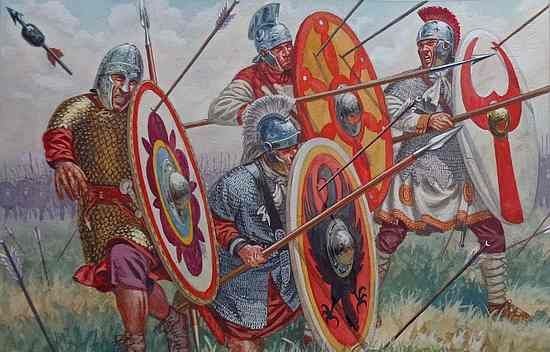
The economic crisis that struck the Empire in the 3rd century led to a sharp deterioration in the situation of all lower classes of the population and caused a number of powerful demonstrations of the masses in the provinces, Italy and in Rome itself. The deeper the process of development of the colonate, the enslavement of small free farmers and artisans, the wider the scale of the resistance of the lower classes. In these conditions, the role of the army as a punitive organ directed against the ” internal enemy” especially increased. Meanwhile, it was precisely at this time that the army, this basic element of the state apparatus, the main instrument of power of the slave-owning class, demonstrated its instability and disobedience to the central government. Military mutinies became a real sign of the times. The socio-economic crisis did not bypass the army, which was recruited mainly from small free landowners, that is, from the social stratum that most acutely felt the consequences of the economic decline. And although the reasons and nature of the military and peasant movements were in many ways different, the soldiers could not help but feel their involvement in the unfolding struggle between large and small landowners. To a large extent, this was facilitated by the principle of local recruitment, so that the soldiers could maintain relations with their fellow villagers. The semi-regular nature of the Bagaudae movement, which definitely had military skills, can be fully explained by the participation of veterans, and perhaps even regular army soldiers. It is no coincidence that after Maximian suppressed the Bagaudae movement in 286, a thorough purge of personnel was carried out in all Gallic garrisons, so that 200-300 people were executed at a time.
Of course, the role of the army in the movement of the oppressed masses cannot be overestimated, but the increasingly frequent cases of disobedience by the troops could not help but alarm the Roman government. In order to stop the undesirable contacts of the army with the population, it was necessary to oppose these forces. The economic basis for such opposition was state benefits and privileges granted to veteran and soldier landownership, and the social basis was the introduction and legal registration of hereditary military service.
As a veteran, the soldier received a number of important privileges, which varied from time to time according to the length of his service, his rank upon discharge, and the status of the unit in which he served. According to a regulation drawn up in 311, all veterans were exempt from the poll tax, with one who had served 20 years or was discharged due to injury receiving such an exemption for his wife as well, and one who had served a full 24 years obtaining an exemption for four family members. However, Constantine later reduced these privileges: exemption from the tax was granted only to the veteran and his wife, provided that he had served 24 years and was found unfit for service. In addition, veterans were exempt from public works and from any monetary taxes, and were granted the right to duty-free trade and to conclude transactions.
In addition to the reward that the soldier received upon discharge, he was given the freedom to choose: either to engage in trade, in which case he received a cash subsidy, which under Constantine amounted to 100 follii, or to cultivate the plot of land allocated to him, receiving a pair of oxen, 50 modii of seed grain and 50 follii for initial costs. Under Valentinian I, in the conditions of inflation, the issuance of a cash subsidy lost its meaning and instead they began to give double the amount of horned cattle and seed grain.
Economic support for veterans was not an innovation of the 4th century and was a concern for all Roman emperors. The privileges of veterans grew, shrank and changed depending on the conditions of the economic development of the Empire. In the 3rd century , the economic privileges of veterans were reduced in connection with the general tax policy of the Empire, which to some extent may explain the growth of discontent among the military. However, in the 4th century , judging by legal documents, the government’s efforts were aimed at improving the economic situation of veterans. These efforts were explained not only by the interest in having a stable source of recruits, but also by the desire to enlist the support of the military class in the fight against the enslaved population.
Hereditary military service also has its roots in earlier times. As early as the 3rd century, military service was an indispensable condition for the transfer of a veteran’s land plot from father to son. However, at that time it was more of an economic incentive than a legal obligation, and apparently the veteran’s son was not prohibited from leaving the canaba for the city, where he could become a craftsman or merchant. In the 4th century, the obligation of hereditary military service received legal form and was extended to all soldiers in the Roman army. In the texts of the corresponding imperial decrees, this obligation was justified by reference to the benefits and privileges that soldiers received upon retirement. Thus, a hereditary class of military men appeared in the Empire, which became the support of the Roman emperors.
Of course, even now veteran farmers have not ceased to feel the impact of the economic crisis, but their situation was incomparably better than that of simple peasants, who were completely deprived of any privileges. And former soldiers steadfastly held on to their rights, jealously guarding them from any attempts to violate what belonged to them. The emperors managed, if not to oppose, then at least to tear the soldiers away from the social strata from which they came. In the 4th century, cases of joint actions by soldiers and local residents are almost unknown to us.
At the same time, hereditary-compulsory military service obviously could not satisfy the Empire’s need for recruits. Moreover, the military reform conceived by Diocletian and Constantine, as well as the intensification of military operations, required a significant increase in the size of the army. Formally, the principle of universal military service for all Roman citizens continued to operate in the Empire, but in practice, due to the established political tradition, the army had long since turned into a permanent professional army, staffed by volunteers. The only mandatory condition for admission to service, in addition to physical characteristics, was free birth.
Until the 3rd century AD, the Empire obviously had no shortage of volunteers. Successful campaigns of conquest, the prospect of obtaining land and Roman citizenship attracted ruined or ruined small landowners. After the edict of Caracalla and with the ever-deepening economic crisis, the situation changed. Now, farming after military service no longer promised much benefit, and Roman citizenship only brought new hardships. And military service itself became more difficult and dangerous: the army was scattered outside the cities on remote borders, internecine strife forced military units to fight among themselves, and painful defeats from external enemies became more frequent. Service in the army brought neither honor nor respect, and if there were still volunteers, their desire was most likely explained by the desire to avoid the more difficult hardships of civilian life or the opportunity to profit at someone else’s expense.
Under these conditions, the emperors took advantage of the existing letter of the law and resorted to the forced conscription of Roman citizens, which constituted one of the distinctive features of the recruitment system of the Roman army in the 4th century AD. According to the new form of recruitment, the supply of recruits became a kind of property tax. The classical principle of personal military service was decisively revised. The credit for this innovation belongs to Diocletian.
From 293, according to the emperor’s decree, large landowners, who were subject to a sufficiently high tax, were obliged to supply one or more recruits. Smaller landowners united in special groups, making up together such a tax amount as to supply one recruit. High-ranking officials were not exempt from supplying recruits. Large landowners often resorted to tricks and sent as recruits not coloni registered to their land, but vagabonds or even sons of veterans, who were obliged to serve anyway. In order to stop such machinations, Valens introduced a strict registration of landowners and strictly collected from landowners for violations discovered.
In the conditions of economic growth experienced by the eastern provinces in the 4th century , many landowners were interested in preserving the workforce and therefore preferred to pay a ransom (aurum tironicum) of 36 solidi instead of supplying a recruit. However, this did not suit the state and in 362 Julian issued a special decree prohibiting senators from paying ransom payments, obliging them to supply recruits. However, already under Valens, this rule began to be abandoned, and by the end of the century, the right of senators to ransom was enshrined in laws.
Recruitment, according to Vegetius, was carried out carelessly and was full of abuses. Often landowners gave people to recruits who were burdensome to them. Such people obviously included obstinate, dishonest, sick or simply lazy people, but they could also be rebellious elements who rebelled against merciless exploitation and did not suit their masters. It is clear that the latter did not contribute to the strengthening of the Roman army.
At the same time, recruits had to meet certain requirements. In terms of age, according to the decree of 326, they could not be younger than 20 and not older than 25. Later laws extended the age limits, so that now the army took people from 19 years old, and for the sons of veterans who evaded service, the upper limit of conscription was 35 years. In addition to age and physical fitness, another professional requirement was the recruit’s height: the old minimum of 510/12 Roman feet was reduced in 367 to 57/10 feet. This reduction clearly speaks of the difficulties in recruiting an army that the Empire experienced in the 4th century. These difficulties become even more understandable if we consider that throughout the century the emperors waged a desperate fight against mass desertion. The forced nature of service in no way reconciled Roman citizens with it, who were well aware of all the negative aspects of military duties, which have already been discussed above. They resisted in every way, including self-mutilation, cutting off their thumbs. Cases of self-mutilation became especially widespread in the 80s and 90s after the catastrophic defeat of the Roman army at Adrianople. But now, more than ever, the Empire needed new recruits, so in 381 Theodosius ordered that the crippled, despite everything, be recruited for service, and taxpayers were to supply two cripples for one healthy one.
Decisive measures were also taken to combat desertion. In 368, Valentinian ordered Viventius, the praetorian prefect of Gaul, to burn deserters alive, which, however, did not solve the problem. A more effective system was to prevent desertion and create conditions that made it difficult for fugitives to hide. In 383, instead of a deserter, the actor who hid him on the estate without the knowledge of the master was burned. In the rescript of Gratian, Valentinian and Theodosius from 380, a slave who betrayed a soldier-deserter was granted freedom. A landowner was obliged to provide three new recruits for hiding one deserter. To facilitate the process of catching and identifying deserters, recruits were branded.
Recruitment was one of the main components of the Roman army’s recruitment system. But in addition to recruits, vagrants and people who did not belong to the college or other state organization were also called up for military service. They were periodically rounded up, sending detachments under the command of a protector or tribune. In emergency situations, the entire combat-ready population of the Empire, including monks, was called up for military service.
The path to the army was not closed to volunteers. Moreover, the government encouraged such a step, promising a reward of 10 solidi and allowing for the possibility of an earlier retirement. But it was hardly possible to expect, due to the above reasons, a large influx of volunteers. Only isolated cases of such are known.
By the end of the 4th century, the government began to limit the privileges of veterans and information about the heredity of military service disappeared. Apparently, at the turn of the 4th and 5th centuries, a decisive reorientation from internal sources of obtaining soldier material to external ones took place in the system of recruiting the Roman army. With the ransom money received from landowners, the government preferred to recruit mercenaries from barbarians, who were alien to the internal social conflicts of the Empire. Moreover, beginning in the 4th century , barbarians from the most wild tribes living outside the Empire began to be actively recruited into the army. The more barbarian the composition of the detachment, the higher its combat value was considered.
The barbarians themselves willingly went into Roman military service, and they were prompted to do so not by a ” natural warlike instinct ” , but by their way of life, determined by the level of development of productive forces they had achieved and the historical situation that had developed. Most of the tribes surrounding the Empire were in the process of disintegration of the tribal system, when the royal power of the barbarians still acted as the spokesman for the interests of all free members of the tribe interested in seizing land for settlement and military booty. At the same time, the property stratification among free community members, which marked the beginning of the process of class formation, led to an increase in the importance of military squads, with the help of which the nobility sought to strengthen their position. Military service with the Romans objectively contributed to the strengthening of the positions of the squad members and the nobility, introducing the barbarians to the more developed Roman culture and generously paying for military services. The stabilization of military-tribal unions of barbarians and the desire of tribes, in contrast to previous raids, to settle on the territory of the Empire and cultivate the land, created favorable opportunities for the acceptance of not only individual groups of barbarians, but also entire tribes into Roman military service.
Beginning in the 4th century , the majority of barbarians serving in the Roman army were Germans, Goths, Franks, and Gauls; in addition to them, Atekotts from Britain, Sarmatians from the Lower Danube, Persians from the East, Moors from Africa, Iberians and Armenians from the Caucasus, and, at the end of the 4th century, Huns were also recruited. A significant portion of the barbarians serving in the Roman army were volunteers who were attracted by the ordinary life of a Roman soldier, which seemed luxurious to most of them due to the abundant food, fine clothing, equipment, weapons, and periodic payment in gold and silver coins. In addition, the prospect of promotion was attractive; Many of the barbarians not only served in the most honorable troops, but also became junior and senior commanders, and sometimes even masters of the army, such as the Frank Silvanus, appointed by Constantius II as the head of the infantry, or the Sarmatian Victor, who became the head of the cavalry.
However, the government was not satisfied with barbarian volunteers alone, since in addition to them, barbarians from among the prisoners of war and people who surrendered to the will of the Roman government, victims of intertribal wars or internal feuds were also called up for military service. A widespread practice was to impose on the defeated tribes the obligation to supply young men for service in the army. The tribes fulfilled these obligations either annually or bought them off at one time.
No less widespread was the system of barbarian military settlements, according to which the government permitted, and sometimes forced, barbarian tribes to settle on Roman territory and were allocated land, which they were obliged to defend and supply recruits to the Roman army. On the German border in Gaul, such barbarian settlers were called ” letes”, in other areas of the Empire – ” inquilines ” or ” gentili “. In their legal status, letes were similar to peasant tenants. Like the coloni, they were tied to the land and could neither leave it nor expand it without the knowledge of the emperor.
The land allocated to the barbarians was obviously subject to the same duties and privileges as the landed estate of a veteran. In both cases, the heredity of the military profession was a mandatory condition. In 400, Stilicho, by a special decree, confirmed that the leti were to be called upon to fulfill their hereditary duties in the same way as the sons of veterans.
At the same time, the government did everything to isolate the local population from contact with the barbarian settlers, fearing an alliance between them that could arise on the basis of their common economic position. The barbarians represented too dangerous a military force to allow their connection with rebellious elements. And that such an alliance was not an empty threat is proven by the law of 323, which determined a severe penalty in the case of a ” criminal conspiracy” between a barbarian and a Roman subject.
One of the government’s preventive measures was the prohibition of marriage between provincial citizens and barbarians, ” since such marriages are suspicious and punishable by death . ” Another, no less important measure was the administrative subordination of barbarian settlements directly to the military department.
Another form of recruiting barbarians for Roman military service was the conclusion of treaties with tribes living in areas bordering the Empire. According to the terms of these treaties, the tribes were obliged to supply their contingents of troops under the command of their own tribal leaders to the ranks of the Roman army for a certain reward. The reward could be expressed in gold or food supplies, and the terms of the treaty were limited to abstaining from raids on Roman territory by these tribes. The tribes that concluded such a treaty were called ” foederati”, and this system was used practically along the entire border of the Roman Empire, from the limes of the deserts of the African provinces to the distant Caucasus Mountains.
Usually the federate tribes provided military assistance to the Romans only when hostilities were conducted near their permanent residence, but sometimes the Romans managed to attract them to more distant campaigns. Thus, Crocus, the leader of the Alamanni, who commanded a detachment of his compatriots in Britain, provided significant assistance to Constantine in his proclamation as emperor in 306, and in 378 a detachment of Saracens played a decisive role in the victory of Valens over the Goths at the walls of Constantinople.
We know nothing about the number and structural organization of the federates’ troops. Apparently, it was unstable and varied in accordance with the peculiarities of the military organization of a particular tribe with which the Roman government concluded an agreement. However, in any case, the forces represented by the federates were large enough, since neither Julian, who planned a campaign in Persia, nor Procopius, who raised a rebellion in Thrace, decided to take decisive action until they were joined by the federates’ troops. Just as the Emperor Valens expected tangible support from the Arabs in the war against the Visigoths.
In the case of Procopius, the Goths agreed to supply a 10,000-strong force. Comparing this number with the usual number of Roman troops participating in a campaign, for example, with Julian’s 13,000 soldiers at the Battle of Strasbourg, or with his 18,000 troops in the Persian expedition, or with Constantine’s army in his fight against Licinius in 324, which numbered 20,000 men, one can conclude that the role of the federates was quite significant. If we take into account that the Roman army itself had many barbarian soldiers, who constituted its main striking force, it turns out that the Roman army of the 4th century AD fought mainly with the hands of barbarians. In this regard, the question arises about the reliability of such an army, its loyalty to the Roman government.
Contrary to expectations, it turns out that the Romans had no reason to complain about their army. Only isolated cases of betrayal and desertion to the enemy are known. Thus, in 354, some Alamanni commanders of the Roman army were suspected of having given away the Roman military plans to their fellow tribesmen and thereby disrupting the operation being prepared against them. In 357, a deserter from the Scutarii encouraged the Alamanni to attack, telling them that Julian had only 13 thousand men. However, not a single ancient writer, including the experienced military man Ammianus Marcellinus, hints that the barbarian troops were unreliable, even when they fought against their fellow countrymen. Such ” unpatriotic” behavior is explained by the underdevelopment of class and state institutions in the tribes bordering the Empire. It is known that the Germans, forcibly planted by the Romans on the land as leti, often refused to run away to their free fellow tribesmen for fear of being killed or sold back to the Romans. In addition, the tribes were constantly at war with each other, and this struggle was aggravated by frequent intra-tribal strife between different clans fighting for power. The emperors, skillfully acting according to the old and proven principle of ” divide and rule” , achieved no less an effect by diplomatic means than by purely military ones. A clear example of this can be the actions of Valentinian I, who entered into an alliance with the Burgundians and set them against the Alemanni (around 370), taking advantage of the strife that arose between these tribes for the possession of salt deposits. The barbarians themselves, during their long service in the Roman army, lost close ties with their people and gradually assimilated with the Romans. They all learned Latin, the official language of the army, and often forgot their native language. Barbarians who had reached high command positions did not return home after completing their service, preferring to spend their last years in the comfort of Roman civilization than to live in the unsafe and wretched native places.
Nevertheless, the Roman government was strongly condemned for recruiting barbarians in such excessive numbers. Not the least role in this was played by the concern about the large state expenditures on mercenaries. The loss of the ” Roman spirit ” by the army , which was associated with strong discipline and high training in military skills, was also a concern. Already in the 5th century, Valentinian III, perhaps not without the influence of the work of Vegetius, attempted to revive the Roman army by calling many Roman recruits under its banner. But neither the economic conditions nor the profound changes that had taken place in Roman society could support this measure. The very name ” Roman” , with which Valentinian III tried to kindle patriotic feelings, aroused only insatiable greed in the ruling class, and for the coloni and peasants it was a symbol of merciless exploitation and oppression.
Thanks to significant changes in the recruitment and staffing system, Diocletian and Constantine managed to increase the army’s size to 500-600 thousand people, and this number, as sources show, was maintained throughout the 4th century. However, even such a huge army was not enough to effectively defend the borders and maintain firm order within the country. The solution was found in the creation of a special strategic reserve, the so-called field army, which eventually turned into the main striking force.
References:
Autore: Lazarev Sergey Alexandrovich (ЛАЗАРЕВ Сергей Александрович)
Fonte: Ancientrome
 militartis.com
Lascia un commento