The Modern Breakthrough
In the modern era of the novel Coronavirus plague, a revolutionary concept of the Breakthrough on the battlefield should be contemplated when considering engaging in the friction of war on all fronts. This modernized form of the Breakthrough should be understood and considered within the realm of the objective perspective of the quantitative and qualitative forces that will play major roles in the art of war. The brief, fashionable era of “Hybrid Warfare” is over, as simple cyber warfare technology along with asymmetrical shock forces will no longer be acknowledged as adequate in defeating any enemy at only one breakthrough along the enemy’s lines, regardless if that enemy be positioned in a large swath of land or within the confinements of a city.
What will now be of the utmost importance will be to engage enemy forces using both symmetrical warfare and irregular warfare along a designated front with tactical nuclear weapons at the various army fronts’ disposal. Using nuclear weapons to enforce a Breakthrough will be achieved through fighting past the exterior lines of the enemy’s army or armies by breaching at innumerable places to throw the enemy into physical and psychological chaos and strategic and tactical disarray. Nothing less than a detailed operation of sweeping surprise attacks using not only the tried, conventional armies of infantry, airborne and tank forces, but also using together the artillery units and tactical nuclear missiles.
Intercontinental nuclear missiles should be utilized only when hitting the enemy’s deep military installations and manufacturing plants that are producing the enemy’s military arms. In such a case as the Russian-Ukrainian war, it would be more prudent to use tactical nuclear weapons on the battlefield than to simply hit the enemy’s cities with such weapons that would only cause a catastrophic retaliation. However, it was the Chief of Staff for the Soviet Armed forces during World War II, Aleksei I. Antonov, who persuaded the American and British alliance to destroy Dresden in order to save the lives of thousands of Allied troops. The art of war should not be created by impressions but by the detailed analysis of the combat situation. Such an analysis was created by Chief of Staff Antonov.
Before I go into any major discussion about what I call the Sweeping Front Breakthrough, it is necessary to discuss the history of the art of war that precedes such a strategic and tactically creative military art.
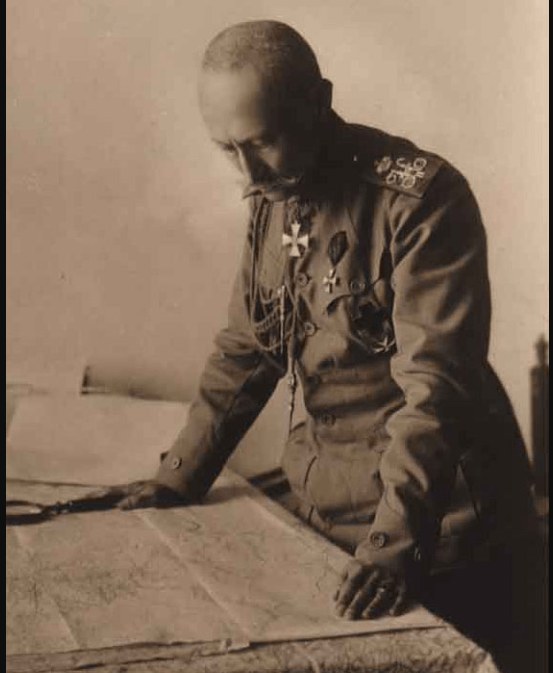
In terms of theory, perhaps the most important concept of the Breakthrough in the offensive attack is the Brusilov Offensive named after the Russian General, Aleksei A. Brusilov, who created the first modern offensive attack at various points along the enemy’s entrenched lines. The Brusilov Offensive was qualified by the number of troops available for a Breakthrough or numerous Breakthroughs at many given points. This includes as well as the immediate shock value of the initial attack during the various stages of operations that are achieved with reconnaissance penetration near the enemy’s frontline positions or deep in the rear of the enemy’s logistic support bases. If current military historians and military theorists study what Brusilov achieved against the Austrian-Hungarian forces along the Eastern front, then there will be a deeper understanding, for instance, of what the modern Russian Armed Forces may desire to achieve should they invade the vast territory of the Ukraine in our time.
Patrick Armstrong, who was a military analyst in the Canadian Department of National Defense specializing in the USSR/Russia military affairs, gives this vital perception of the birth of the modern offensive attack: “Brusilov had his soldiers dig trenches – saps – forward so that they would only have 50 to 100 metres to run: “Brusilov wanted the point of departure for the Russian infantry assaults to be no greater than 100 meters, and he preferred that the distance be 60 meters or less”; the British had the whole distance to cover. Third, light reconnaissance teams went into no man’s land to check the accuracy of each phase of the bombardment and direct the next.
Artillery is most effective in the first few seconds – merely lying down significantly increases the probability of survival. Brusilov also understood that the cessation of fire will be taken by the enemy as a signal that the attack is about to begin. This will be seen again in Soviet artillery use in the Second World War and is the reason for the Soviet/Russian development of MLRS which produce tremendous explosive fire in very quick times (the BM-21 Grad can fire 40 rockets in 20 seconds. To say nothing of this.).
And fourth, Brusilov used every means of deception available to him to make the enemy think the attacks were coming somewhere else: overwhelming the Austro-Hungarian forces with information and options… Brusilov mounted a counterintelligence campaign, sending false instructions over the radio and by messenger while specific instructions concerning the offensive were relayed verbally… false artillery batteries…”[1]
What the Canadian military analyst emphasizes is the first objective Brusilov wanted to achieve which was to stun the enemy forces with short but severe and intense artillery firepower, but only attacking with the infantry after they had gotten as close as possible to the enemy’s trenches, lessening the amount of time and space to be navigated in order to make a violent and unexpected contact with the enemy’s infantry forces. And, most importantly, to achieve the surprise of the attack through various kinds of deception about where the forces would attack, feinting here and there along the enemy’s wide front. If the Ukraine is to be attacked by Russian forces in our era, some of these attack tactics will be used to not only stun the enemy along a wide front but behind the enemy’s lines as well. This would be a continuation of deep operations which are also a part of Soviet military thought.
Although the Russian armies throughout history have been known for the massing of Russian troops before a major attack, the Russian generals understand that sizeable numbers are not everything. As Clausewitz observed about numerical superiority, “It follows that superiority in numbers is only one of the factors which produce victory; therefore, far from having obtained everything or even the principal thing with superiority in numbers, we have perhaps obtained very little by it, according as the circumstances involved happen to vary”[2]. To the modern commander this means that numbers are not absolutely necessary to achieve victory. The quality and the tactical massing of troops, along with the correct usage of air and artillery support, and finally the usage of tactical nuclear weapons in the initial Breakthroughs at given points are ultimately crucial to the success of the offensive attack.
To clarify this point, I again turn to Clausewitz, “Much more frequently the relative superiority — that is, the skillful massing of superior forcers on the decisive point — has its foundations in the correct appreciation of such a point, in the appropriate direction…”[3] If the Russian Armed Forces should attack the Ukraine, the Baltic States or the outer perimeters of Western European countries, it will be through military stealth, spreading confusion about intentions and through triggering deliberate political provocations toward Western forces or the NATO countries. The Russian military does not count only on a massive number of Russian troops at the core of achieving total destruction of their adversaries. We know the West can also provoke Russia with economic sanctions and other forms of political repression and harassment.
Great Power Chauvinism
There is in the Western world a nationalist chauvinism masked by NATO in its aspirations to eliminate Russian expansionist policies militarily and politically. However, there is also a new emergence of Russian chauvinism that has been rebuilt by the Russian capitalist oligarchs and to an extent by proxy, the Russian regime currently in power.
We should remember what Lenin wrote in a memo to the Soviet Political Bureau: “we consider ourselves, the Ukrainian SSR, and others, equal and enter with them on an equal basis into a new union, a new federation, the Union of the Soviet Republics of Europe and Asia”. Lenin in that same memo to the Political Bureau, October 6, 1922, also militantly advocated for the Bolshevik party to defend the right of self-determination of oppressed nations within the former Russian Empire and the right of ethnic nationalities to political equality as well.
This included the language-rights movement of the newly formed republics. In a rather grim humorous comment, he addressed the question of Russian chauvinism with this quip: “I declare war to the death on Great Russian chauvinism. I shall eat it with all my healthy teeth as soon as I get rid of this accursed bad tooth.” In our time, I would state that the teeth in both camps are rotten, and my assessment is that the Russian people who are still an advanced proletariat people are not interested in war for territorial expansionism.
Great-Power Chauvinism is in crisis in the West. The United States and Western Europe has lost its power to reign in the various countries that it once controlled through colonialism, intimidating posturing and economic sanctions. From the coming of age of the People’s Republic of China to the defeats in Vietnam, Cuba, Algeria, Afghanistan and Syria, they see the Ukraine as one of their last opportunities to regain economic and political territory through goading the decadent leadership in Kyiv to help them achieve their goal of destroying Russia. In 2004, the Russian President, Putin gave his view of self-determination and integration, but from a Eurasian and not a Soviet point of view, in which he said, “I would say that these problems can be formulated very simply. This is great-power chauvinism, this is nationalism, this is the personal ambitions of those on whom political decisions depend, and, finally, this is just stupidity, ordinary cavemen’s stupidity”. Historical circumstances will determine the usage of nuclear weapons on the battlefield. There is an irony here in the build-up of massive Russian troops along the Russian and Ukraine border. National chauvinism is the putrid smell of death on both sides of the Russian and Ukrainian border. It is not lost on this military historian that the massing of Russian and Ukrainian troops is not so far from where the Brusilov Offensive took place against Austro-Hungarian troops not long after the beginning of World War I.
Gerasimov Doctrine
In addition to the number of troops and the quality of troops in the modern Offensive Attack is the important concept of the surprise factor. There is much discussion in the Western world among military circles about the so-called “Gerasimov Doctrine”. This military ‘Doctrine’ should be studied carefully within the context of historical Soviet and Russian military thought and with an interest toward gaining foresight in war engagement. Much of the thought by Russian Chief of Staff Valery Gerasimov is a continual work in progress beginning at the entrance of the Russian military engagement against Islamic terrorists’ forces in the state of Syria.
As Gen. Gerasimov stated in one brief sentence in his essay, The Value of Science is in the Foresight, “Wars are no longer declared and, having begun, proceed according to an unfamiliar template”[4]which alludes to “months” and “days” of military activity without the element of surprise. This does not lead to a complete annihilation of the enemy. Rather, it leads to a degree of stalemate or uneven progress where both forces, offensive and defensive, are stalled without a political settlement. A political settlement is most important for engaging in war in the first place.
The components that General Gerasimov does not mention are neither the massing of superior forces nor the element of surprise. Instead, he dwells on this factor of modern warfare:
The experience of military conflicts—including those connected with the so-called color revolutions in North Africa and the Middle East—confirms that a perfectly thriving state can, in a matter of months and even days, be transformed into an arena of fierce armed conflict, become a victim of foreign intervention, and sink into a web of chaos, humanitarian catastrophe, and civil war.[5]
The Changed Rules of Warfare
What we see from this modern concept of warfare, the so-called ‘Hybrid War model much touted by established American military theorists, is that Gen. Gerasimov, in his visionary way, has foreseen a new way of war when he declares, “The very “rules of war” have changed. The role of nonmilitary means of achieving political and strategic goals has grown, and, in many cases, they have exceeded the power of force of weapons in their effectiveness”.[6]
In other words, from the American military point of view there is no value in the massing of troops in the modern concept of general warfare, nor is the element of surprise essential to waging war. It is not that the American military generals state this specifically. However, the very fact that they rely on advanced military technology like cyberspace military hardware and advanced missile installations or mobile missiles to subdue the enemy is a misconceived way of understanding the ongoing complexity of the ever-evolving art of modern war. What is needed in the American military institutions is a revolutionary art of military operations. I would suggest this must be the case if the American military forces are to move forward as warfare itself moves forward in intensity and scope in the twenty-first century. Therefore, it is imperative to discuss the possibility of a world war which will be connected to revolutions and civil wars in the progression of world history.
Regarding the Offensive Attack and the usage of tactical nuclear weapons, I would like to note specifically the importance of “surprise” in the initial attack or attacks along an Offensive Front. I would advocate that there needs to be a quantitative and qualitative Offensive Attack. There also needs to be in-depth operations behind enemy lines in order to be not only successful, but also far-reaching. It is necessary to instill in the strategic outlook the surprise of the attack, for as Clausewitz advised us, “We say: surprise lies at the foundation of all undertakings without exception, only in very different degrees, according to the nature of the undertaking and other circumstances… Secrecy and rapidity are the two factors in this product”.[7]
However, he warns that when “moral superiority is able to intimidate and outdo the other, then it will be able to use the surprise with greater success”[8]. would term this the Moral Political Authority which is imbued in the people of a nation-state or country whose armed forces wage war in the first place.
Sidorenko’s Insight
Professionally and creatively, I owe a huge debt of gratitude to the great Soviet military theorist, Colonel A.A. Sidorenko, whom I consider to be the father of the modern Offensive Attack with nuclear weapons. I wish to expand to a small extent on his theory of the operational art of the offensive attack. I will quote in full a certain passage from Col. Sidorenko I hope will give credence to my conceptual form of a Breakthrough in the modern art of war.
The Soviet military theorist describes specifically the old concept of a Breakthrough prior to World War II, when he states: “The strong aspect of this form of Breakthrough consisted of the fact that it permitted the maximum massing of forces and means and creating decisive superiority over the enemy on a selected direction. However, experience showed that the laughing of a blow on one direction and passivity on the remaining front, the attainment of the secrecy of preparation of the operation was hindered and the defender had the opportunity to adopt his measures… Therefore, the Breakthrough on narrow sector with passivity on the remainder of the front, as a rule, did not lead to success.[9]
Thus, the attempt at Breakthroughs during the Battles of Verdun and the Somme did not produce anything beyond more wasted and massive casualties, and did not decide the outcome of World War I. It would take a general with a will of iron to pursue a different and more creative kind of attack. The Russian General A.A. Brusilov would bring creativity to the art of war, specifically along the Southwestern Front where Russian troops were facing off thousands of Austrian and German forces. I would say not since the Napoleonic Wars was there a general of any merit who brought such forceful imagination to the forefront in the modern friction of war.
Col. Sidorenko emphasizes this kind of energetic warfare by Brusilov: “An entirely different character was acquired by the actions when the offensive operation began with the launching of a number of strikes and the simultaneous breakthrough on several directions… This form of operation was first employed by troops of the Russian Southwestern Front under the command of Gen A.A. Brusilov in June 1916… The troops of the Russian of the Southwestern Front launched an offensive in a zone 470 km wide. In this zone, four army (of which one was the main one) and a number of corps strikes were launched simultaneously.”[10]
This remarkable arduousness created by General Brusilov for that time in early twentieth century modern warfare would resonate during the Great Patriotic War along the Eastern Front. Stalin’s marshals would create many fronts with numerous army groups that would make General Brusilov’s army corps look small by comparison. Such is the profoundness when a creative concept comes into being and matures over the years. Thus, the modern offensive attack can be found in the genius of the Brusilov Offensive during the War to end all Wars with Brusilov’s meticulous and detailed military planning withstanding the harsh test of time. It Brusilov’s concept of a military offensive which can apply to battlefields with modern armies and modern weapons, including tactical nuclear weapons.
However, a well-planned and audacious offensive attack is not enough. The Russian military armed forces, like their adversaries, are capable of blunders and great debacles. (This includes not waging a just war, but a war of opportunism and brutal expansionism at any cost.) When political motivations are corrupt, when in the end the overall welfare of the nation’s people who sacrifice their sons, daughters, husbands and wives for national interests is not considered, there is a consequence for this. Only with the moral, political and spiritual superiority can victory be achieved against a tenacious and heartless enemy. In advocating the usage of tactical nuclear weapons on many fronts of the battlefield, it should be understood that such warfare must be in harmony with the will of the people who are in the rear of the struggle creating their own fronts of warfare against the enemy. Tactical Nuclear Weapons as a choice of weapon must be used appropriately during many Breakthroughs along all fronts when a world war emerges.
Though as Col. Sidorenko eloquently reminds any military historian or theorist whose life is intertwined with the fate of the people, “If war is unleashed by the imperialists, it will be not only combat with equipment and weapons. The war is waged by people, and man always was and will remain the deciding force in armed conflict”[11] If war is unleashed with nuclear weapons along many fronts, the idea of the need for great sacrifice should be wedded into the political, psychological and culture aspirations of the people, which will then be the deciding factor in the course of combat operations.
Notes:
1.https://www.strategic-culture.org/news/2021/11/04/the-russian-way-in-warfare-the-brusilov-offensive/
2. Karl Von Clausewitz, On War, trans. By O.J. Mahijs Jolles. NY: The Modern Library, 1943
3. Ibid. 140.
4. https://jmc.msu.edu/50th/download/21-conflict.pdfD
5.Ibid.
6.Ibid.
7.Clausewitz, 142.
8.Ibid, 145.
9. A.A. Sidorenko, The Offensive. Washing D.C: Translated and Published Under The Auspices of
UNITED AIR FORCE, 1970, 14,
10.Ibid, 15.
11.A.A. Sidorenko, 222.
Autore: Luis Lázaro Tijerina
Fonte: Academia.edu
 militartis.com
Lascia un commento