
The question of the evolution of the Byzantine army in Italy has two aspects: sociological and organizational. In social terms, this problem is not considered. But since the army is not just a unique social group, but a certain socio-administrative structure with clear tasks and goals, its development in this aspect also requires special study[1] .
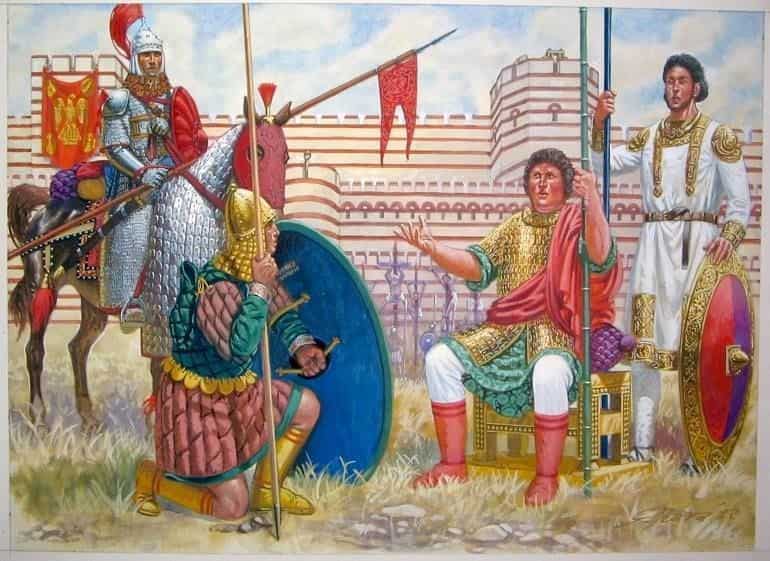
By the end of the Gothic War, the regular Byzantine army was the only armed force on the territory of Byzantine Italy. Its core was the stratioti warriors, united into numeri (Greek: αριθμоι): units numbering from 200 to 500 soldiers, led by a tribune [2] . Sources are replete with the names of such numeri in Italy [3] , and in the Italian lexicon the expressions “to be in a numeri” and “to serve in the army” sounded like synonyms. (Thus, Pope Gregory the Great uses the combination “in numeris militasse”[4] in the latter case .)
Of the other types of military formations in Italy, there were certainly scholae—units of the palace guard. However, we have only two early (6th century) references to them (Tjader 24, 27). They did not play a significant role in the military history of Byzantine Italy, and in the 7th century, they apparently disappeared. Nothing is known about either the federate formations or the border guards-limitanei (contrary to the opinion of L.M. Hartmann)[5], and their presence in Byzantine Italy is unlikely.
The numerus was stationed in cities and fortresses, either in whole or in parts (for example, the Theodosian numerus was partly located in Rome and partly in Ravenna) [6]. In some cases, they were quartered in specially built military camps: such a camp is known in Istria, where the numerus Tergestinus was based [7]. Naturally, a numerus could be redeployed, transferred from one place to another, and news of this has been preserved in the sources. Each such unit had a headquarters – “the house of such and such a numerus” (there is a mention of its presence, for example, in Rimini: Domucella S.Georgii numeri Ariminensis – BK62). The army systematically received a state salary – “ruga”, for the payment of which special officials were appointed – sakellarii [8] . This ruga was the main source of income for soldiers and commanders in peacetime. From all that has been said it follows that the Byzantine army in Italy represented a part of the regular imperial army with all its characteristic features [9] .
However, already in the first months of the Lombard invasion, the Byzantines faced the problem of a shortage of armed forces in Italy. The severe defeats suffered by the Greeks in Italy in the last third of the 6th century were largely due to the lack of warriors, which was constantly aggravated by significant losses. The chronicler John of Biclaria even reports, with a certain exaggeration, the death of all Byzantine soldiers in Italy (“omnino sunt caesi”) [10] . Sporadic dispatches of additional armed contingents to the Apennines (three cases are known: in 575, 579 and 591) [11] did not improve the situation, and it is no coincidence that the letters of the Roman popes Pelagius II and Gregory the Great are filled with calls for help addressed to the emperors and exarchs [12].
The only possible way out of the critical situation was to form an army on the spot, in Italy. Thus, among the numeri, units began to appear that bore the names of Italian settlements, in accordance with the locality where the military recruitment was carried out: numeri victricum Mediolanensium (Tjader 20), Veronensium (Tjader 22), felicum Ravennatium (Tjader 37), Ariminensium (BC 62), Tarvisianus [13], Tergestinus [14], Centumcellensium [15] , etc.
As in the entire territory of the empire, the basis for the formation of these numerus was the recruitment of volunteers, ready to serve for a fee, from among the local inhabitants [16] , although it was from Italy (more precisely from Sicily) that the last evidence in the history of Byzantium about the conscription of recruits-tirons has come down to us [17] . From the end of the 6th century, other numerus stationed in Italy were also replenished by the local population, regardless of their names. In this regard, the news about Pavlacis, a warrior of the numerus Arminiorum (639), who was the son of Stefan, the primicer of the numerus Veronensium (Tjader 22), is very indicative. In other words, the son of an officer of the Verona numerus, undoubtedly formed in Italy, served in the “Armenian” numerus.
Using local human resources, the Byzantines were able to sharply increase the number of their troops in Italy. If we assume that all the numers had a full complement of personnel, then according to the calculations of T.S. Brown, the regular Byzantine army in Italy consisted of about 32,000 soldiers [18] . At the same time, according to the calculations of A. Pertusi, with the number of a numer on average being 300-400 people, the garrison of Ravenna had 4200-5600 soldiers, in Rome – 1200-1600, in Grado – 900-1200 people [19] .
However, it was the formation of an army from local residents that was the first prerequisite for the subsequent regularization of the army, since it included many Italian landowners, for whom the main source of income was agricultural rent, and therefore, service in the army was a means of increasing social prestige, but not a material condition for existence. Those military men who did not have their own land began to use their social status to acquire it (by purchasing, and more often by renting) [20] .
A powerful accelerator of this process was the systematic, often long-term, delays in the payment of salaries (rugi) to Byzantine soldiers in Italy [21] . Conflicts related to non-payment of salaries to soldiers are noted by sources in 616 and 642. In 616, the Ravenna exarch Eleftherios suppressed the anti-Byzantine uprising in Ravenna and Naples, returned to Ravenna, and “after the payment of the ruga to the soldiers, peace was established throughout Italy”[22] . It is clear that the payment of the ruga gave rise to friction between the soldiers and the Byzantine authorities.
In 640, in Rome, the prominent Byzantine official Chartularius Maurice provoked the destruction of the Lateran Palace treasury by the Roman garrison, convincing the soldiers that the Pope was hiding from them the money that the emperor sent them “time after time” (“pervices”) [23] . Thus, the deadlines for the payment of the ruga had already been missed several times; the soldiers had not received their pay for years. Consequently, by this time (c. mid-7th century), the Byzantine garrison of Rome could already exist for a long time without pay.
Before us is important evidence of the transformation of the army into a specific social group, connected to the place of deployment by certain economic ties. This is an army-estate, as can be judged by the story of the source about the sack of the Lateran in 640. “Everyone was indignant against God’s Church and, disdaining their souls, all armed who were in the city of Rome, from a boy to an old man, moved to the aforementioned Lateran Palace” [24] . The papal treasury was plundered, and Mauritius ordered that “the army (“exercitus”) remain in the Lateran Palace,” and he himself wrote about what had happened to the exarch.
Thus, in 640, the Roman army — the recipients of the ruga — were people “from a boy to an old man.” At the same time, they alone constituted the armed part of the townspeople (“all armed who were in the city…”). Mauritius tried to use them when in 642 he raised a rebellion in Rome against the central authority. He conspired “with those with whom he had previously devastated God’s church, rebelled against the patrician Isaac (the Exarch of Ravenna. – O.B.) and sent messengers to all the fortresses (“castra”) that were located around the city of Rome, and gathered them, and bound himself to them by an oath”. Consequently, by the middle of the 7th century, part of the forming army-class lived in the city (this includes, of course, women, children, old people – those representatives of the “army” who do not constitute an army in the proper sense of the word), while the other part of the warriors carried out garrison service in nearby fortresses (“castra”).
In the future, the receipt of wages plays an increasingly smaller role in the life of the army. Finally, Emperor Justinian II, during his first reign (685-695), exempted the patrimonies of Bruttium and Lucania from paying the main military tax, the annona militaris, and levied arrears on its collection owed by the population of Sicily [25] . As is known, the annona militaris went mainly to the issue of ruga to the troops, and this news is the last (indirect) mention of the military ruga in the sources on the history of Byzantine Italy. With a high degree of probability, we can assume that we have before us one of several imperial decrees that collectively abolished the collection of the military annona throughout Italy, and therefore the payment of military ruga to the Italian army. In this case, the end of the 7th century is the time of the final irregularization of the Byzantine army in Italy.
The transformation of the Italian exercitus into an irregular army inevitably affected its mobility. At the first stage of Byzantine rule, one or another military unit could be redeployed without difficulty. From the middle of the 7th century, the exercitus no longer departed from its permanent bases. The army was capable of setting out on a more or less short-term campaign (in 642 from Ravenna to Rome to suppress the rebellion of Mauritius, in 653 there to eliminate the consequences of the uprising of the exarch Olympius, in 668 from Istria, Campania and Sardinia to Sicily to defeat the usurper Mezetius, in 692 from Ravenna and Pentapolis to Rome to save Pope Sergius I from arrest). However, having fulfilled its mission, the army would certainly return home.
Thus, the army of each part of the Byzantine possessions in Italy became its permanent garrison. In the Apennines there were five such military associations: exercitus Ravennatis (in the words of Gregory the Great, “the first army of Italy” [26] ), Romanus, Neapolitanus, Siciliae, Pentapolitanus. All of them, however, were part of a single Italian exercitus. A military seal has survived to this day (dated very uncertainly: between 550 and 650) with the inscription: “God-saved army of Italy” (“Deus adjuta exercitus Italiae”) [27] .
A very indicative phenomenon in this process of the Byzantine army in Rome is its gradual subordination to the Roman popes. The material basis for such subordination was the dependence of the army on the payment of money from the papal treasury. As early as the end of the 6th century, Pope Gregory the Great declared: “As in Ravenna the pious emperors have a sakellarius for the first army of Italy, who, in necessary cases, finances daily expenses, so in this city (Rome. – O.B.) in such cases I am the sakellarius for them!” [28] . That is why the words of the chartularius Maurice about the pope concealing the military salary allegedly sent by the emperor seemed so plausible to the soldiers. In practice, in order to avoid excesses, the popes often paid the soldiers’ ruga from their own funds [29] . In such a situation, the army, naturally, felt its dependence on the papal curia all the time.
As the issuance of ruga became an increasingly sporadic phenomenon, the dependence must have weakened. However, by this time a significant part of the soldiers in Rome (as in Ravenna) rented lands of the church patrimonium [30] , and thus financial dependence was transformed into land dependence. In addition, the local Roman army itself psychologically perceived the Roman pope as its spiritual father. It is no accident that the Byzantine emperors were forced to include in the text of the oath of the Roman bishop a peculiar oath: “… the most Christian Roman state … to protect and defend together with the most devoted and strongest soldiers of the Roman state in Italy; rebels and enemies of the noble empire … to subdue and overthrow not with the edge of the sword, but with wise advice, so that the brilliant army does not suffer losses” . The government, as we see, recognizes that the pope is capable of using the army at his own discretion, and tries to limit its military activity to the struggle against the external enemies of the empire; it clearly understands the danger for the Byzantine power of the participation of the Roman army led by the pope in internal conflicts in Italy. It is characteristic that since the sack of the Lateran by the chartular Maurice, the authorities have never succeeded in using the Roman army in the struggle against the pope. In such cases, soldiers were sent from Ravenna and Pentapolis, until the events of 692 demonstrated that warriors from other regions of Italy also did not wish to act against the Roman throne. As for the Roman warriors, for them already in the second half of the 7th century the Roman pope is the main leader and authority.
The situation was somewhat different in other regions of Italy. Here the payment of ruga was carried out by the military commanders themselves (by the exarch Eleftherios in 616, by the magistrum militum Don in 642) [31] . Although outside Rome (for example, in Ravenna) [32] the funds for paying salaries were often drawn from the church treasury, local hierarchs did not participate in their payment themselves. In addition, unlike the Roman popes, the archbishops of Ravenna and Naples and the patriarchs of Grado most often did not play an independent political role in Italy. As a result, they did not become regional military leaders.
The transformation of the Byzantine army into a local military formation led in Rome to its reorientation towards new leaders; in other centers it gave rise to the practice of electing military commanders by the army itself and from among its ranks, which was completely alien to Byzantium.
The first time this happened was in Ravenna during the anti-Byzantine revolt in 710. The second time was in Rialto, where the election of a dux (“doge”) became a tradition and was sanctioned by the Byzantine government in 742 [33] . Soon after the publication of the iconoclastic edicts of Emperor Leo III the Isaurian, “all the provinces of Italy” elected duxes for themselves. Placitumde Rizano (804) reports that “under the rule of the Greeks” the local possessors in Istria had the actus tribunati, that is, the right to elect tribunes, as well as domestics, vicars, and locoservators [34] . “Whoever wanted to receive a higher dignity than tribune went to the emperor, who appointed him a hypate.” Consequently, the rule of election was extended in Italy in the last years of Byzantine rule also to the lower and middle command staff of the army, and the results of such elections were considered final. Only the highest commanders, starting with the ipate or consul, needed imperial approval (apparently, also after local elections). The election of military leaders became another important symptom of the “naturalization” of the Byzantine army in Italy, turning it into a local military militia.
The evolution of the army in Ravenna was completed by the reform carried out during the anti-imperial revolt by the newly elected dux George. George “… divided the inhabitants of the city into 11 parts. Each soldier acted in accordance with his “militia” and “bandus”. Here are the names of these formations: “Ravenna, bandus primus, bandus secundus, bandus novus, invictus, Constantinopolitanus, firmens, laetus, Mediolanensi, Veronense, Classensis, partes pontificis cum clericis”[35] .
As we can see, the military organization created by Ravenna during the uprising is a continuation of the traditional Byzantine one. In the phrase “each warrior acted in accordance with his militia and bandus, i.e. Ravenna, bandus primus…” “Ravenna” corresponds to the concept of “exercitus”, “bandus” – to the concept of “numerus”. In other words, each warrior in the rebellious Ravenna was considered a soldier of the Ravenna exercitus and one or another numerus: as in the Byzantine army. Additional evidence of such an interpretation can be seen in the fact that the “Strategikon” of Emperor Maurice uses the term “bandus” to designate regular Byzantine military units [36] . Among the names of bandi mentioned in the source are such as Mediolanensium, Veronensium, Letorum (Laetus), which previously existed in the Byzantine army in Italy. The Ravenna numerus (“numerus Ravennatis”) was divided by George into two new ones – “Ravenna First” and “Ravenna Second”.
It is quite possible that the Constantinople numerus had also appeared in Italy earlier. At the same time, George organized several completely new numers, but they hardly differed from the others in their structure. It can therefore be considered that it was the army-exercitus that served as a model for George and became the basis for the new military association created by the rebels. This change was not particularly sharp, since exercitus by the beginning of the 8th century had finally lost its regular character. It should be noted that George was forced during the uprising to send military detachments from Ravenna to guard the suburban fortresses – castra. Unlike in the middle of the 7th century, at this time they no longer had permanent garrisons [37] . Carrying out a punitive action against Ravenna, the soldiers of Justinian II climbed the city walls and began throwing burning objects inside. This would have been impossible if the walls had been guarded. The army-exercitus was at that time in Ravenna, but it was no longer an army. It was a part of the population, fit to act as part of the militia, but not having managed to rise up in defense of the city at the critical moment.
The structure created by George was subsequently maintained in Ravenna for many decades (“to this day,” in the 40s of the 9th century) [38] . In the history of Ravenna, George’s reform finally completed the process of turning the Byzantine army into a local irregular military formation. For most other cities in Italy, and above all for Rome, this boundary was the anti-iconoclastic uprisings of the late 20s and early 30s of the 7th century.
From the military-organizational point of view, the main links in the evolution of the army in Byzantine Italy in chronological order are as follows:
- the transition to the formation of military units (numeri) in Italy itself;
- the replenishment of all Byzantine units in the Apennines at the expense of local natives;
- long-term delays in the payment of salaries to soldiers, and then a complete refusal to issue ruga;
- the cessation of the transfer of troops from one city to another, which determined the permanent composition of the exercitus of individual provinces;
- the transformation of the pope into the unofficial head of the Roman exercitus;
- the establishment of the election of military commanders;
- the refusal to carry out permanent garrison service and service to protect the walls of cities;
- finally, a spontaneous reform of the internal structure of the army in accordance with local conditions, regardless of the will of the Byzantine government.
In the process of evolution of the army in Italy, its place in the social structure of the country naturally changed. Studying this issue, S. Diehl was the first to note that the army-militia united in its ranks that part of the urban population that stood above the plebs and roughly corresponded to the layer of large and medium landowners – possessores.
He believed, however, that we are talking about a special urban militia, different from the Byzantine army itself . This idea was further developed in a special monograph by P. Razi [39] . Such an interpretation of the concept of militia does not follow from the sources, which universally use this term as a synonym for exercitus. The sources do not know of any other terms to designate the army in Italy. The opinion about the existence of some specific militia is based solely on speculative arguments. Among them are the participation of the militia in uprisings against the central government, the active role of the army in the elections of the Pope, etc.
These phenomena, however, are easily explained by both specific historical reasons and general trends in the development of military organization in Italy [40] . By contrasting exercitus and militia as a regular army and a people’s militia, historians, in essence, contrast different stages in the development of one and the same social organism – the Byzantine army in Italy. The hypothesis of the existence of a special, distinct urban militia is the result of a historiographical misunderstanding.
At the same time, the idea of Sh. Diehl that the basis of the army was made up of land possessors living in the cities seems correct. The very fact of their presence in the army in the 7th-8th centuries does not raise any doubts. But the question of how complete the mutual correspondence was between the army-exercitus and the layer of city owners remains controversial. Thus, A. Guillou believes that the military structure of Byzantine Italy was based on a kind of universal military service of the city population[41] . Of course, such a service was introduced in Ravenna during the uprising of 710-711. However, its introduction can only be considered a temporary measure. Firstly, it should be remembered that it also affected the clergy, which did not constitute a separate number, but formed the “partes pontificis cum clericis”. In the future, the clergy in Ravenna was not subject to mobilization. Secondly (and this is the main thing), if the army included the entire urban population, then exercitus would dissolve into other social strata.
Meanwhile, we systematically encounter it in sources both in the 8th and 9th centuries. Exercitus in the last period of the history of Byzantine Italy became a privileged social group, possessing the right to bear arms and to elect representatives of the military administration, which had long ago subordinated the civil one. Neither of these privileges were possessed by other strata of the population under normal conditions, which, of course, did not exclude the possibility of general armed uprisings in moments of particular danger or the participation of all citizens in the election of duxes during a popular uprising.
Exercitus in Byzantine Italy was therefore quite clearly separated from other categories of the population. Did it absorb the entire layer of urban possessors? In the conditions of the scarcity of statistical data, typical for the early Middle Ages, different points of view are permissible in solving this problem. Thus, T.S. Brown, referring to sporadic news about landowners who were in military service, notes: “It is natural to assume that individual possessores joined the army, but one cannot speak of the merging of an entire class with the army” [42] . It still seems that the point of view of the English researcher can be somewhat adjusted.
Let us recall that the Pragmatic Sanction of 554 established the procedure for the election of civilian leaders of the provinces (judices) by landowners – possessors [43] . In the process of transformation of the social structures of Byzantine Italy, the role of civilian administrators was usurped by the military – duces and tribuni, and these positions also eventually became elective. We have no reason to believe that the most influential part of the city population — the large and medium possessors who lived there — lost their voting rights at that time, despite the fact that the Pragmatic Sanction was not officially abolished.
Most likely, these people have retained their rights, joining the new privileged stratum. They had better opportunities for this than any other social group, since, unlike people who lived by their own productive labor, they appropriated land rent, which meant that during the period of gradual irregularization, troops could perform military duties without receiving a penny for a long time. In the conditions of social upheavals of the 6th-8th centuries, the late antique possessors could not survive completely. Some of them, having gone bankrupt and lost their estates, left the historical arena. But the rest joined the stratum of medieval landowners. Of course, the new ruling class also included other social groups, primarily officials and military personnel, who initially did not have real estate in Italy. The local land possessors formed a single amalgam with them. The economic well-being of this new social stratum depended primarily on the possession of land; the high social status of its representatives was determined by belonging to the privileged class of “militia” or “exercitus”.
Notes:
- This issue is examined in more detail in the article: Borodin O. R. Evolution of the army in Byzantine Italy in the 6th-8th centuries (military-organizational aspect) / / Byzantine Time, 46, 1986. P. 124-138.
- Grosse R. Romische Militargeschichte von Gallienus bis zum Beginn der byzantinischen Themenverfassung. B., 1920. S. 274; Guillou A. Regionalisme et independence… P. 151.
- For a summary of these reports, see Ch. Diehl: Diehl Ch. Op. cit. P. 316.
- Greg. Magn., Ep. IV, 37.
- Hartmann LM Untersuchungen… S. 52.
- Greg. Magn., Er. II, 45; Tjader 16.
- Placitum de Rizano … P. 52.
- Greg. Magn., Er. II, 45; V, 30; 36, 38, 39; IX, 240.
- For general principles of material support for the Byzantine army, see: Patlagean E. L’impot page par les soldiers au VI£ siecle / / Armees et fiscalites in the antique world. P., 1977. P. 303-309.
- Johannis Biclarensis Chronicon // PL. T. 72. Col. 867.
- Johannis Biclarensis Chronicon… Col. 865; Menandri protectoris fragmenta. P. 331-332; Georgius Cedrenus. S’uvovyu; ‘iGTopicov/Ed. J. Becker. Bonnae, 1838. P. 695.
- P.L. T. 72. Col. 704; Greg. Magn., Er. II, 45; V, 36 etc.
- CIL, V, 1593.
- Placitum de Rizano … P. 52.
- Deed of gift of 744. See: Guillou A. Regionalisme et independence… P. 310-311.
- On this main method of replenishing the army in Byzantium, see: Teall J. K. The Barbarians in Justinian’s Army / / Speculum. Vol. XL. No. 2. 1965. P. 296.
- Greg. Magn., Ep. II, 38.
- Brown TS Op. cit. P. 84.
- Pertusi A. Ordinamenti militari, guerre in Occidente e teorie di guerra dei Bizantini // Settimane di Studio del Centro Italiano di Studi sull’ Alto Medioevo, XV, T. II. Spoleto, 1968. P. 682.
- For more on this, see Part II, Chapter 3 below.
- See the special work: Borodin O. R. Soldier’s salary (“ruga”) in the army of the Ravenna Exarchate / / Classes and estates of medieval society. Moscow, 1988. Pp. 18-22.
- Liber Pontificalis… T. I. R. 319.
- Ibid. T. I. P. 328.
- Ibid.
- Ibid. T. I. P. 331.
- Ibid. T. I. R. 366, 369.
- Greg. Magn., Ep. III, 14.
- Zacos G. and Veglery A. Byzantine Lead Seals. T. I, Part I. Basel, 1972, No. 807. P. 583-584,
- Greg. Magn., Ер. V, 39. It should be noted that the Russian researcher D. P. Lys translated the ending of the phrase (“…ita in hac urbe in causis talibus eorum saccelarius ego sum”) as follows: “…so in this city I am the treasurer of the Lombards.” The word “eorum” – “their” – was attributed to the Lombards mentioned several phrases earlier, and the statement itself acquired a completely different meaning: “I buy off the Lombards so often that I can already be considered their treasurer.” (Lys D. P. The Growth of the Political Role of the Roman Church during the Pontificate of Gregory I (590-604) // Social and Economic Problems of the History of the Ancient World and the Middle Ages. Collection of Works. Moscow, 1974. P. 108). It is difficult to agree with such an interpretation. The letter is addressed to the Byzantine Empress, to whom Pope Gregory would hardly have been so dangerously ironic about himself, reporting that he was systematically financing the Lombards. The word “eogit” should probably be attributed either to the Byzantine warriors (not directly named in the text, but implied by the mention of the Ravenese “exercitus” at the beginning of the phrase), or to the expenses used for their needs (in the source – “expensas”).
- Greg. Magn., Ep. V, 36,38.
- For ome, see the “Collection of Canons of Cardinal Deusdedit”: Die Kanonensammlung des Kardinals Deusdedit…, No. CCXIV, CCLI, CCXIII etc.
- Liber Diurnus… P. 110.
- Liber Pontificalis… T. IP 331.
34.Greg. Magn., Ep., IX, 240. - See about this: Diehl Ch. La republique de Venice. P., 1967. P. 36. The source reports that the first dux was elected 150 years after the arrival of the Lombards in Italy, i.e. in 718 or 719 (Johannis Diaconi Chronicon Venetum… P. 11.)
- lacitum de Rizano … P. 53.
- Agnellus. Op. cit. P. 370.
- This was noted by J. Haldon (Haldon JF Recruitment and Conscription in Byzantine Army. A Study on the Origins of the Stratiotika Ktemata. 550-950. Vienna, 1979. P. 32).
- Agnellus. Op. cit. P. 369. Another option was also possible: the fortress gradually turned into a small town with a permanent population. Such was the fate of Cervia, Sarsina and a number of other settlements. In Istria, a military camp, which retained its former name, turned into such a settlement. See: Placitum de Rizano … P. 52.
- Agnellus. Op. cit. P. 370.
- Diehl Ch. Op. cit. P. 312-315.
- Masi “Exercitus Italicus” e milizie cittadine dell’alto medioevo. Padova, 1937.
- See a more detailed justification of this position: Borodin O. R. Evolution of the army… P. 130-131, 137-138.
Autore: Oleg Robertovich Borodin (Олег Робертович Бородин)
Fonte: Exarchate of Ravenna. Byzantines in Italy (Равеннский экзархат. Византийцы в Италии)
 militartis.com
Lascia un commento