
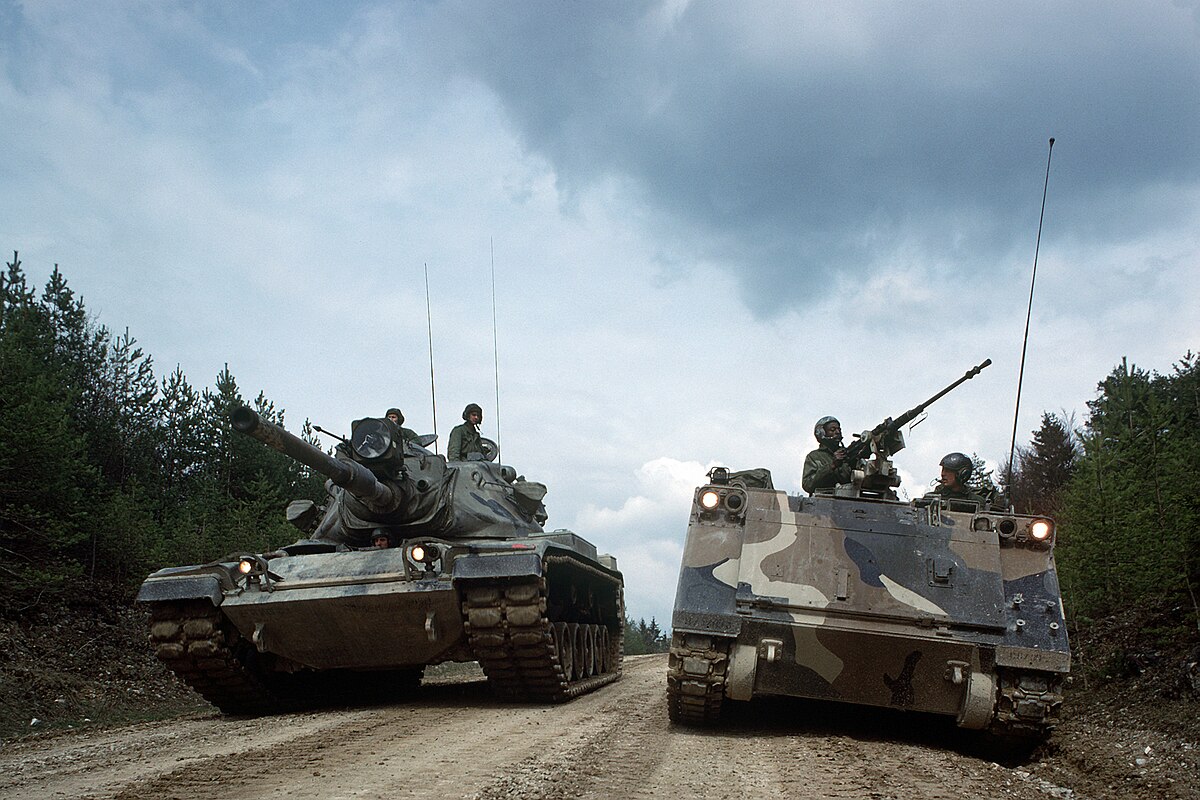
The Pentagon’s military preparations devote a significant place to the development of armored and mechanized forces. Thus, of the 13 divisions currently in the regular army’s combat strength, three are armored and four are mechanized. A mechanized division is considered the main combined arms unit, comprising units and subdivisions of various branches of the armed forces and services. It is capable of conducting combat operations with or without the use of nuclear weapons, independently or as part of a larger unit (association).
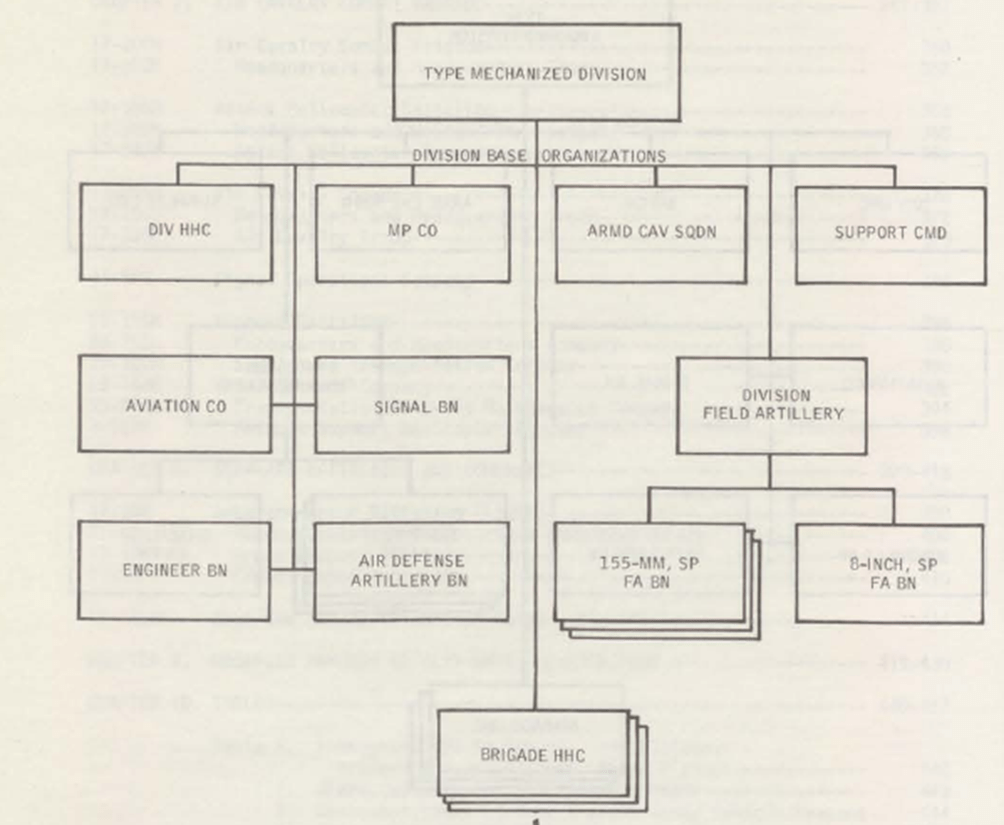
Organizationally, the division includes three brigade headquarters, six motorized infantry and four tank battalions, three 155-mm howitzer divisions, a 203.2-mm howitzer division, an Honest John anti-aircraft missile division (in accordance with the rearmament plan, it can be replaced by a Lance anti-aircraft missile division), a mixed anti-aircraft division of Chaparral SAMs and Vulcan anti-aircraft guns, three separate battalions (reconnaissance, communications, and engineer), three separate companies (headquarters, army aviation, and military police), as well as a rear command consisting of three battalions (transport and supply, medical, repair) and three companies (headquarters, adjutant general, and financial).
The total number of personnel in the division is over 10,500. It is armed with the following: 243 tanks (216 medium and 27 light), Honest John-4 NUR launchers; 12 203.2 mm howitzers; 54 155 howitzers; 103 81 mm and 106.7 mm mortars; over 150 TOW ATGM launchers and 90 mm recoilless ATGM launchers; 24 Chaparral SAM launchers; 24 20 mm six-barreled Vulcan SAMs; 67 Red Eye SAM crews; about 700 armored personnel carriers and armored vehicles; over 2,800 automobiles; 61 helicopters; 1,238 40 mm grenade launchers; 12.7 mm machine guns – 295; 7.62 mm machine guns – over 600; automatic rifles – about 13,800; pistols and submachine guns – up to 3,400.
According to American military experts, the success of a modern combined arms battle depends on high firepower, striking power and mobility of troops, as well as on the correct application of the basic principles of conducting combat operations. These principles include massive use of forces and means of combat, planning and purposefulness, offensive nature of actions, surprise, economy of forces and means, maneuverability, unity of command and combat support of troops.
The principle of massing provides for use at the decisive moment in the decisive direction of the maximum number of available forces and means, including nuclear weapons.” Clear planning, simplicity of design and purposefulness contribute to the successful conduct of military operations. The offensive nature of the actions is considered one of the most important factors in achieving the defeat and destruction of the enemy. Surprise is ensured by secrecy and speed of action, misleading the enemy about your intentions, using unexpected means and methods of struggle, and conducting effective reconnaissance. The principle of economy of forces and means consists in rationally distributing troops to perform the main and secondary tasks by concentrating the main efforts in the decisive direction, while in secondary directions an offensive with a limited purpose or defensive (retreat) actions are conducted. With the help of maneuver, it is envisaged to change the balance of forces and means in your favor. Its essence lies in concentrating the required number of troops in the main direction at the decisive moment to defeat the opposing enemy. Unity of command ensures the unification of the efforts of all troops by coordinating their actions to fulfill the general tasks. Combat support includes measures to protect troops from a sudden attack by the enemy and to ensure freedom of action for their troops.
In conditions of using nuclear weapons, the success of a battle is directly dependent on the results of its use, taking into account the above general principles. It is believed that all these principles, under certain conditions, can be applied to varying degrees in both offensive and defensive combat.
Offensive actions.
An offensive is considered the main type of combat operations, during which decisive goals can be achieved in defeating and destroying the enemy and capturing his territory. Depending on the current situation, a mechanized division, acting as part of an army corps or independently, can attack an enemy who has hastily gone over to the defensive or is occupying a prepared defense. An offensive against an enemy who has hastily gone over to the defensive can be used both at the beginning of a war and during subsequent actions. It will be characterized by encounter battles, deployment of units and subdivisions on the move and fighting at a significant distance from friendly troops. An offensive against a prepared defense will be undertaken, as a rule, in conditions of direct contact with the enemy.
Before the offensive, a mechanized division may be located in the initial position or in the concentration area. The initial position is usually occupied by the division when organizing an offensive against a prepared defense in conditions of direct contact with the enemy. The mechanized division will have to conduct an offensive against an enemy that has hastily gone over to the defensive on the move. In this case, the division and its units may not be assigned initial areas for the offensive: they will operate from the concentration areas and deploy for battle from the march. In this case, it is recommended to indicate the initial line for the offensive in order to coordinate the actions of all units and subdivisions of the first echelon. The concentration area of the division is usually assigned at a distance of 30-50 km or more from the front line and reaches 350-450 km2 in area.
A mechanized division operating as part of an army corps may be in the first or second echelon. When in the first echelon of a corps, it may advance in the direction of the main attack with the task of breaking through the enemy’s defenses and ensuring the entry of the corps’ second echelon into the zone, or it may operate in a secondary direction. When in the second echelon, it may be used to complete the breakthrough of the enemy’s second line of defense and develop the success of the offensive.
First-echelon divisions are usually assigned an offensive zone and are given tasks in depth. The width of the offensive zone is determined depending on the role and place of the division in the corps’s battle formation, the task received, the nature of the terrain, and the composition of the opposing enemy’s troops. In the main direction, it can be 20 km or more. The immediate task of a first-echelon division is to break through the main defensive zone and capture an objective at a depth of 20 km or more, and the final task is to capture objectives at a depth of 35 km or more.
The formation of the battle order of a mechanized division and its units in an offensive depends on the combat mission, the availability of forces and resources (primarily nuclear weapons), the width of the offensive zone, the nature of the terrain and the expected resistance of the enemy. The most appropriate formation of the division’s battle order is considered to be in two echelons: two brigades in the first echelon and one in the second (reserve). The depth of the division’s battle order reaches 25-30 km (Fig. I). A single-echelon formation is recommended when the width of the offensive zone is large, and the depth of the combat mission is insignificant. A battle order in three echelons is used in an unclear situation, a narrow offensive zone and a mission at great depth.
During an offensive battle, a mechanized division is usually reinforced with various means. It can receive nuclear weapons, one or two 155-mm howitzer battalions, one or two 203.2-mm howitzer battalions, a sapper battalion, and other subunits. The Honest John NUR battalion and 203.2-mm howitzer battalions (regular and attached) usually perform general support missions. Regular 155-mm howitzer battalions are distributed among brigades and provide them with direct support.
During the battle, in order to successfully complete the assigned task, the division commander creates three brigade groupings from the regular and attached forces and assets: one in the direction of the main attack, the second in the auxiliary direction, and the third in the second echelon (reserve). Each grouping is usually headed by a brigade commander. The main attack grouping may optionally include three motorized infantry and one tank battalion, one or two artillery divisions, an engineer company, and other units; the grouping in the auxiliary direction may have two motorized infantry and one tank battalion, and the second echelon (reserve) grouping – two tank and one motorized infantry battalion.
The division’s reconnaissance battalion is usually used to conduct ground and air reconnaissance of the terrain, enemy forces and assets, to secure junctions and flanks, and in some cases to conduct an offensive in a secondary direction.
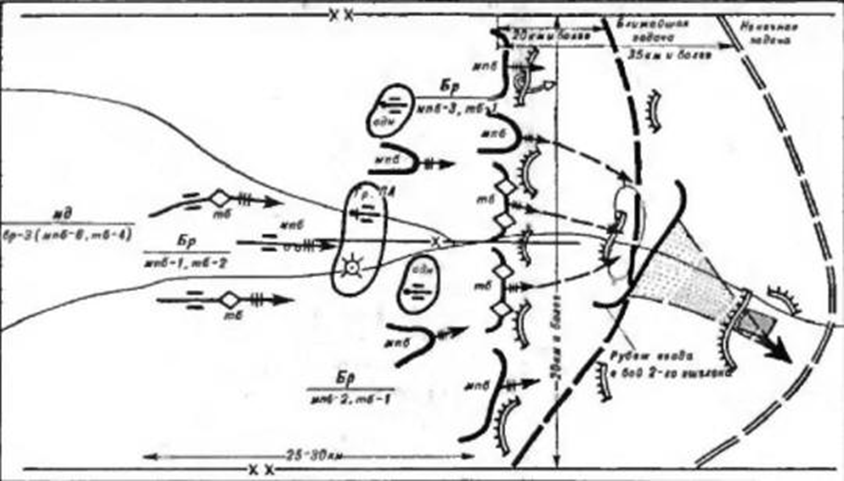
Fig. 1. Mechanized division on the offensive (variant)
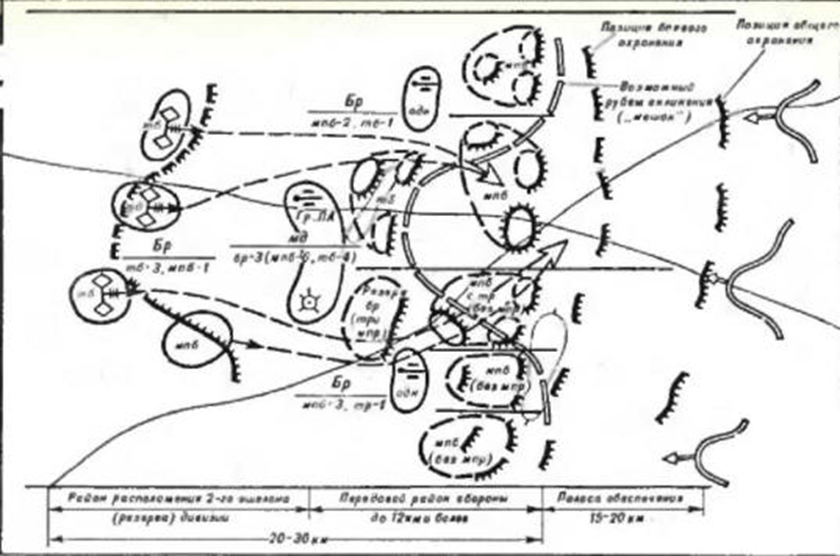
Fig. 2. Mechanized division in mobile defense (variant)
Immediately before going on the offensive, it is envisaged to conduct nuclear, artillery and aviation preparation. In the event that a mechanized division moves from the concentration area to the initial line, it must reach the attack line before the end of such preparation. Nuclear preparation is conducted in accordance with the fire support plan and is aimed at destroying the main enemy targets, such as the launch sites of nuclear missile weapons, the main concentrations of troops and equipment, artillery, command posts and communication centers. Artillery preparation using conventional ammunition is conducted against targets that have not been subjected to nuclear strikes and against surviving pockets of resistance. Simultaneously with artillery preparation or at another time favorable to the attacking force, air strikes are carried out using conventional ammunition in order to prevent the regrouping of enemy troops and the approach of his reserves from the depths, as well as to prevent the possibility of carrying out measures to eliminate the consequences of a nuclear attack.
With the exit of units and subdivisions to the attack line and the end of nuclear, artillery and aviation preparation, the troops immediately go over to a decisive offensive, and the fire of supporting means is transferred to the depth and flanks of the areas of nuclear strikes. The main task of artillery at this time is to provide direct support to the troops by hitting targets that impede the advance of the advancing troops, conducting counter-battery combat and covering gaps in the battle formations with fire.
According to American experts, an attack in modern conditions will most often be carried out not on foot, but on armored personnel carriers and guns. An offensive may take the form of a simultaneous and continuous advance of units and subdivisions until the tasks assigned to them are completed, if the enemy’s main objects (targets) are reliably suppressed. Otherwise, the offensive will be conducted from object to object. It is believed that advancing tanks and motorized infantry should break through as quickly as possible into the depths of the enemy’s defense through areas where nuclear strikes have been carried out, thereby depriving him of the opportunity to use reserves to organize the defense of these areas.
During combat, it is recommended to give broad initiative to brigade and battalion commanders. Having captured the defense areas of the first echelon units, tanks and motorized infantry continue to continuously develop the offensive into the depth of the defense with the aim of breaking through it as quickly as possible. Having captured the designated object, the units secure it, put themselves in order, and then continue the offensive. If the enemy offers insignificant resistance, the motorized infantry usually advances in company and platoon columns following the tanks. Only where the enemy offers strong resistance can it dismount and deploy in battle formation. In the depth of the defense, the troops’ actions will break up into a number of separate battles and be highly maneuverable. The second echelon (reserve) moves in dispersed battle formations in readiness for immediate entry into battle. Depending on the situation, it can be introduced into battle in full or in parts.
The main tasks of the second echelon (reserve) are to ensure the development of the success achieved by the units of the first echelon, as well as to replace units that have been subjected to enemy nuclear strikes. It is recommended that the second echelon (reserve) be restored when it is brought into battle.
In order to increase the tempo of the offensive, to prevent the withdrawal or approach of enemy troops, it is envisaged to drop tactical airborne assault forces consisting of a platoon, company or battalion into the enemy rear. The task of the assault force is to capture and hold tactically important areas of terrain or objects and to disrupt the enemy’s intentions. After achieving the assigned task, the mechanized division consolidates itself on the captured line and prepares to perform a new task.
Defensive actions.
According to American military experts, defense is a type of combat aimed at disrupting or repelling an enemy offensive, holding positions, saving forces and resources, and creating favorable conditions for going on the offensive. It is emphasized that if, when conducting defensive actions using conventional weapons, the goal is achieved by persistently holding the terrain, then in conditions of using nuclear weapons – mainly by inflicting maximum losses on the advancing enemy and destroying its strike groups with nuclear strikes and counterattacks.
A mechanized division can go on the defensive under various conditions: at the beginning of a war or during it; in conditions of using nuclear weapons or only conventional weapons, but under the threat of using nuclear weapons and their subsequent use. Depending on the situation, a division can go on the defensive in advance (deliberately) or hastily (forced).
In conditions of using nuclear weapons, it is recommended to build defense in such a way as to ensure the necessary dispersal of troops and equipment and thereby reduce losses. A mechanized division will often defend itself on a wide front and create significant depth due to the location of troops, the equipment of reserve and false strong points, the creation of blocking and cut-off positions. The defense of the division must be deep and circular. The basis for success in defense lies in its activity, manifested in counterattacks, as well as in preemptive strikes, especially with nuclear weapons, against an enemy preparing to attack.
American military experts divide defense into two types: mobile and defense of the area. It is believed that in conditions of using nuclear weapons, mobile defense will be conducted more often, and in conditions of using only conventional means – defense of the area. A mechanized division is capable of conducting both types of defenses. However, due to the fact that it has great firepower, striking force and maneuverability, it is envisaged to be used more often in mobile defense.
The essence of mobile defense is the maximum activity of troops, fire weapons and its conduct by the method of defensive-offensive actions. In this case, it is envisaged to deploy a minimum number of forces and means on the forward edge of the division’s defense, and to place most of them in the depths (Fig. 2). The following tasks are usually assigned to the security and first-echelon units: to warn their troops about the enemy’s offensive, to force him to deploy prematurely and to direct the main enemy group in a direction favorable to the defender in order to deliver a powerful fire strike against it and successfully carry out a counterattack. The second echelon is introduced into battle to deliver a counterattack (after a strong fire strike) in order to destroy the enemy in an advantageous place and at a decisive time.
The defense of a region is organized and conducted with the purpose of holding a certain region and is based on the maximum use of firepower, engineering equipment of the terrain and the location of the main forces and resources in the forward defense area of the division. It is recommended to switch to such defense when it is necessary to hold a certain line or area and in the case of insufficient depth of defense, when the enemy has greater mobility than the defender, and the terrain does not allow maneuver.
The depth of a defense zone usually includes three elements: a security zone, a forward defense area, and a second-echelon or reserve area (Fig. 3). The security zone is created in the absence of contact with the enemy. It includes general and combat security positions. General security is set up by order of the division commander at a distance of 15-20 km from the forward edge of the forward area. Combat security is set up by first-echelon brigades. General security may be assigned from a battalion to a brigade, and combat security may be assigned from a platoon (company).
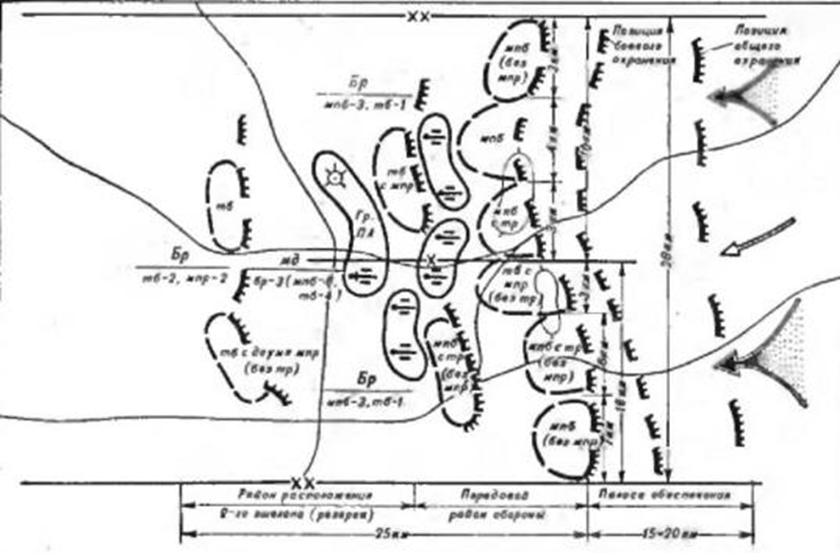
Fig. 3 Mechanized division in defense of the area (variant)
The first echelon brigades are located in the forward defense area with a depth of up to 12 km or more. The total depth of defense of a mechanized division, without taking into account the security zone, can reach 20-30 km.
The battle formation of a mechanized division in defense will most often be built in two echelons. Depending on the type of defense, forces and resources are distributed unevenly among the echelons. Thus, in a mobile defense, a smaller part of the forces and resources will be in the first echelon than in the defense of an area, and, conversely, in the defense of an area, the majority of the forces and resources of the division will be located in the first echelon. Usually, two brigades are allocated to the first echelon of the division and one to the second. However, in a mobile defense, mainly motorized infantry battalions will be allocated to the brigades of the first echelon, and tank battalions to the brigade of the second echelon. In the defense of an area, tank battalions will be distributed almost evenly.
The reinforcement of a division in defense is approximately the same as in the offensive. The width of the division’s defense zone depends on the assigned task, terrain conditions, and the grouping of the opposing enemy. When calculating the width of a division’s defense zone, the width of the defense front of one battalion and their total number on the front line are usually taken. According to the statutory standards, the width of the battalion’s defense front is 3,000 m and the depth is 2,500 m. Based on this, the brigade’s defense front can be 6 km (two battalions in the first echelon) and 12 km (four battalions in the first echelon), and for a division 20-30 km. However, the American press indicates that under conditions of using nuclear weapons, the width of the battalion’s defense front can be 6-7 km, a company 1,800 m and the intervals between companies 2,300-3,200 m. This width is justified by the impossibility of hitting two adjacent companies with one 10 kt nuclear munition. The width of the division’s defense strip in accordance with this can be 30-35 km with five battalions located on the forward edge of the division’s defense and 42-49 km with seven battalions located there.
In defense, great importance is attached to the engineering support of troops. In the forward defense area, battalion defense areas, company and platoon strong points, cutoff and blocking positions are usually equipped. All this is supplemented by a system of engineering obstacles. In the area of the second echelon (reserve) of the division, the main and reserve defense areas of combat units, cutoff and blocking positions, as well as positions for artillery, mortars and the location of nuclear weapons are equipped. Particular attention is paid to the location of the search and equipment of the terrain in order to create “bags” for drawing the main enemy groups into them and destroying them with fire and counterattacks.
Considerable attention in defense is paid to fire support of the battle. In a mechanized division, a fire support plan is usually developed. Fire support is especially carefully planned and linked to the actions of the troops to defeat the main enemy group drawn into a pre-prepared “bag”.
The division’s defensive bon is usually planned to begin with general and combat security units, which conduct it using the method of restraining actions. The main task of security is to promptly reveal the beginning of the enemy’s offensive, identify the grouping of his troops, restrain their advance and give their main forces the opportunity to enter the battle in an organized manner. As the enemy approaches the forward edge of the forward defense area, fire from all means is intensified and forward units enter the battle. The security units, under cover of the forward units, withdraw behind the forward edge of the defense and receive new tasks.
In mobile defense, when the offensive cannot be stopped, the first echelon brigades take all measures to force the enemy to advance in a direction favorable to the defender or into a pre-prepared “bag” in order to deliver a fire strike, primarily nuclear, and to carry out a counterattack. A counterattack plan is drawn up in advance based on an assessment of the situation and possible enemy action options. The most suitable moment for a counterattack is considered to be when the enemy’s offensive has slowed down or stopped and when the enemy has not yet been able to consolidate the achieved line. In mobile defense, a counterattack pursues a decisive goal – the destruction of an enemy troop grouping that has penetrated the defense. In this case, it is usually carried out jointly by the second echelons (reserves) of brigades and divisions. The most preferable is a counterattack on the flank of the enemy that has penetrated, but the possibility of carrying it out from the front is not excluded, especially in conditions of the use of nuclear weapons. In the event of an enemy penetration in several places, the division commander determines the most threatened direction and sends the bulk of the reserve there. In this case, brigade reserves will most often be used independently. Counterattacks are usually supported by fire from all types of weapons and air strikes. In conditions of the use of nuclear weapons, they are carried out after the nuclear strike.
In the defense of an area, the goal of a counterattack is to dislodge the enemy who has penetrated the defense, and in the event of a breakthrough of the defense areas of the first-echelon battalions, to restore the lost position by counterattacking with the second echelons (reserves) of the brigades of the first echelon of the division. It is believed that counterattacking with the forces of the second echelons of brigades in conditions of an offensive by superior enemy forces is inappropriate, except in cases where it is necessary to return a lost important point, on the retention of which the success of the entire defense depends. A counterattack by the second echelon (reserves) of the brigades of the first echelon can be undertaken when the enemy has penetrated to a depth of up to 2 km. If counterattacks by these forces do not lead to the restoration of the position, then the units of these brigades strive to contain the further advance of the enemy and create conditions for counterattacking by the second echelon (reserves) of the division or even corps. In the event of a successful counterattack, the lost position and the system of engineering obstacles are restored, reserves are created, and the troops prepare to repel the enemy’s offensive. In a favorable situation, a defensive battle can develop into an offensive.
The Pentagon, preparing for aggressive wars, believes that ground forces will seize and hold territory and therefore constantly increase their combat readiness
Autore: Colonel K. Kupriyanov
Fonte: Foreign Military Review No1 – 1975 (Оглавление журнала “Зарубежное военное обозрение” №1 1975)
 militartis.com
Lascia un commento