
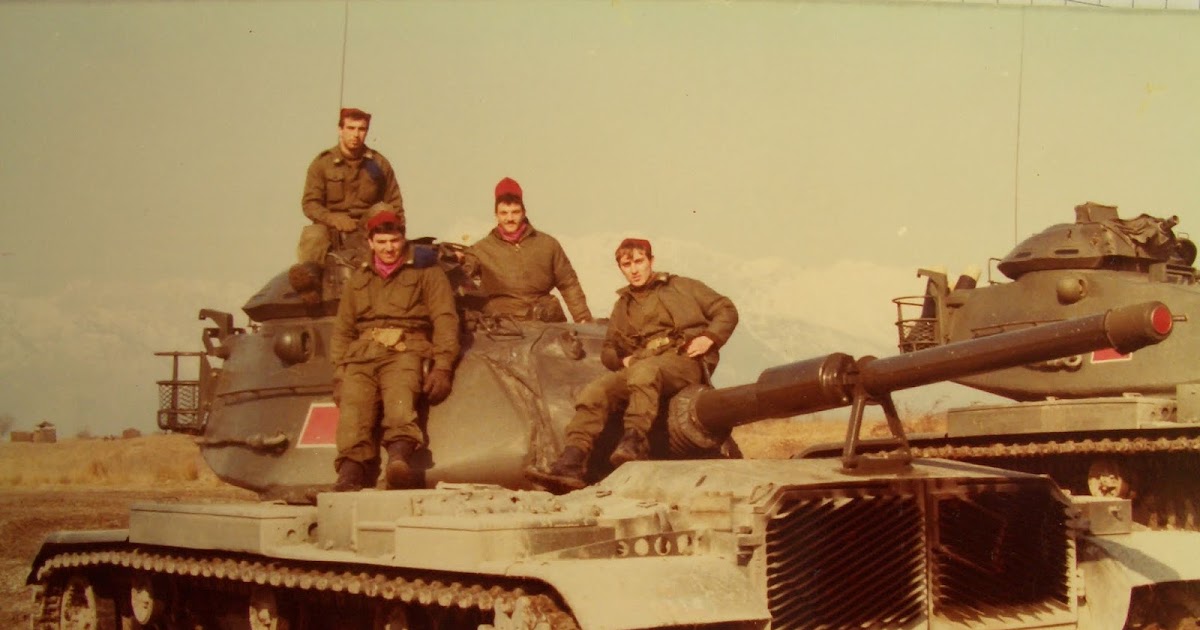
The core of the Italian armed forces is the ground forces, the development of which is in accordance with the requirements of the command of the aggressive NATO bloc. Italian experts consider the armored forces to be the main striking force of the ground forces. They are intended to solve the most important tasks in various types of combat operations.
Organizationally, the Italian armored forces consist of armored divisions, an armored cavalry brigade, armored divisions and tank battalions (squadrons), which are part of infantry divisions and separate infantry brigades.
The armored division is the main tactical unit of armored troops. According to Italian experts, it has a high firepower, high maneuverability, significant striking power and relatively good anti-nuclear and anti-chemical protection, and is capable of conducting all types of combat operations: attacking and destroying the defending enemy, capturing his defensive positions, penetrating deep into the enemy’s rear and successfully pursuing his units, launching strong counterattacks on the advancing enemy group, conducting mobile defense and defense of the area, carrying out deterrent and retreat actions, and destroying enemy air and sea landings.
As emphasized in the Italian press, the role of a division is determined primarily by the place it occupies in the battle formation of an army corps and the importance of the direction in which it operates. An armored division usually operates as part of an army corps and can only in certain cases perform tasks independently. In an offensive in conditions of the use of nuclear weapons, it is considered advisable to use it in the first or second echelons of an army corps in the direction of the main attack. In an offensive without the use of nuclear weapons or in defense, a division, as a rule, constitutes the second echelon (reserve) of an army corps.
The division consists of: headquarters, command company, two tank and one motorized infantry regiment, self-propelled artillery regiment (four divisions of 153-mm self-propelled howitzers and a division of 203.2-mm self-propelled howitzers), three separate battalions (reconnaissance, communications and engineer-sapper), logistics regiment, light aviation detachment and carabinieri company. The number of personnel is over 17,000 people. The division is armed with more than 360 tanks. 12 203.2-mm self-propelled howitzers, 72 155-mm self-propelled howitzers, about 100 mortars of various calibers, 28 ATGM installations, about 100 106-mm recoilless rifles, over 400 anti-tank rocket guns, about 850 armored personnel carriers, more than 2,000 vehicles, 8 aircraft and helicopters . Armored vehicles include M24 light tanks, American-made M47 and M60A1 medium tanks, and West German Leopard tanks
During combat, tactical groups (reinforced regiments) are usually created in divisions on the basis of tank and motorized infantry regiments, and within them – battalion tactical subgroups (reinforced battalions). According to Italian military experts, such a distribution of forces and means allows for more effective use of their capabilities. The composition of tactical groups and subgroups depends on their place in the battle order of the division (regiment) and the upcoming task. A tactical group operating in the first echelon in the main direction usually includes two tank subgroups and one motorized infantry group, an anti-tank reserve and engineer-sapper units.
In order to effectively support the combat operations of an armored division, a divisional artillery group is created on the basis of organic and attached artillery, which is divided into two subgroups: general and direct support. The general support subgroup usually includes a 203.2 mm howitzer battalion and 1-2 155 mm howitzer battalions. This subgroup remains subordinate to the division commander to solve fire missions in the interests of the division as a whole, as well as to reinforce the regiments operating in the main direction with fire. The direct support subgroup is used to provide fire support for the combat operations of regiments (tactical groups) of the first echelon at the rate of 1-2 battalions per regiment. However, control of these battalions, with the exception of those cases when they are attached to regiments for reinforcement, is carried out centrally.
The distance of the firing positions of 155 mm howitzer divisions from the front line is 2-6 km, 203.2 mm howitzers – 4-8 km. For each division, primary and reserve firing positions are prepared, the dimensions of which can be 2.5 x 2 km or more for 155 mm howitzer divisions, 5.5 x 5 km for 203.2 mm howitzer divisions.
Armored division on the offensive
For an offensive, a division receives a strip, the width of which is determined by the received combat mission, the nature of the defense and the composition of the enemy forces, the terrain features, and the combat capabilities of its troops. It is believed that under conditions of the use of nuclear weapons, an armored division can most effectively operate in a strip no more than 20 km wide.
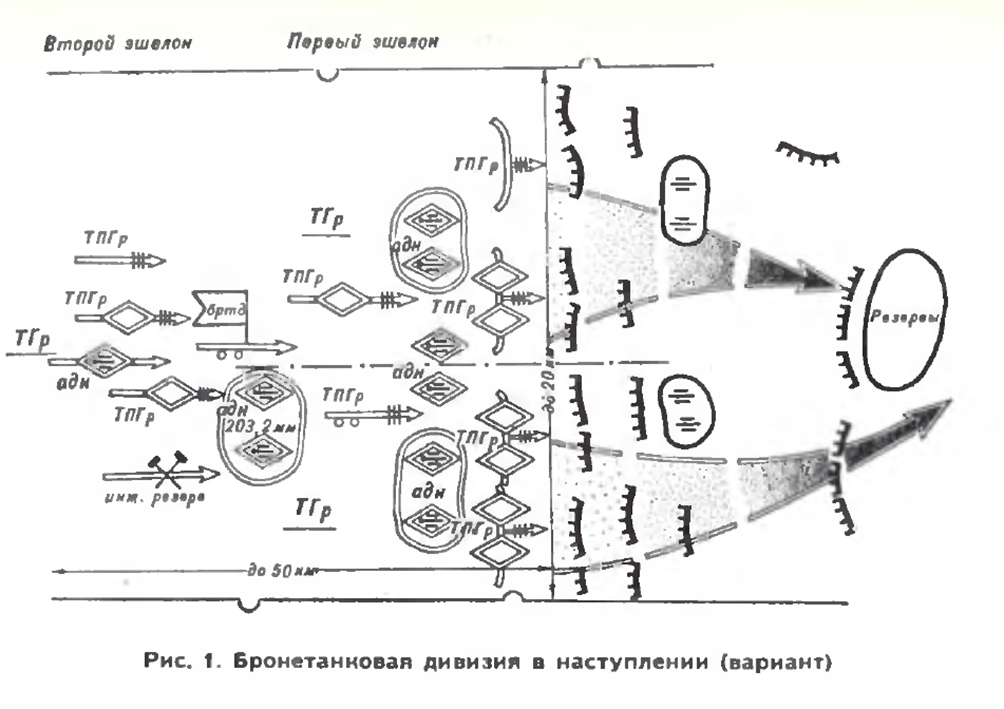
In an offensive, an armored division is used, as a rule, in the main direction in the first or second echelon (reserve) of an army corps. When operating in the first echelon of a corps, a division can advance from a waiting area or from direct contact with the enemy. Being in the second echelon (reserve) of a corps, a division increases the force of the first echelon’s strike, develops an offensive in depth, and repels enemy counterattacks.
In the offensive zone, the division delivers the main blow and one or two auxiliary ones. According to Italian experts, this allows the enemy to be misled about true intentions and to ensure a wide maneuver of forces and means during the battle. The main blow is delivered on a relatively narrow section of the front and in the shortest direction to the offensive object. Blows in auxiliary directions should contribute to the expansion of the breakthrough area and hamper the enemy’s possible maneuver.
In conditions of combat operations with the use of nuclear weapons, as well as in an offensive without the use of nuclear weapons against an enemy who has hastily gone over to the defensive, in order to deliver the most powerful initial blow, the battle formation of an armored division is planned to be built, as a rule, in one echelon with the allocation of general, anti-tank and engineering reserves. In this case, a two-echelon formation is used for the battle formation of tactical groups. Tank tactical groups are recommended to be used in the first echelon in all cases. When attacking a previously prepared enemy defense in a non-nuclear war, the division’s battle formation will usually be built in two echelons with the allocation of appropriate reserves.
The first echelon usually includes the majority of motorized infantry battalions. It is intended to break through the enemy’s defenses and create favorable conditions for the purpose of developing success in depth. The second echelon usually includes a tank tactical group (reinforced tank regiment), whose task is to develop success in the main direction.
Tank tactical groups operate in the direction of the division’s main attack, where the main efforts of the general support artillery subgroup are also concentrated.
The division’s combined arms reserve may include 1-2 tactical subgroups captured from tactical groups operating in a secondary direction. It is intended to solve problems that suddenly arise during an offensive. According to Italian specialists, the main purpose of the reserve is to develop success in the direction in which it has emerged. Based on this, before the offensive, the reserve is given the direction of movement and possible lines of entry into battle. Before entering into battle, the reserve’s task is clarified, and interaction with the tactical groups of the first echelon and artillery is organized.
The Italian military press emphasizes that if the warring parties have nuclear weapons, commanders of all ranks must disperse the axial formations during the division’s offensive and conduct constant and active reconnaissance. Dispersion of combat formations is achieved by creating such gaps between tactical groups and subgroups that would make it possible to avoid the simultaneous defeat of two battalions by one medium-power nuclear strike.
The combat missions of an armored division in an offensive are determined by the corps commander and depend on the concept of the offensive, the nature of the defense and the composition of the enemy forces, the state of the division’s troops and their combat capabilities, and the terrain. The depth and content of the assigned missions are primarily influenced by the scale of the use of nuclear weapons both in the offensive zone and on the flanks. It is believed that the greater the depth of the enemy’s suppression by nuclear weapons, the more opportunities will be created for fragmenting his defense and defeating his troops in parts, for maintaining the superiority of one’s own forces and means in decisive directions, as well as for increasing the force of the strike and developing the offensive at a high rate.
The combat mission of a division is divided into immediate and subsequent. The immediate mission of an armored division operating in the first echelon of a corps may be to break through the first echelon of the enemy division’s defense and reach the position of the divisional reserves. The subsequent mission may consist of developing the success and completing the breakthrough of the defense to the entire tactical depth or be reduced to actions toward one of the flanks with the purpose of encircling and destroying a certain enemy group. The subsequent mission is usually accomplished by introducing the second echelon (reserve) into battle.
The initial position for an offensive under the threat of using nuclear weapons is recommended to be taken in such a way that the main forces of the first echelon of troops are brought as close as possible to the enemy’s forward defense line and thereby prevent nuclear strikes being launched against them. In some cases, and especially when the offensive envisages launching nuclear strikes against the enemy’s forward defense line, the initial position may be taken at some distance from it.
Before going on the offensive, nuclear strikes are carried out (when conducting combat operations with the use of nuclear weapons), artillery and air preparations are conducted. Nuclear strikes, depending on the power of the available ammunition, the position of the troops and the concept of the battle, can be carried out on objects located in the first or second position. During the fire preparation, strikes are carried out on enemy strongholds, weapons of mass destruction, command posts, communication centers, tank and artillery units in firing positions. The enemy is suppressed especially tightly in the direction of the main attack. The beginning and end of the division’s fire preparation is determined by the corps commander.
Immediately after the end of the fire preparation, the first echelon of the division quickly goes on the offensive, trying to use the impact of the fire preparation on the enemy as effectively as possible and deprive him of the opportunity to put himself in order. As the division’s units reach the attack line, the fire of the supporting weapons is transferred to the depth, and in the area of delivering a nuclear strike – to the flanks.
To achieve success, it is recommended to conduct the offensive decisively, at a high pace. Between the centers of resistance, the attacking units and parts advance in pre-battle formations, quickly break through into the depths in as many directions as possible in order to quickly expand the area of the breakthrough, bypass the flanks of the enemy, encircle and destroy him. Having met stubborn resistance from the enemy, the attacking parts follow closely behind the fire of the supporting means until they approach the enemy position at the distance of the throw into the attack. If the enemy’s anti-tank defense is suppressed, then tanks advance in front, which capture the object of attack and take up all-round defense in positions favorable for defense, waiting for the approach of the motorized infantry advancing behind them. In the presence of strong anti-tank defense of the enemy, dismounted motorized infantry advances forward, supported by fire from tanks and other weapons.
The offensive of units and subdivisions is also supported by aviation, which strikes the most important centers of resistance that hinder the successful advance of troops, as well as command posts, communication centers, approaching reserves and rear facilities of the defending enemy.
The first echelons of tactical groups are followed by the second echelons, ready to reinforce the first echelons, develop success, or repel enemy counterattacks. In the course of developing success, enemy counterattacks are repelled, as a rule, from the spot. In order to maintain a high rate of advance and a rapid breakthrough of the tactical depth of defense, it is recommended to widely use tactical airborne assault forces. The composition of the assault force, depending on the current situation and the task at hand, can be from a platoon to a company. It is landed in areas not occupied by enemy troops, or in those that have previously been the target of nuclear strikes.
During the offensive, the division commander ensures the consistent fulfillment of the assigned tasks and, if necessary, makes changes to the original battle plan, ensures the concentration of efforts in the direction of the main attack and makes a decision to introduce the second echelon (reserve) into the battle, which is usually introduced after the completion of the division’s immediate task in order to develop success in depth. If necessary, the second echelon is introduced to complete the immediate task or to reinforce the tactical groups of the first echelon. After this, the division commander takes measures to restore the second echelon or reserve. In the event of the inability of the division to continue the offensive in order to complete the subsequent task, it destroys enemy resistance centers, repels possible counterattacks and ensures the introduction of the second echelon of the corps into the battle, preparing and clearing the routes of movement and providing it with fire support. The division of the second echelon of the corps advances to the line of introduction into the battle at maximum speed, reducing halts and stops to a minimum.
Armored division on the defensive
Defense, according to the views of the Italian command, is a type of combat action to which troops switch temporarily (under the influence of superior enemy forces) or deliberately. In both cases, the goal of defense is to inflict losses and wear out the enemy, disrupt or repel his offensive, hold the occupied terrain and gain time to prepare for an offensive. Sometimes troops switch to defense on one section of the front in order to save forces for an offensive on another.
According to the views of the Italian military command, defense is divided into mobile and area defense. The choice of the type of defense is determined by the tasks, the current situation and the availability of forces and means.
The Italian military press indicates that an armored division has an organization and weapons designed primarily for offensive operations, but it is also capable of effective defense when part of a corps or in army reserves.
An armored division can perform the following tasks: defend objects located in the depths; conduct defense on a wide front in order to cover the main group of the corps, organizing defense in the rear; defend a certain zone as part of an army corps or field army; conduct a holding battle for a certain time in accordance with the retreat plan of the higher headquarters.
When operating as part of a corps, a division is most often located in its second echelon (reserve) and is used to launch counterattacks, defend an area prepared in engineering terms, and also to reinforce or replace divisions of the first echelon. In some cases, it can organize and conduct defense independently.
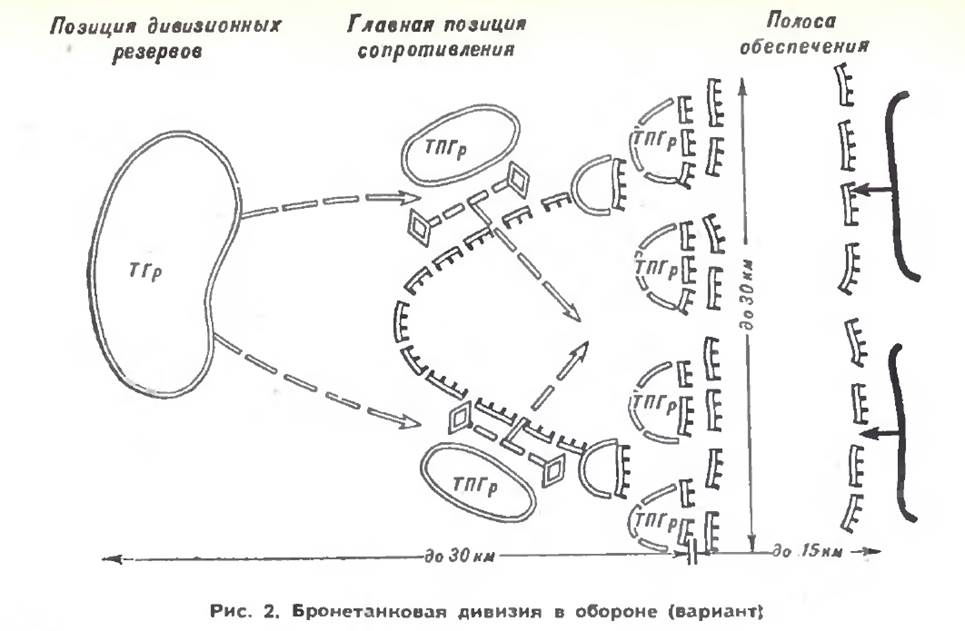
When conducting a mobile defense, an armored division receives a strip 20-30 km wide along the front and up to 30 km deep. The defense strip includes a security strip 10-15 km deep and a resistance position, which consists of the main resistance position and the position of divisional reserves, located 15-20 km from the forward edge of the defense
The security zone in the division’s mobile defense is created in the absence of direct contact with the enemy. It is usually occupied by the division’s reconnaissance battalion, reinforced by artillery, engineer-sapper and motorized infantry units. If the covering troops are sent by a corps, then in this case only general security is allocated from the division. In addition, combat security consisting of a company is sent from the tactical groups of the first echelon at a distance of up to 2.5 km from the forward edge of the defense. The lines of the covering troops and combat security are covered by mine-explosive barriers.
Within the main resistance position, strong points, cut-off and blocking positions are set up, and a system of engineering obstacles is created. Strong points or positions are prepared on tactically important terrain areas that dominate enemy approach routes or facilitate drawing the enemy into an area advantageous to the defender. The main resistance position is defended by the first echelon of the division. It includes tactical group defense areas, battalion defense areas (tactical subgroups), and fire weapon positions.
Tactical groups of the first echelon build their battle formations in 1-2 echelons, having 2-3 tactical subgroups in the first echelon and 1-2 in the second. In a secondary direction, a tactical group can defend itself on a wide front and build its battle formation in one echelon with the allocation of a reserve. As a rule, the first echelon of an armored division includes most of the motorized infantry units.
The area of the second echelon (reserve), as well as the main resistance position, is prepared in engineering terms. Reserve and blocking positions are equipped in the most probable directions of attack with the aim of creating a “bag” into which the enemy is planned to be drawn in during the defense for its defeat. The second echelon is located at the position of the divisional reserves or close to it in readiness to launch a counterattack or conduct a defensive battle.
Italian military experts pay great attention to artillery fire planning, defense, and the advance preparation of firing positions from which effective fire support can be provided for the division’s combat operations at all stages of defense. Thus, for a 155-mm howitzer division, it is recommended to have 1-2 firing positions in the support zone, 1-2 on the main resistance zone, and at least one in the positions of divisional reserves.
A division’s defensive battle consists of holding actions by cover troops, fighting to hold the main resistance position, and counterattacking. If there is a security zone, the defensive battle is started by cover troops. Their actions are supported by artillery from temporary or reserve positions and tactical aviation . Using nuclear land mines and mine-explosive barriers, the troops defeat the advancing enemy, delay its advance, and force it to deploy its main forces in battle formation. Without engaging in protracted battles, cover units withdraw in an organized manner to the combat outpost position. Under the cover of artillery fire, they pass through the battle formations and proceed to areas designated for them in advance.
The Italian military press emphasizes that when the enemy’s main forces approach the forward edge of the division’s defense, it is necessary to take all measures to force them to deploy in battle formation and prevent a breakthrough of the defense on the move. For this purpose, it is recommended to deliver a massive strike with artillery and aviation against the main enemy group, approaching columns and command posts, especially in the direction of the enemy’s main attack. When the enemy approaches the first trench of the first position, fire is conducted with maximum intensity from all types of weapons.
If the enemy’s advance cannot be stopped, the first echelon troops conduct the battle in such a way as to direct it to an area advantageous for delivering a massive attack with fire weapons and conducting a counterattack. For this purpose, all measures are taken to hold certain defense nodes and blocking positions in some directions and containment actions are conducted in others, forcing the enemy to move in a direction advantageous to the defender. When the enemy reaches the area designated for its stop, a massive attack with fire weapons is delivered against it. To complete the rout of the enemy who has penetrated the defense and restore the situation, a counterattack is conducted by the second echelon with the support of all the division’s fire weapons.
The most suitable moment for counterattacks is considered to be when the enemy’s advance has slowed down or stopped, and he has not yet managed to consolidate his position and regroup his forces.
The deployment lines for the counterattack are selected on terrain that ensures the secrecy of the exit and rapid deployment of the second echelon (reserve) into combat formation, the ability to effectively defeat the enemy from these lines with anti-tank fire, artillery and tanks, as well as a convenient transition of troops to the counterattack. The main striking force of the counterattacking echelon are tank units and subdivisions, which build their combat formations, as a rule, in two echelons. To build up efforts, the counterattack of the second echelon of the division can be carried out simultaneously with counterattacks of the reserves of the tactical groups of the first echelon and is supported by fire from all artillery and actions of tactical aviation.
In the event of an unfavorable outcome of the divisional reserve counterattack, the troops consolidate their positions and firmly hold defensive positions. If it is impossible to hold off the advancing enemy, the second echelon can switch to containment actions..
Autore: Colonel K. Kupriyanov
Fonte: Foreign Military Review No2 – 1975 (Оглавление журнала “Зарубежное военное обозрение” №2 1975)
 militartis.com
Lascia un commento