
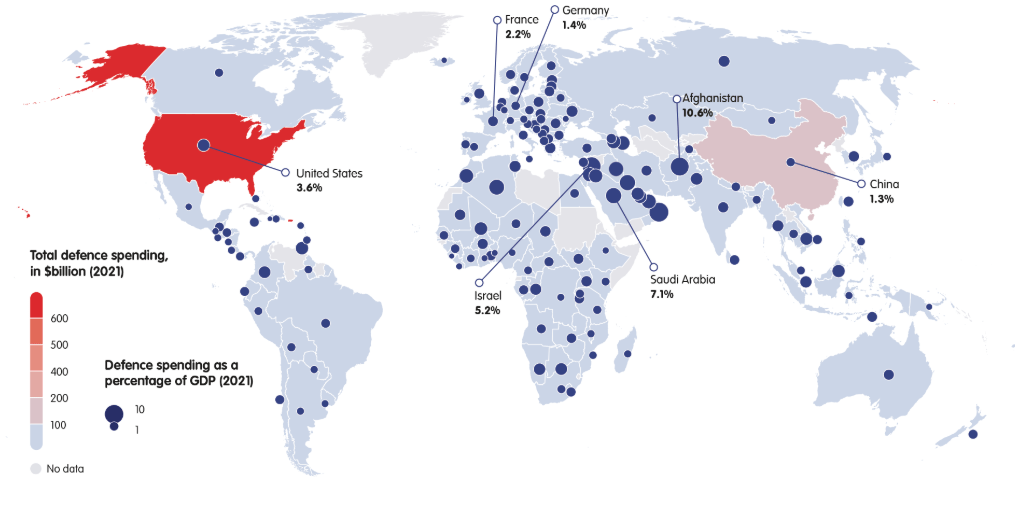
The dominant liberal theory has presented military expenditure as unproductive and wars and economic conflicts are prejudicial to the good functioning of economic mechanisms. Today the success of the American economy, which was regarded as declining at the end of the years 1980, raises the issue of the correlation between war, military expenditures, and economic growth with a new acuity. The theory of Paul Kennedy (1987) who explained at the end of the 1980s that the excessive importance given to military strength by the major economic powers has always been a factor of their decline, is challenged. The decline of USA is contradicted by the facts, with the collapse of the socialist system and the raise of the new economy of information, which have reinforced the American economy and technology (Smith, & al., 2008). Many analysts during the 1980s considered the Soviet Union as a greater military power than the United States, 20 years later the situation has radically changed, for the almost exclusive advantage of USA a kind of hegemonic power while maintaining a high level of military expenditures, almost the half of the world total, notably on military R&D. The reorganization of its arms industries has even been considered as a factor of “creative destruction” and the development of armaments adapted to the new strategic needs, such as terrorism and the uncontrolled spread of nuclear weapons.
The end of the Cold War has led to several changes in the arms industry at the world level. The expected “peace dividends” did nor appear, as the crisis on arms markets, due to the decrease in military expenditures, was not yet overcome when the defence budgets picked up again (Fontanel, Ward, 2002). The market logic has been encouraged in Western Countries to restructure the arms industries. The development of generic or dual technologies was encouraged, as well as the diversification on civil markets. The consolidation of the American arms industry has been quickly achieved, thanks to a strategy of rationalization and cost reduction, as well as of integration of military activities. The results was clearly less convincing in Western Europe, while the countries of ex-Warsaw Pact suffered from a dramatic industrial crisis.
Since 2000, disarmament is no more relevant. The Treaty of Rome and the World Trade Organization (WTO) recognize the inalienable right for governments to manage their defence and their security. The objective of national independence was decisive in the choice of the arms production; afterwards economic reasons have prevailed, such as imports replacement by national production (Fontanel, Saraiva, 1986) and increase of arms exports, development of the high technologies with spin-off useful for civilian purposes or job creation. States of arms-producing countries have always uses the military sector to set up their industrial policy.
The Peace-making Globalization disappointed
The rise of military expenditure during the Cold War induces several studies on their economic consequences whether neoclassical or Keynesian. Many famous economists have advocated for the end of the arms race, notably Arrow, Galbraith, Tobin or Sen, gathered within associations Economists Against Arms Race (ECAAR). Some studies dealt with the potential economic consequences of world disarmament, using mainly macroeconomic models. The economic analyses of the arms race had started with the Richardson model (1960). The World Model of Leontiev and Duchin (1980, 1983) analyses the economic consequences of disarmament of industrialized countries, with the transfer of savings to developing countries. Another model about the effects of military expenditures on the France and Morocco countries gave some unexpected results (Fontanel, 1982) on the relation between economic growth and military expenditures.
Some economic studies explained that military expenditures divert financial means, thus limiting civil investments. The reports of the United Nations at the beginning of the 1980s stresses the importance of the sums engaged in the military sector, and they insist on the considerable opportunity cost that they represented, in particular for developing countries (Accordino, 2000 ; Fontanel, 1981, 1982). Mary Kaldor (1982) had considered that the Military Industrial Complex (MIC) of industrialized countries, generated too sophisticated and costly technologies. The protection and secrecy rules of the military sector prevent technological spin-offs on civil production and guaranteed outlets for a few privileged firms. The end of the cold war in 1991 has opened the way to a disarmament process at the world level. Taking account their unproductive character (in a cosmopolitan or peaceful economy), the military expenditure should assert negative effects on the world growth in the long run. A logic of “arms control” and disarmament took place of arms race. In 1990s, the advocates of the direct conversion of military facilities (from the sword to the plow) considered that it should turn industrial activity towards unexploited opportunities in the civil sector. But the reality of conversion has been less encouraging, because of its induced costs, notably for retraining the staff, and because of the high financial barriers to get entry on civil markets. The cut in military expenditure has increased unemployment in arms producing countries, making it necessary to adapt the economic policy. The disarmament has created an obsolescence of productive capital and the need to undertake heavy investments. A restructuring of military industries may have negative economic effects in the short run.
However, disarmament is not equivalent to a reduction of military expenditure. Disarmament may have different forms, such as the reduction of the military expenditure, the cessation of some arms productions or the destruction of weapons.
– The destruction of weapons stocks or the control of disarmament agreements leads to additional costs. Moreover, a destruction of weapons stocks neither guarantees the reduction in the strategic capacity, nor that the military expenditure.
– Partial disarmament modifies the balance of power and often implies a procedure of rearmament.
– Lastly, the immediate conversion of the military productions into civil ones often proves inadequate. The military secrecy and the very strict administrative rules have created a culture far removed from market’s constraints. Sophisticated military technology is generally not adapted to mass production, and the products resulting from conversion obtain uncompetitive costs in a market strongly encumbered by the production of civilian firms.
The arms industry remains important for industrialized economies, but the firms that are the most successful are those that are able to develop dual technologies and to diversify their production in the civil sector. The American disarmament has succeeded in releasing resources for the civilian sector and in attracting the world capital, notably thanks to the development of information technologies, which had first been developed in the military sector.
The reduction of defence budgets did not create the awaited “dividends of peace” nor did it reduce significantly the threats because of the remaining stocks of nuclear weapons. The arms industry remains important for industrialized economies, but the firms that are the most successful are those that are able to develop dual technologies and to diversify their production in the civil sector. On the contrary, disarmament caused major sectorial and regional crises, in particular in the economy of USSR (Aganbeguyan, 1994; Fontanel, Borissova, Ward et al. 1995; Shkaratan et al., 1998 ), but also for some regions or industrial sectors (Fontanel, Matelly 2000). Then, if there is no profit, it is impossible to receive some dividends. The concept of “peace dividend”, very popular during the Cold War among economists, has been replaced at the UNO by “peace investment”, thus showing the costs induced by the disarmament process.
The new firm’s strategy was to sell not only military products but also commercial services. The world concentration process of armament firms is spectacular Since 1991, under the impulse of the government, the American arms industry engaged in mergers-acquisitions, leading to the emergence of four great entities: Boeing, Lockeed Martin, Northtrop Grumman and Raytheon. The size of the firms but also of the American market makes armament firms able to obtain economies of scale and greater export competitiveness than armament companies from foreign countries. However, according to Blanc (2000), the American reorganizations were not just made to reach size effects. These concentration operations are not mainly decided for military or economic reason, but for increasing financial profits for managers and shareholders.
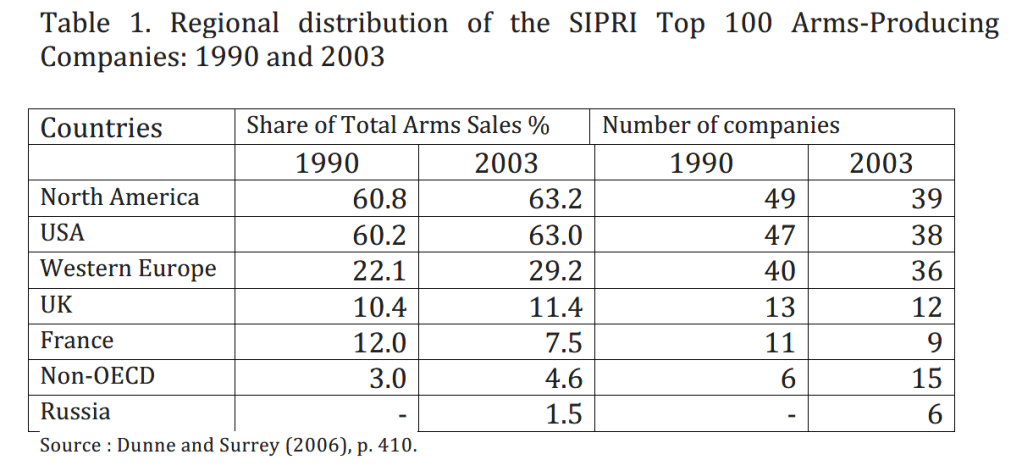
But in other places, and in particular in the countries of the ex USSR, the cut on world military expenditure had a much more destroying impact on the armament industry. Russia, in particular underwent heavy economic losses (Aganbeguyan and al. 1994 ; Fontanel et al. 1998a, 1998b, 2000, 2002; Earle and al. 2001). In 1991, the success of the conversion of the gigantic MIC was presented as a necessary condition for the transition success, notably in several report of UNO. Fifteen years later, force is to note that this conversion was a global failure (Fontanel & Karlik, 2004, Karlik and al. 2008). Military industries, at the base of the Soviet industrial development, could not be reconverted satisfactorily into civil productions. Indeed, the cessation of the military production may have disastrous economic effects in the short run, by involving the closing of factories, which ensured the economic survival of important areas, while at the same
time conversion in civil production proves to be impossible, because of the barriers to get entry in civilian sectors. In addition, the cost of the cessation of military productions must integrate the cost of the capital, which cannot be used in new productions. Unemployment were the immediate consequences of the reduction of Russian military expenditures. Many effects of inertia, related to the administrative rules inherited the preceding political regime, have prevented a good conversion.
Today, most the former Soviet MIC firms are privatized by the Russian government, or were transformed into public companies. Several are now under control of regional authorities. Just as in the West, the firms have tried a diversification toward civil productions and dual technologies, in aeronautics and aerospace, as well as the development of military and civil exports. Today Russia is indeed one of the largest arms exporters in the world. Lastly, it is also necessary to take into account the fact that the destruction of the military materials, associated a procedure of international disarmament, is expensive. Most of the assistance of the Western countries to disarmament was used for the elimination of Weapons of mass destruction.
The spontaneous disarmament of the Soviet Union therefore proved to be an ideological, political, and economic defeat (Earle & Komarov, 2001). Paradoxically, at the beginning of the 1990s, the United Nations reports explained that is was probably in the USSR that conversion should be the most economically interesting, because of the great potential demand of the weak competition and of the capacity for companies to produce dual goods, for military and civil consumption. Gorbatchev himself has based great hopes on the MIC forces to revitalize the national economy. However, the Russian economy suffered from obsolete infrastructures, inertia effects, industrial over-capacity as well as from a very insufficient commercial culture, and an economic crisis. The transition problems are partially due to the incapacity of the military sector for a civilian reconversion. Experience shows that in the short run there exist few dual applications for civil production, even if later on, the spillovers may prove interesting.
Compared to the American firms, it is with delay that European arms firms have been engaged in a reorganization and concentration (Hartley and al., 2008; Dunne, Surry, 2006 ; Fontanel, Ward, 2002). That is explained by the difficulty of reforming a European industry, which was compartmentalized around national markets, preventing the reduction of unit costs and the widening of range of products. In addition, the programs of industrial cooperation in order to set up an integrated European defence industry have been set up only gradually. The success of joint venture is limited, because of rigidities, the rules of national return and additional
administrative costs. The strategic divergences between European countries is the main problem for European defence..
During the decade 1990s, there was a multiplication of joint companies created for marketing and customer service. However, the European industrial structures became very complex, generating duplication, making it necessary to rationalize the productive and commercial structures. After the reform of defence policy engaged in Spain, France or Italy at the end of the years 1990s, it was possible to engage the first great operations of fusions-acquisitions on a European scale, initially in the aerospace one and the electronics of defence, therefore radically modifying the structure of the European industry. Nowadays, some great European firms have emerged on aerospace and the defence electronics markets but in particular for land and naval armaments, the reorganization remain incomplete.
The industrial groups resulting from the reorganisation of the last 1990s have gradually changed their strategies, by multiplying the subsidiaries, joint ventures and alliances, while diversifying in civil productions. These are primarily the sectors of aerospace and defence electronics that were concerned with the diversification process. For France, in 2001, 72% of these markets were contracted by the DGA (Délégation Générale à l’Armement). The groups wish to limit their dependence to official orders. This evolution complicates obviously the statistical analysis of the armament sector, in particular on the level of the appreciation of the manpower really employed in defence.
What importance for military-industrial complex ?
The worldwide liberalization of economic activities did not produce the pacification of international relations and thus does not validate the classical paradigm of peace thanks to free trade. There is a persistent instability, due to nuclear deterrence from the super powers and the economic race and future economic conflict between super powers. USA hold supremacy for new weapons including technological progress. The market logic, seems to have reinforced both the military and economic power of this hegemonic country. For Washington, the opening of the economic frontiers favours the world peace and therefore disarmament. Hoxwever, during the Clinton’s mandate, the national security has been presented as depending on the economic power. Paul Krugman (1996) criticized its idea (a country is not a company). The idea of an economic war justify a strong industrial and trade policy in the USA, using economic intelligence and counter-intelligence. The development of the Advocacy Center, of the National Information Center (DTIV) and of the Central
Information Reference and Control System (CIRC) confirm this US hegemonic policy..
One can wonder whether the war is not essential to the capitalism. In 1967, a report (Anonymous, 1967) has stated that the disappearance of wars would create economic and sociological problem in USA. The idea of conversion was presented as politically unacceptable, given the acquired interests and because there was no real substitutes for war and war threats. Indeed, the report underlined the importance of the military expenditures wasting in the stabilization and control of the national economies. War also permits the citizen’s subordination to the State and the control of social dissensions and antisocial tendencies (Barnett, 2003). New institutions should be created in a situation of lasting peace, so has to maintain citizens’ adhesions to the political authority. In the same perspective, Jacques Attali (1998) present war as the expression of an extreme industrial competition; the history of capitalism implies the emergence of brutal phase, which, if it does not give place to a military war, led with the development of symbolic alienation system (Coulomb, & al. 2005). Nowadays, the latter could be found in the modern ideology of the globalization (Binnendijk, 2002).
In a world of scarcity, the military expenditures, largely unproductive, may be considered as a wasting, notably in the absence of conflicts or major Threats. However, high economic and social inequalities may fuel international conflicts; and yet the globalization process has not solved the problem of poverty and underdevelopment. As Kenneth Arrow (2002) recalled, the preceding age of the globalization peaked at the end of the nineteenth century and was brutally stopped by the World War I, in spite of the rise of world trade and financial flows. Francis Fukuyama (1993) considered the end of the Cold war as the end of history. However, this civilization philosophy does not work. It appears today that asymmetrical wars will multiply in the future (Mùnkler, 2003. The globalization process also makes more industrialized countries more vulnerable to enemy attacks, given the development of communications and mass transports, the population concentration in urban zone, etc. While the Cold War arms races opposed comparable actors, the new arms races will be asymmetrical, confronting countries with high-tech weapons to less developed countries, but with mew weapons. Several examples, such as African conflicts or the attacks of September 2001, have proved that the technological superiority is not a guarantee of security or of victory, whereas industrialized countries wish to limit the human loss of life.
Moreover, the cost of the new wars is much lower than that of Cold War conflicts. The American-Soviet arms racehad impoverished the Soviet economy-y, leading to its collapse. The current asymmetrical conflicts do not require the same level of financial resources. Recent terrorists acts have
shown that military inferiority could be offset by commando-suicides. The terrorist methods have the advantage of not having to count on the implication and the support of the civil population, unlike the guerrillas. Today there are a lot of conflicts, bur only 2 are interstate conflicts, United States against Iraq and India against China. Most of the others were new conflicts, not limited to an interstate confrontation. They involve new actors, such as militia, political groups or civil population. These conflicts are difficult to identify in time and in space and require international operations (notably with UNO) that associate human rights specialists and
technicians to rebuild the state apparatus. It appears however that
economic misery and social inequalities, combined with political oppression, are factors of conflicts. In the 1980s, the “debt crisis” remains important for some developing countries and their dependence toward the International Monetary Fund and the World Bank limits their sovereignty and their chances for democracy. The economic argument of peace through development thus seems particularly significant in the African cases.
The arms industry changed with globalization. It is internationalized, even if arms markets remain mainly national and if the government keep on supporting arms exports. The USA used the conversion process of the arms industry to reduce by a half the regular suppliers of Pentagon and by instituting commercial standards for the military purchases. The dissolution of COCOM, partially replaced by the arrangement of Wassenaar to keep some restrictions against the rogue states, permitted exports of products usable for weapons, in particular the telecommunication and computers materials. Thus, dual technologies have been used for civilian ends. Indeed, military and civil technologies of satellites are very close and military ones are able to replace old civilian satellites.
The concept of globalization expresses the integration of the productive and commercial activities in global market system. It applies to the creation of value, from the export to the total integration of production. All reorganization process has a cost, like any investment it supposes economic risks. From a cultural point of view, the military sector is expressed mainly in the field of the high technology. It privileges some technologies, which then influence all the economy. Three assumptions are generally retained for the study of the economic effectiveness of the military R&D. First eviction effect supposes that appropriations for military sector of a new technology produced by military R&D are done to the detriment of the civil sector. Then the technology transfers between military and civil sector suppose the passage from a technological and strategic priority (often kept secret) to an economic priority. Lastly, the demand-pull effect makes an additional request for R&D that supports the forces of innovation.
Today, the art of warfare remains linked with technological progress, but the political considerations become preponderant. The new generation weapons are based on information technologies, in the forms of meta-systems, thus qualifying the compete overlap of the weapons systems and command chains. The installation of computer viruses likely to make inoffensive the enemy weapons may give a considerable power to a State. USA keeps its lead in this field, thanks to its advance in information technology. A limited number of firms control the production of these new materials, thus reinforcing the influence of the MIC. Europe being connected with American networks, its dependence toward the American army is reinforced. The law of the strongest prevails here and will favour the global supremacy of the American industry on world markets.
The military sector can be more likely than the private sector to reveal major innovations boosting economic growth, in particular through rise in productivity. The demand for defence would have largely accelerated the development of new technologies in USA in the past. More particularly, the sectors of aeronautics, nuclear and electrical energy, data processing, Internet and space are more concerned. The technological maturity is necessary so that the innovation leads to productivity gains. A major war threat produces a new technological revolution sufficient to durably increase productivity rates. But only the existence of an external threat could lead once again to the mobilization of the scientific, technical and financial resources necessary to make appear these major technologies, as during the Cold War (Ruttan, 2006)..
In peacetime, the military sector does not have sufficient incentive to carry out such an effort, nor does other parts of the public sector. Private sector is not able to initiate a new major technology, considering the induced short term profits and the slowness of the cycle of innovation, which often lasts several decades. In the same order of idea, Bellais and Foucault (2005) criticize the reforms of the defence policies in Western countries; the liberalization and the market logic discourage long-term R&D, which is thus central for industrial innovations.
The question of the relation between the defence budget of defence and economic development is important, at constant national security level. For example, the advantages resulting from the maintenance of a high level of military expenditure, in terms of domination on the international economy, should be taken into account (trade agreements, markets liberalization, diplomatic pressure, etc.). The long-term economic consequences of an excessive militarisation should also be considered. As the US defence budget increases the public deficit exerts an inflationary effect, and it undoubtedly influences the dollar parity and the flows of
foreign direct investments. The links between military expenditure and economic growth is thus multiple and difficult to analyse.
With the extension of NATO, the risks of conflicts between the great powers decline. The rise of American military expenditure, along with forces redeployment and new strategies, reinforces United States hegemony in front of its allies Nevertheless the importance of the American armament, turned a priori toward the zero defect of national defence, is likely to favour conflicts, as it obliges the adversaries to innovate and to find new techniques to erode the American power (Ayduinly, & al. 2005).
Bibliografia:
Accordino, J.J. (2000), Captives of the Cold War economy : the struggle for defense conversion in American Communities, Westport, Praeger.
Aganbeguyan, A., Fontanel, J. (1994), Un monde en transition. Les exemples de la Russie et de l’industrie d’armement, Cahiers de l’Espace Europe, n°5, Grenoble,
Anonyme (1968), La paix indésirable, rapport sur l’utilité des guerres. Préface J.K. Galbraith, Calmann Levy, Paris..
Arrow, K. (2002), La globalisation et ses implications pour la sécurité internationale, Pax Economica, 6, Grenoble.
Attali, J. (1998), Dictionnaire du XXIe siècle, Fayard, Paris.
Aydinli, E., Roseveau, J.N. (2005), Globalization, security and the nation state. Paradigms in transition. State University of New York Press.
Barnett, R.W. (2003), Asymetrical warfare, Brassey’s Inc. Washington.
Bellais, R., Foucault, M. (2005), Europe de l’armement, Defense et Sécurité Internationale, 1.
Binnendijk, H. (2002), Transforming America’s military, National Defence Univerity Press.
Blanc, G. (2000), Dépenses militaires, restructuration de l’industrie d’armement et privatisation de la défense : Analyse comparée France-Etats-Unis 1994/1999. Arès, Défense et Sécurité, XVIII(3).
Colard, D., Fontanel, J. and Guilhaudis, J.F., 1981. Le Désarmement pour le développement: dossier d’un pari difficile (Vol. 19). Fondation pour les études de défense nationale.
Coulomb, F., Fontanel, J. (2000), La puissance des Etats et la globalisation économique, Ares, Défense et Sécurité, n°45, Mai.
Coulomb, F. and Fontanel, J., 2003. Disarmament: A century of economic thought. Defence and peace economics, 14(3), pp.193-208.
Coulomb, F., Bensahel, L., Fontanel, J. (2005), The concepts of economic war and economic conflicts in a global market economy. Arms, War, and Terrorism in the Global Economy Today : Economic Analyses and Civilian Alternatives, 13, LIT Verlag, Bremer Schriften zur Konversion,
Dunne, J.P., Surry, E. (2006), Arms production. SIPRI Yearbook, Oxford University Press. Earle, J.S., Komarov, I. (2001), Measuring defense conversion and transition in Russia, Defence and Peace Economics, 12(2).
European Defence Agency., (2007), A strategy for the European Defencce technological and industrial base? EDA, Brussels..
Fontane!, J. (1982) Mi!itary Expenditure and Economic Growth: France, Morocco. report written for the United Nations, 6.
Fontane!, J., Saraiva-Drummond, J. (1986), L’industrie d’armement comme vecteur du déve!oppement économique, Etudes Polémologiques, n° 40, Paris
Fontane!, J. Borissova, I, Ward, M. (1995), The princip!es of arms conversion in the case of Russia, Defence and Peace Economics 6(3).
Fontane!, J. (1995) Organisations économiques internationales, Masson.
Fontane!, J., Hébert, J-P. (1997), “The end of the French grandeur po!icy.” Defence and Peace Economics 8, no. 1 (1997
Fontane!, J. and Cou!omb, F. (1998a). Le succès de !a conversion des industries d’armement, condition nécessaire de !a réussite de !a transition. L’avenir de l’économie russe en question, Presses Universitaires de Grenob!e, Grenob!e.
Fontane!, J., Gaidar, I. (1998b), L’avenir de l’économie russe en question, Presses Universitaires de Grenob!e, Grenob!e.
Fontane!, J., Mate!!y, S. (2000), Le coût des dividendes de !a paix, Mondes en développement, Tome 28
Fontane!, J. and Ward, M.D., 2002. A hard !ook at the costs of peace. World Economics, 3(2).
Fontane!, J., Kar!ik, A. (2004), The industry of armaments in Russia: Co!!apse or
reviva! ? in Guerres et conflits économiques, Université Pierre Mendès France, Grenob!e. Fontane!, J., Kar!ik, A. (2005), L’industrie d’armement de !a Russie, Innovations. Fontane!, J. (2007). Questions d’éthique: Guerre, démocratie, économie, éducation,
marketing, sport, genre. Editions L’Harmattan.
Fontane!, J., (2005). La g!oba!isation en ana!yse. Géoéconomie et stratégie des acteurs, L’Harmattan, Paris, 250.
Fontane!, J., Chatterji, M. (2008). War, Peace, and Security. Emera!d Group Pub!ishing. Fontane!, J., Samson, I. (2008), The determinants of mi!itary expenditures, War, Peace, and Security, Fontane!, J. and Chatterji, M. eds. Emera!d Group Pub!ishing
Fukuyama, F. (1993), The end of history and the !ast man, Penguin, London.
Hart!ey, K., Be!!ais, R., Hébert, J-P. (2008), The evo!ution and future of European Defence Firms, in War, Peace, and Security, Fontane!, J. and Chatterji, M. eds.. Emera!d Group Pub!ishing
Hébert, J-P. (2002), Le rapport des dépenses mi!itaires Etats-Unis/Europe se réduit en !ongue période. Le Débat stratégique (60).
Ka!dor, M. (1982), The baroque arsenal, Deutsch Edition, London.
Kar!ik, A., Maximtsev, I, Hébert, J-P., C!ouet, P-M. (2008), Defense-industria! estab!ishment of Russia, in Fontane!, J. and Chatterji, M. eds., 2008. War, Peace, and Security. Emera!d Group Pub!ishing.
Kennedy, P. (1987), The Rise and Fa!! of the Great Powers, Random House, New York. Krugman, P. (1996), A country is not a company, Harvard Business Review, Jan.-Feb.
Léontiev, W., Duchin F. (1983), Military spending : Facts and Figures. Worldwide implications and Future outlook. Oxford University Press.
Mùnk!er, H. (2003), The wars of the 21st century, IRRD 85(849).
Richardson, L.F. (1960), Arms and insecurity : a mathematical study of the causes and origins of war. The Boxwood Press, Pittsburgh.
Ruttan, V.W. (2006), Is war necessary for economic growth ? Military procurement and technology development. Oxford University Press. Oxford.
Shkaratan, O. and Fontane!, J., 1998. Conversion and personne! in the Russian mi!itary-industria!-comp!ex. Defence and peace economics, 9(4), pp.367-379.
Smith, R., Humm, A. and Fontane!, J., 1987. Capita!-!abour substitution in defence provision. London.
Smith, R., Humm, A., Fontane!, J. (1985) The economics of exporting arms, Journal of Peace Research, 22(3).
Smith, R., Fontane!, J. (2008), Internationa! security, defence economics and the powers of nations, in War, peace and security, Emera!d
Autore: Jacques Fontanel
Fonte: Economics of International Security
Categorie
Tags
 militartis.com
Lascia un commento