
It is know that everything new is well forgotten old. This expression reflects the essence of the historical research method widely used in science. The study of any object and phenomenon from the point of view of the dialectic of its development from the moment of its appearance to the current state, the analysis of transformations and changes help to understand the essence of the studied, the current state and development prospects.
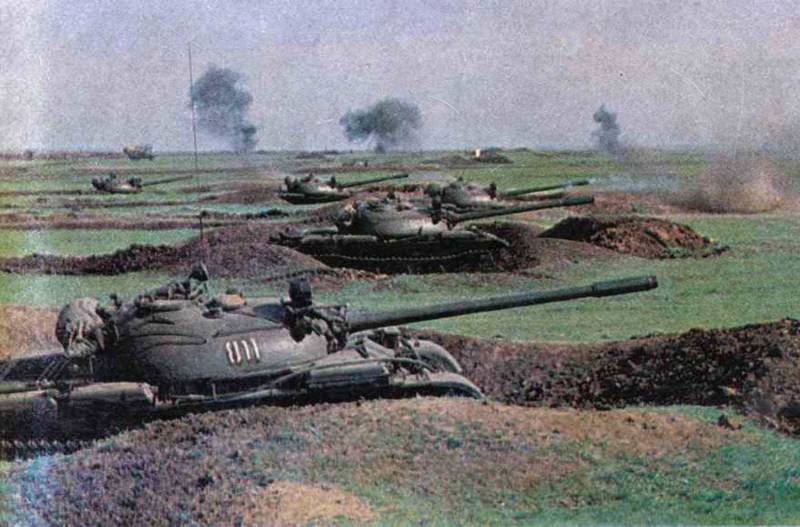
In military affairs, the historical method is not only applicable, it is simply necessary to eliminate previously made mistakes. Thus, it will be very useful to use the historical method when considering the issue of the advisability of firing from tanks from closed firing positions (CFP). We are talking about the “new” method of combat use of tank units, which is widely promoted today in our Armed Forces. The essence of the method consists in involving tanks in the performance of fire missions of field artillery from CFP, which are not typical for them.
Studying the history of firing from tanks with closed firing positions does not require deep immersion in time; it is enough to look back only three quarters of a century. For the first time, armored vehicles were involved in firing from closed firing positions at the final stage of the Great Patriotic War. At that time, tanks and self-propelled artillery guns of the second echelons were involved in the artillery preparation of an offensive as a reinforcement of field artillery to increase the fire impact on the enemy before the attack. Corresponding instructions appeared in post-war artillery textbooks and manuals, as well as in the Rules for Firing from Tanks. In 1958, the Office of the Chief of Armored Troops of the Soviet Army published a training manual “Firing from Tanks and Self-Propelled Artillery Mounts from Closed Firing Positions” 1 . The use of tanks in firing from closed firing positions remained relevant until the 1970s. The last instructions on this topic were contained in the 1970 “Instructions for the Fire Control of Ground Artillery” 2 and in the “Tank Firing Rules (PST-74)” of 1974 3. Then this method of combat use of tanks was abandoned, recognizing that firing from tanks with CFP was ineffective.
And now, almost 40 years later, we are witnessing a revival of the idea of firing from tanks with a CFP, which is presented as a useful and necessary innovation in light of today’s requirements. The main argument is that the firepower of the standard artillery of motorized rifle brigades does not allow for the necessary volume of fire missions to be carried out in an offensive, which is quite fair. The sharp decline in the firepower of artillery is a natural result of the reduction in the quantitative composition of artillery in the RF Armed Forces in the 1990s.
However, a number of questions naturally arise regarding the involvement of tanks in the performance of field artillery tasks. Firstly , how expedient is it to strengthen artillery at the expense of tank troops diverted to perform artillery fire tasks with the CFP that are not typical for them? Secondly , how effective is a tank when used as a field artillery weapon? Thirdly, what is the economic component of such a decision?
In searching for answers to the first two questions, let us turn to historical analysis. The unsuccessful attempts to create “universal” weapons in the 1930s and the rejection of such in favor of highly specialized weapons immediately come to mind. Again, the above-mentioned personal experience of reinforcing tanks with their artillery when firing from the CFP during artillery preparation for an offensive and the rejection of such use of tanks. However, this is only a theory. A scientific approachrequires testing theory in practice, in full accordance with the historical path of knowledge: “From living contemplation to abstract thinking and from it to practice.” To practically test the effectiveness of tanks in performing field artillery tasks, experimental firing was organized in May 2018 under the leadership of the Military Scientific Committee of the Ground Forces at the Prudboy training ground of the Southern Military District. The results of the experiment are very instructive and are of interest to all interested parties.
An artillery battery of 152-mm self-propelled howitzers 2S19 and a tank company armed with T-90 tanks were involved in the experimental firing. The first part of the experiment involved each unit performing two planned fire missions with concentrated and barrage fire from pre-prepared CFPs. In the second part of the experiment, the units involved had to change firing positions and perform two unplanned fire missions with the same types of fire. The effectiveness of the firing was assessed based on such indicators as fire accuracy and the size of the explosion zone (accuracy).
The first planned task was to hit individual targets at medium firing ranges . The artillery battery salvo was overshot by 120 m with a small (15 m) deviation to the right, which, according to standards, corresponds to the rating of “good”. After entering the corrections, the target was covered by a zone of explosions measuring 50 m along the front and 100 m deep with a slight predominance of overshots. The zone of explosions of the tank company salvo was significantly larger: 640 m along the front and 1280 m deep. There were four undershots from 500 to 900 m and one overshot – 350 m. With such a dispersion of shells, it is impossible to determine the deviation of the center of the salvo from the target, so the tank company commander determined the corrections for each tank separately. But since he had no skills in adjusting fire, the second salvo fell short, the shells were distributed over an area measuring 1750 by 500 m. The closest gap was 100 m from the target.
Approximately the same picture, in terms of shooting efficiency, took place during the conduct of barrage fire , the front of which was supposed to be 300 m. The artillery battery carried out this task in more difficult conditions, for it the barrage fire was flank. The center of the battery’s salvo flew over the aiming point by 100 m, and the dimensions of the explosion zone were 250 by 130 m. No fire adjustments were made, since the assigned task was completed. The first salvo of the tank company fell short, which is unacceptable due to the violation of the requirements for ensuring the safety of its troops. The explosion zone significantly exceeded the specified dimensions of the barrage fire section (675 m along the front and 550 m in depth). Fire adjustments by the tank company commander did not change anything. Again, all the shortfalls were achieved, the shell explosions were distributed over an area of 600 m by 700 m.
After moving to new firing positions, the participants in the experiment were given the same task – to suppress the enemy command post . The artillerymen and tankers carried out the firing task in turns, opening fire to kill without preliminary sighting.
The first salvos of the artillery battery and tank company did not hit the target, which was a natural result of performing fire missions from unprepared CFPs against an unplanned target. The center of the battery salvo explosions deviated from the target to the right by 450 m. After entering corrections, the target was hit, the size of the explosion zone was 100 m by 200 m.
The first damaging salvo of the tank company was short of the target and deviated greatly to the right. The explosions, as with firing from a prepared CFP, were distributed over a large area (600 m by 500 m), significantly exceeding the size of the target. The attempts of the tank company commander to adjust the fire did not improve the shooting results; the next two damaging series did not hit the target area. In terms of accuracy, the third damaging burst was the most successful, in which the shell explosions were distributed over an area of 400 m by 250 m, and the center of the group of explosions in it was short of the target by 350 m.
Next, the artillerymen and tankmen had to conduct a stationary barrage fire. The artillery battery commander was given the opportunity to check the correctness of the settings with two shots from the main gun and, after entering corrections, proceed to firing to kill, firing a salvo from the battery. The shell bursts were distributed over a 320 m front with a deviation from the center of the LZO section to the right by 80 m. According to current standards, this result corresponds to the assessment of “good”.
When firing by a tank company, five shells did not reach the LZ area, and one overshot by 900 m. The undershot values ranged from 200 m to 1100 m, which poses a danger to friendly troops when conducting LZ. The distribution area of undershot explosions, without taking into account the abnormal deviation, was 430 m along the front and 950 m in depth.
Thus, the conducted experimental firing showed low efficiency of firing from tanks with CFP , both from prepared and unprepared positions. Firing from tanks has much worse indicators of accuracy and accuracy of fire, in comparison with artillery. In addition to the indicators of accuracy and accuracy, during the experiment, the time of execution of fire missions by an artillery battery and a tank company was secretly assessed, so as not to violate safety requirements. The time of execution of fire missions by a tank company was an order of magnitude longer than that of an artillery battery. According to the criteria for assessing the accuracy of artillery fire with CFP, the tankers did not complete a single task for a positive assessment. Unlike the tank company, the fire of the artillery battery was controlled. All four fire missions were completed by the artillerymen. In other words, the tank company turned out to be a bad artillery battery, which confirmed the validity of the refusal to fire from tanks with CFP in the 70s of the last century.
It is obvious that the results of firing from tanks with CFP could have been better if tank crews had been constantly preparing for it, and tank company commanders had been able to determine target coordinates and adjust the fire of their tanks. It is important to note that the need to resolve these issues was described in the 1958 training manual on firing from tanks with CFP 4 , as well as in the “Instructions for Artillery Fire Control” of 1964 and 1970 5 . Particular attention was paid in these documents to the fact that tanks can be used for firing from CFP only with the full assistance of artillery specialists in preparing for firing , calculating corrections and settings. Independent implementation of all of the above measures by tank crews was considered an extreme case. During the experiment, such an extreme case occurred; no assistance was provided to the tank crews. This raises another problem – the availability of forces and means to provide such assistance. In principle, it is possible to introduce tank crews to artillery science, and it is quite realistic to train and drill tank crews for firing from the CFP. It is also possible to involve artillery forces and means for this, but only in peacetime. In wartime, there will be no such opportunities, since the artillery of a motorized rifle brigade simply does not have extra forces and means for these purposes. The staff composition of each type of troops in the brigade is designed to perform its own, highly specialized functions.
There is another important problem — replenishment of ammunition expended by tanks with CFP . The 1958 training manual recommended involving second-tier tank units in firing from CFP, organizing the supply of shells from the ground to perform fire missions. It was forbidden to expend shells from the ammunition rack, since they were intended for firing after the second echelons entered combat. The supply of shells from the ground to tanks was prescribed to be carried out by rifle units specially involved for this purpose 6 . How to solve this problem today? Modern tanks have an automated loading process, and there is no loader in the crew. Therefore, to fire from CFP, shells will have to be expended from the tanks’ ammunition racks, which is what happened during experimental firing. The ammunition rack of a modern tank contains about two dozen high-explosive fragmentation shells, almost all of which were expended during fire missions from CFP. There is currently no clear answer to the questions of who, how, and at what time will replenish this reserve in a combat situation.
In addition to organizational issues, there are also technical problems when firing from tanks with a CFP . For precise aiming of field artillery guns in the horizontal plane, a special optical-mechanical device, a panorama, is included in the sighting devices. When preparing for firing, it is necessary to check the parallelism of the optical axis of the panorama and the axis of the barrel bore, which ensures the accuracy of horizontal aiming of the gun using the panorama up to half the division of the goniometer. Modern tanks are not equipped with such devices for precise horizontal aiming when firing from a CFP, so it was necessary to use an azimuth indicator. But this device is significantly less accurate compared to an artillery panorama, in addition, it does not provide for verification of the parallelism of the axis of the indicator in the zero position with the axis of the barrel bore. In this regard, it is very difficult to achieve precise aiming of a tank in the horizontal plane, which was confirmed during experimental firing. A detailed study of the dispersion of tank shells during experimental firing showed that often the explosions of right-flank tanks were on the left and vice versa.
Another technical problem is the survivability of gun barrels. According to technical specifications, the survivability resource of a tank gun barrel when firing high-explosive fragmentation shells is about one thousand shots. For modern artillery guns, this figure is significantly higher and amounts to 5-7 thousand shots. To perform just one fire mission with a CFP, each tank will need to expend at least ten shells. If tanks are regularly involved in such missions, the survivability resource of their gun barrels will be quickly exhausted.
The large range spread of tank shell bursts observed during the experimental firing can be explained by the fact that the firing involved tanks from the combat training group, which had significant barrel wear. Individual adjustments for each tank for barrel bore wear were not determined or taken into account, which was most likely the reason for the large number of undershoots.
In addition to technical problems, economic problems will also arise when regularly using tanks for firing with CFP . Frequent replacement of tank gun barrels will be expensive for the state. In addition, the cost of producing high-explosive fragmentation tank shells exceeds the price of identical shells for field artillery. Consequently, with the same shell consumption, firing from tanks with CFP is less economically effective than firing from howitzers.
Let us consider firing from tanks with CFP from the point of view of the effectiveness of the destructive action of shells . Thus, in field artillery, in order to obtain the maximum destructive action of fragments, it is possible to choose the most advantageous (as large as possible) angle of incidence of shells by changing the amount of gunpowder in the propellant charge. For tank rounds, changing the amount of gunpowder in the charge is not provided. Tank guns fire on one charge, and the projectile flies along a flat trajectory. For this reason, when firing tanks with high-explosive fragmentation shells with CFP, the number of damaging fragments will be minimal. In addition to better fragmentation action, variable charges give artillery another important advantage – the ability to conduct overhead fire through the ridges of shelters and hit targets on the reverse slopes of heights. Tank guns cannot perform such tasks. Based on the results of a theoretical assessment of the feasibility of involving tanks in performing fire tasks with CFP that are not typical for them, taking into account the results of practical experimental firing, the following conclusions can be made:
- firstly, when firing from a closed position, an artillery battery significantly surpasses a tank company in terms of firing accuracy, the accuracy of shells falling in the target area and, as a result, the effectiveness of fire;
- second, the damaging effect of artillery shell fragments is in many cases higher than the effect of tank shell fragments due to the possibility of choosing charges;
- thirdly, the use of tanks to carry out fire missions from the CFP is not profitable from an economic point of view (low survivability of gun barrels and higher cost of shell production);
- fourth, the issue of replenishing tank ammunition stowage after completing fire missions from the CFP has not been resolved;
- fifth – in case of urgent need, tank units can be involved in performing fire missions from the CFP, but they must be prepared for this. For the direct preparation of tank units for firing from the CFP, it is necessary to involve the forces and means of artillery units..
Notes:
1 Shooting from tanks and self-propelled artillery units from closed firing positions: a tutorial. Moscow: Voenizdat MO USSR, 1958.
2. Manual on fire control of ground artillery. Part I. Fire control of a division (regiment, brigade). Moscow: Military Publishing House of the USSR Ministry of Defense, 1970.
3 Rules for firing from tanks (PST-74). Moscow: Military Publishing House of the USSR Ministry of Defense, 1974.
4 Shooting from tanks and self-propelled artillery units…
5 Instructions for the control of ground artillery fire. 6 Shooting from tanks and self-propelled artillery units
Autore: А.П. ЕДЕМСКИЙ (A.P. EDEMSKIY)
Fonte: Военная мысль – Военно теоретический журнал (Pensiero Militare)
Categorie
Tags
 militartis.com
Lascia un commento