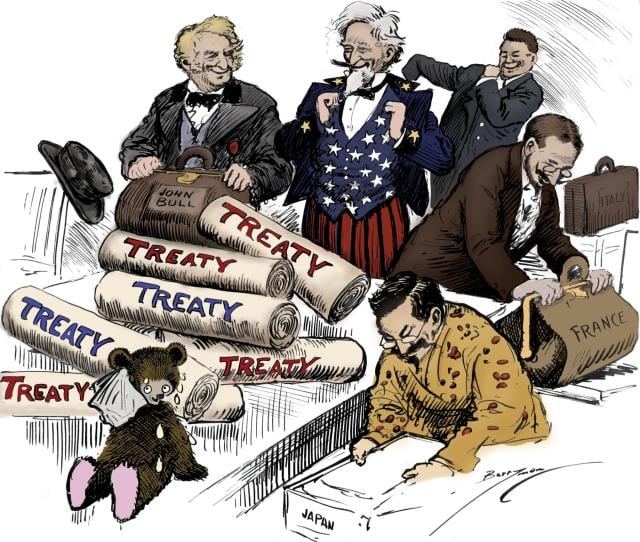
At he 1921-1922 Washington Conference on naval arms limitation had a profound effect on the French Navy. For the Marine Nationale, as in the other signatory fleets—those of Great Britain, the United States, Japan, and Italy—the conference and resultant treaty stymied capital ship construction. However, in its attempt to forestall a battleship arms race of the kind that had helped spark World War I, the treaty led instead to an increased focus on cruiser, aircraft carrier, and submarine development. France was humiliated by the conference’s outcome; despite possessing an overseas empire second in size only to that of Great Britain, she was allocated a minor ratio of capital ship tonnage, and on par only with Italy—a young and aggressive nation with Mediterranean ambitions. Although overshadowed by the emerging U.S. -Japanese naval rivalry in the Pacific, the Washington Treaty presaged a naval arms race between the Third Republic and Fascist Italy for control of the western and central Mediterranean.
Nevertheless, for the French Navy, the Washington Treaty reaffirmed many of the views of the Jeune École (Young School), the doctrine which throughout the second half of the nineteenth century had espoused the value of smaller warships—armed with the latest breakthroughs in torpedo and mine warfare—to counter the powerful battle fleet of Great Britain, France’s preeminent naval rival until the early 1900s. What resulted in the wake of the treaty was in many ways a golden age of French naval architecture, which produced a series of innovative and striking vessels, large and small. Although the catastrophic events of 1940 unfolded in a way few in the French Navy could foresee, on the eve of World War II the Marine Nationale retained—despite significant financial hurdles—the means to contest the Mediterranean against its Italian rival.
Epochs of heady growth—followed by periods of tremendous upheaval— have characterized the long and turbulent history of the French Navy. Throughout the nineteenth century, the Marine Nationale was the second largest fleet in the world after Great Britain’s Royal Navy. However, with the commissioning of Britain’s revolutionary HMS Dreadnought in 1906, the British-inspired fleet of Imperial Germany rapidly eclipsed the French position. France, meanwhile, did not lay down her first dreadnought, Courbet, until 1910. As the French Navy fell steadily behind in quantity and quality, World War I (1914-1918) further diverted resources from naval development in favor of the army. On the eve of the Washington Conference in 1921, France maintained a largely obsolete fleet.1
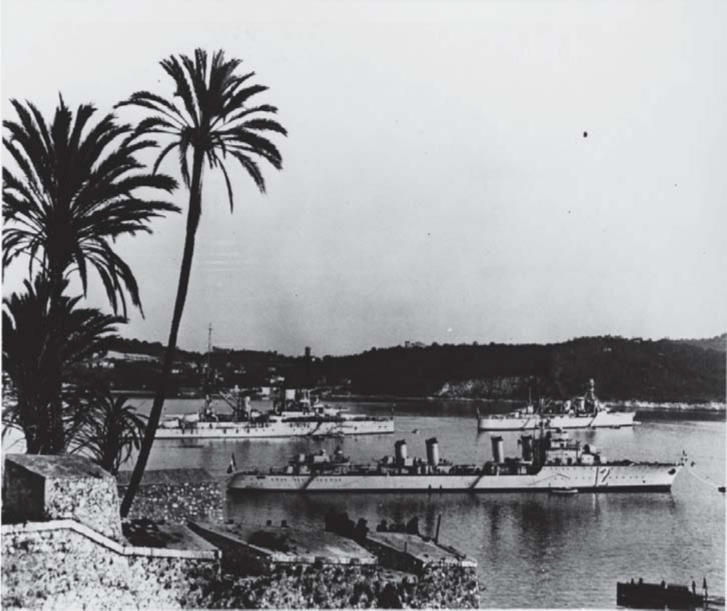
Figure 1. French warships at Villefranche on the Riviera in February 1939. In the foreground is the contre-torpilleur Vauban, on the right is the proto-treaty cruiser Duguay-Trouin, and on the left is the modernized World War I-era dreadnought Courbet. Courtesy of www.history.navy.mil
The United States government invited Great Britain, Japan, France, and Italy to Washington in the hope of forestalling a renewed—and expensive— battleship arms race of the kind that had soured Anglo-German relations and destabilized Europe before World War I. As representatives of a major colonial power, the French delegation came to Washington expecting parity with the Japanese Empire. However, France was in 1921 a great power in decline, a fact many of her policymakers seemed loath to admit. French naval planners had in any case given up on the nationalist dream of a global navy. Knowing that the Republic could never afford such a force in the wake of World War I, they had advocated a fleet with a regional scope: an ability to dominate the Mediterranean and tip the scales in an Anglo-American conflict—preferably in support of the latter—and one equal to the German and Italian fleets combined. It was this resultant navy with which the French nation went to war in 1939.2
The Washington Treaty itself was as ground-breaking as it was succinct. Capital ship ratios totalled 525,000 tons for Great Britain and the United States, 315,000 tons for Japan, and 175,000 tons for Italy and France. Aircraft carrier ratios were set at 315,000 tons for Great Britain and the United States, 81,000 tons for Japan, and 60,000 tons for Italy and France. Battleships were also limited to 35,000 tons individual displacement and 16-inch (bore diameter) main armament, while carriers were individually limited to 27,000 tons. Furthermore, the treaty stipulated a 10-year “battleship holiday” in which no new capital ships would be laid down. A qualitative—but not quantitative—limit was extended to all other vessels at 10,000 tons and 8-inch main armament; the resulting “treaty cruiser” would become a prolific warship in all five navies.3
For the French delegation, led by Prime Minister Aristide Briand, the Washington Conference included a series of humiliations. After being slighted in the seating arrangement—Briand found no place for himself at the great power table and ended up among the British dominions—the French (along with the Italians) were kept out of the initial round of negotiations on account of their relative naval weakness and lack of recent construction. And while Italy was very pleased by an offer of parity in capital ships with her emerging rival, the French were appalled. The sizes of the signatories’ navies at the time of the conference was apparently what mattered in determining the limitation ratios, not their world standing or colonial responsibilities; a move clearly favoring nations like the United States and Great Britain.4
However, cloaked in this loss of prestige at the hands of la perfide Albion (“perfidious Albion”) the fact remains that the French delegation actually accomplished its main goal at Washington. The construction of expensive capital ships was in the 1920s a low priority for the financially strapped Third Republic. By consenting to battleship parity with Italy, Briand helped ensure there would be no quantitative limits on cruisers, flotilla craft, and submarines; vessels that French naval planners saw as essential in the confined waters of the Mediterranean. This was no mean feat considering that the British favored outright abolishment of the submarine, while the United States pushed for ratios. Desiring a large cruiser fleet for colonial policing and commerce protection, the British eventually came around to the French position as it enabled them to press for similar ships. Furthermore, the treaty gave France—along with Italy—the right to build 70,000 tons of new capital ships during the building holiday, to enable her to modernize her ageing battle line. It was the Jeune École doctrine born anew, a French alternative to the big-fleet, decisive battle theories of the American naval officer and Francophile Alfred Thayer Mahan.5
Although the Washington Treaty helped delineate the Franco-Italian naval rivalry, French strategists had viewed their World War I ally as a potential adversary as early as 1919. This assumption was natural given the mutual interest of the two nations in controlling the Mediterranean as regional powers, France as an empire in decline, Italy as a young nation on the rise. France’s interest in the Mediterranean stemmed in large part from the need to maintain her lines of communication with the Maghreb—the jewel of her colonial empire—and beyond. In the period of 1914–1918, the French shipped thousands of colonial troops from North Africa and as far away as Senegal to the Western Front. By fighting for France, they made a major contribution to the Allied victory. Naturally, interbellum policy makers took it for granted that the colonies would provide la Métropole (metropolitan France) with crucial manpower in any future war. Ensuring the safe transport of these troops was a vital function of the navy. Protection of Middle Eastern oil shipments also played its part; their most obvious and direct route to French ports was through the Mediterranean, not around the Cape of Good Hope.6
In the wake of the Washington Treaty, the Marine Nationale’s doctrinal development included an increased focus on groups of fast hit-and-run raiders in lieu of the traditional battle fleet. This new model navy, centered on treaty cruisers and powerful destroyers—and augmented where appropriate by a small core of battleships—would be used to mount raids on Italian lines of communication, as well as counter similar sorties by the Italian Regia Marina (Royal Navy). As fleet scouts and sea-lane interdictors, submarines—a traditional French focus—were a crucial component of the new fleet. The Italians appeared to reach similar conclusions on the use of naval power in the Mediterranean, as was the case with other rivals like the United States and Japan in the Pacific. Unsurprisingly, the navies of France and Italy came to resemble one another.7
The Washington Treaty had permitted France to construct 70,000 tons of new capital ships during the building holiday, and like the other signatory navies, she also set about modernizing her aged fleet of six dreadnoughts. The modernization efforts made to the Courbet and Bretagne classes were less comprehensive than those being given foreign contemporaries, no doubt in part because French planners were hard pressed to find the old and slow vessels useful employment in their new model navy—except perhaps in the shore bombardment role.8 Italy’s first post-Washington treaty cruisers—the Trento class—had meanwhile made a big impression on French naval planners, being both fast and heavily armed. Not surprisingly, French capital ship design gravitated toward a fast, modestly sized “cruiser-killer,” not unlike in concept to the British World War I-era battlecruiser.9
Planning was well underway on what would become the Dunkerque class when, from an unexpected direction, the world learned in 1929 of Germany’s Deutschland class “pocket battleships.” These unique vessels, essentially heavily armed cruisers, mounted an 11 -inch main armament, well in excess of the Italian 8-inch guns the French cruiser-killers expected to encounter. Modifications quickly followed. The result was a 26,500-ton fast battleship theoretically immune to 11-inch shellfire, armed with eight 13 -inch guns in two innovative quadruple turrets, and at 30 knots fast enough to catch the German raiders. The two ships, Dunkerque and Strasbourg, launched in 1935 and 1936 respectively, comprised the hard-hitting core of the late interbellum Marine Nationale. Their battlecruiser-like design also made them ideal raiders in their own right, and the British viewed them with apprehension after France’s 1940 armistice with Nazi Germany. The British—their backs to the wall—realized the potential threat these two ships posed if Germany controlled them outright. As it was, the German 1940 Armistice commission allowed the French to keep their fleet, out of a similar fear that the French ships would otherwise flee to Britain before they could be secured. Ultimately the Dunkerques spurred Italy and Germany to lay down fast battleships of their own (the Littorio and Scharnhorst classes, respectively), to which the French countered yet again with an improved and enlarged design, the Richelieu class. The namesake vessel, of 37,250 tons and equipped with eight 15-inch guns, was nearing completion at Brest when France was overrun by Nazi Germany in June 1940.10
French naval planners responded to the advent of the treaty cruiser with unrestrained fervor. As no quantitative limit had been set on these 10,000-ton, 8-inch gunned vessels in 1922, they saw in this warship the potential—like the Japanese in the Pacific—to compensate for their own inferiority in capital ships with the Anglo-Americans. The concept of the fast, heavily armed cruiser warship also fit well into the doctrinal framework of the Marine Nationale’s Mediterranean focus. As such, the French had already designed a proto–treaty cruiser before the Washington Conference. The three ships of the Duguay-Trouin class essentially preempted the treaty cruiser concept, and although later classified as light cruisers, provided the framework for more powerful vessels.11
The naval architects of the period faced a dilemma when attempting to keep to an arbitrary, treaty-stipulated tonnage limit. Certain characteristics had to be prioritized over others, as it was physically impossible to build a fast, well-protected, and well-armed vessel within a 10,000-ton displacement. French treaty cruiser design therefore essentially went through three phases. Phase one exclusively focused on speed and armament at the expense of protection. This principle produced the Duquesne class, which comprised two ships, the Duquesne and Tourville. They were exceptionally fast at 34 knots but virtually unprotected. In the second phase, French designers, influenced in part by the heavier armor of Italian treaty cruisers, pushed for increased protection, even if this meant a reduction in speed. What resulted were the four ships of the Suffren class.
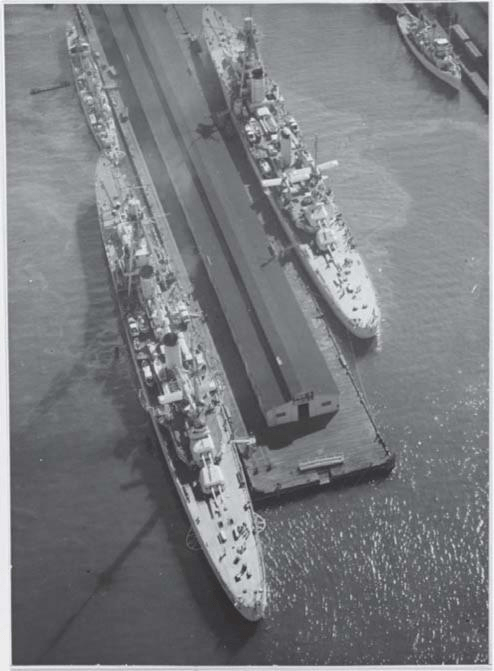
Figure 2. The French heavy cruisers Suffren (r) and Duquesne during a visit to Norfolk in October 1931. Note their four twin 8-in. gun turrets and the scouting floatplanes mounted on catapults abaft their funnels. Courtesy of www.history.navy.mil.
Built in pairs, the first two, Suffren and Colbert, were equipped with an armor belt over the machinery spaces, while the following pair, Foch and Dupleix, had the machinery enclosed by an armored caisson (box). While an improvement over their predecessors in terms of protection, this was still insufficient. Capable of 32 knots, the Suffrens’s focus was still on high speed and armament.12
In the third and final phase, French planners largely reversed the focus on speed in favor of protection. As was characteristic of the naval rivalry between the Third Republic and Italy, the final French treaty cruiser, Algérie, largely coincided with the development of the Regia Marina’s powerful Zara class. A very well-balanced design, Algérie was—along with her Italian counterparts—among the finest treaty cruisers of her generation. She was also the last of her kind built for the Marine Nationale; in the end France only completed seven of the twenty-one treaty cruisers requested after Washington—the same number as Italy.13
The follow-on London Naval Conference of 1930—signed by a French delegation but not ratified by the French government—sought to redress the Washington Treaty’s cruiser imbalance by extending quantitative tonnage limits to these ships. After 1930, cruisers fell into two categories: 8-inch armed category a (heavy) and 6.1-inch armed category b (light). By 1939, in addition to their seven treaty/heavy cruisers, the Marine Nationale possessed a force of ten light cruisers, of which the six units of the La Galissonnière class were a particularly successful design. The earlier generations of light cruisers, including the graceful, one-off experimental Emile Bertin, tended to mirror their very fast but poorly protected treaty cruiser counterparts.14
Destroyer and submarine development perhaps best represents the Jeune École’s spirit in interbellum French naval affairs. Here, as in other aspects of naval construction, the French were very innovative. In 1919, with an eye toward Italy, Chief of the Naval General Staff Admiral Ferdinand de Bon and Georges Leygues, Navy Minister, outlined the future foundations of the Marine Nationale’s destroyer force. The French divided their destroyers into two primary categories: larger contre-torpilleurs (torpedo-boat destroyers) whose primary task it was to scout for and to screen the battle fleet against enemy flotilla craft and light cruisers, and smaller torpilleurs d’escadre (fleet torpedo boats) built primarily to harass and attrite the enemy’s battle line with torpedoes.15
With their demanding mission profile, the Jaguar, Guépard, Aigle, Vauquelin, Le Fantasque, and Mogador classes of contre-torpilleurs were in essence super-destroyers, and they made a notable stir in foreign naval circles when unveiled. Having been conceived as an answer to the Italian post-World War I superiority in light cruisers, the French vessels completely outclassed their foreign contemporaries. The Italians could not fail to take notice, and answered with a whole series of light cruisers specifically designed to counter the French ships.16 On the eve of World War II, the Marine Nationale possessed thirty-two of these striking 2,126 to 2,880-ton vessels. They were the fastest warships in the world for their time. The Le Terrible achieved a blistering 45 knots on trials in 1935. The contre-torpilleurs were a highly visible and potent arm of the interbellum French Navy.17
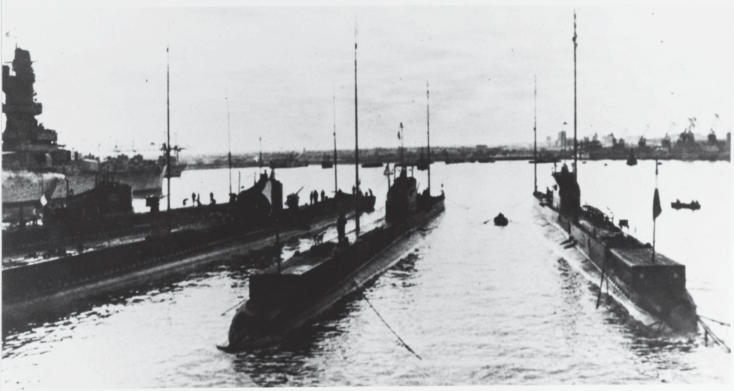
Figure 3. Four 1500-tonne type fleet submarines at Toulon or Marseilles in the 1930s, with the heavy cruiser Algérie on the left. Note the trainable box mounts for the four stern torpedo tubes. A similar triple mount was located abaft the conning tower as well. Courtesy of www.history.navy.mil.
The smaller torpilleurs d’escadre were more akin to the destroyer designs of other navies. Nevertheless, here too the French flair for innovative flotilla craft shone brightly; arguably, only Japan’s large fleet destroyers were comparable. Unlike the other signatory nations, the French also had to build their destroyer force from scratch since it had been particularly hard hit by the lean naval years of 1914-1918. The Bourrasque, L’Adroit, and Le Hardi classes ranged in displacement from 1,320 to 1,772 tons and by 1940 comprised thirty-four ships. Although they carried torpedoes for their primary role as battle-line harassers, the torpilleurs d’escadre also emphasized powerful gun armament. In the end, the super-destroyer and fleet torpedo boat concepts were an inventive solution to France’s capital ship inferiority. However, while impressive vessels, they were not without a number of drawbacks. Their light construction made them poor gunnery platforms in heavy seas, their operational radius was poor, and their mechanical unreliability—the price paid for their many innovative features—caused their captains no shortage of headaches.18
The French have maintained a love affair with the submarine since the time of Jules Verne. The Third Republic saw this sea-denial weapon as a cornerstone of imperial defense—another ingenious way to counter superior enemy battle fleets: “The day when France shall have a fleet of 250-300 submarines it could regard the future with perfect security.”19 Events at Washington clearly reflected this attitude; French indignation vis-à-vis the Anglo-Saxon power bloc tended to revolve around British and American proposals to ban or limit submersibles. However, the French submarine effort in World War I had been rather paltry, and her pre-1918 contraptions were more novel than practical. After securing the secrets of German World War I U-boat design, the French built their interbellum submarine force like their destroyers—from scratch.20
Submarines of the 1920s and 30s were divided into three distinct types: smaller coastal boats for local area defense, medium to large “fleet” boats to accompany the battle fleet and act as its eyes and ears, and large cruisers for long-range commerce interdiction. The French built prolifically in the first two categories, characterized by the 600/630-tonne coastal and 1500-tonne fleet classes. Like its flotilla craft, the navy often contracted its submarine designs out to private yards as an expedient in the face of naval dockyard delays. However, the most famous French submarine built during this period was undoubtedly the one -of-a-kind cro/seur corsa/re submers/ble (raider cruiser submarine) Surcouf. At 2,880 tons and armed with not just torpedoes but also with two 8-inch guns in a watertight turret, a spotter floatplane, a motor launch, and a brig for forty prisoners, Surcouf’s political impact was undoubtedly greater than her practical utility. Essentially a vessel tailored for commerce raiding against global maritime trading powers like Great Britain, France’s erstwhile and future ally, her potential usefulness against Italian or German maritime commerce was slight. In an ironic twist, the huge submarine found itself escorting Allied convoys in the North Atlantic during World War II.21
Aircraft carrier development was not a priority in the Marine Nationale the way it was in the United States or Imperial Japanese Navies. Manifested in the two French carriers built before World War II were separate theories on the utilization of naval airpower. Like many of her contemporaries, Béarn (22,150 tons) was built on a converted capital ship hull (from the canceled Normand/e class dreadnoughts). Although a proper carrier, sporting a number of innovations such as hydraulic arrestor wires and a system for cooling funnel gases blowing across the flight deck, Béarn was, with her modest air wing and 21 knots, too small and slow to have much utility.
The other alternative concept was a less expensive—and less flexible—mobile floatplane base, the 10,000-ton Commandant Teste. Both of these ships were experimental in the French Navy, and World War II interrupted plans meant to test future concepts. But French advances in this area also have to be seen in terms of the naval rivalry with Italy. The latter developed no carrier and banked on seamless coordination between the navy and air force from land bases in the event of war. This fell far short of expectations, and lack of air support would prove to be the Regia Marina’s Achilles’ heel in World War II.22
Ultimately, France’s inability to produce all the ships she wanted was a result not of the limitations imposed by the Washington Treaty, but rather the Third Republic’s own financial straits in the wake of World War I. Coupled with fiscal hardship was the modest capacity of the French naval dockyards. In fact, lengthy build times and interminable delays characterized French warship production as much as technological innovation throughout the interbellum. In an effort to speed up production, private yards built many of the Marine Nationale’s smaller vessels, such as its destroyers and submarines. This in turn resulted in an awkward lack of uniformity among many ships. In addition, despite the originality of French naval thinkers and ship architects—in fact partly because of it—many of their vessels suffered from unreliable engines, light construction, and very short range which hampered their operational effectiveness. Furthermore, in common with all other pre-World War II navies, effective ASW (anti-submarine warfare) tactics or technology received little attention.23
Nevertheless, when comparing the interbellum Marine Nationale with its chief rival, the Regia Marina, the conclusion must be that on the eve of World War II the French, with their modern and innovative fleet, possessed the ability to contest the Mediterranean against Fascist Italy—with or without Great Britain as an ally. The navy’s esprit de corps and confidence in its training, abilities, and equipment was justifiably high as it looked east toward a potential showdown with Mussolini’s sailors. Unlike the Regia Marina, the Marine Nationale also appreciated the possibility that low visibility conditions or night would portend naval engagements; French ships were equipped with powerful searchlights, illuminating shell, flashless propellant, and trainable torpedo tubes for rapid firing.24 Conversely, the Italian Navy’s lack of preparation for night combat—both tactically and technologically—would have serious consequences in its war with Great Britain between 1940 and 1943.25
As the war clouds loomed heavy in the late 1930s, the Allies, conspicuously spearheaded by the Chief of the French Naval General Staff, the dynamic Admiral François Darlan, seriously considered a preemptive strike against Italy. Only Britain’s overblown fears of the risks involved—which the French political and army leadership went along with as they became fixated on the German threat—enabled Mussolini to be the one to declare war first in June 1940. By that time, the German Army’s successes in France had completely altered the strategic picture. It is interesting to consider what may have transpired had the Allies acted more boldly; the Marine Nationale undoubtedly felt ready to do its part, and it is certain that with their combined might the French and British fleets would have presented a daunting foe indeed for the Regia Marina. The Allies may well have succeeded in closing the Mediterranean, with dire consequences for the Axis war effort in general and Italian ambitions in Africa and the Middle East in particular.26
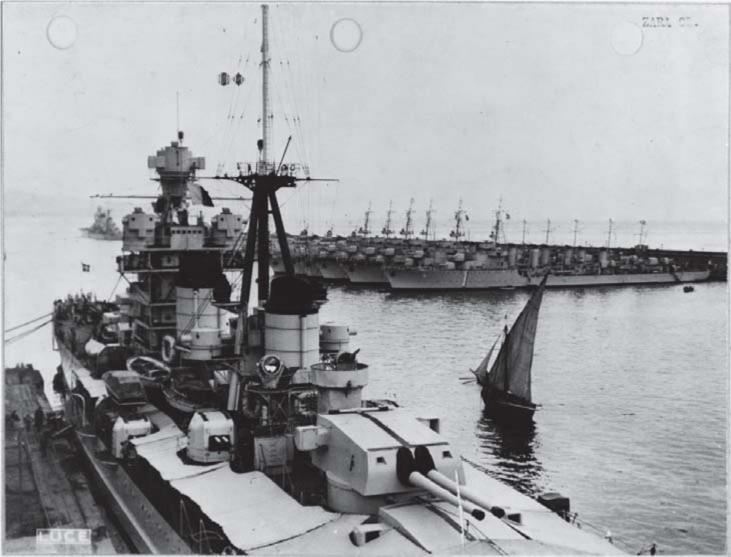
Figure 4. The Mediterranean naval rivals: Six French 2400-tonne type contre-torpilleurs (r to l: Tartu, Albatros, Chevalier Paul, Gerfaut, Aigle, and Vautour) visit Naples in May 1935. In the foreground is the Italian heavy cruiser Zara. “Showing the flag” was an important role for French warships in the interbellum. Courtesy www.history.navy.mil.
The Allied failure to exploit Italy’s vulnerability in the winter of 1939-1940, the Third Republic’s collapse the following June, and the subsequently tragic events at Mers-el-Kébir in Algeria on 3 July 1940—where a bungled British operation to keep French ships out of German hands sank the battleship Bretagne and killed over a thousand French sailors—serves to illustrate that the most carefully laid war plans often come undone due to unforeseen events. Nevertheless, what was left of the fleet, rechristened the Forces Maritimes Françaises (FMF), proved in the end to be one of post-Armistice France’s most powerful political tools, as it continued to exert a strategic influence in the Mediterranean Basin. By its existence as a “fleet-in-being,” it provided priceless leverage. It ensured the Vichy regime a modicum of independence it would otherwise never have enjoyed. As it was, the French (working in their perceived national best interest) navigated a political tightrope between the Axis and Allies from 1940 to 1942.27 The Marine Nationale spent the interbellum preparing for a conflict with Italy in the Mediterranean. This confrontation never materialized as envisioned. When World War II broke out, events soon relegated France and its navy to a comparatively minor role. When the Vichy fleet, imbued with its own unique sense of honor, scuttled its ships at Toulon on 27 November 1942 instead of joining the Allies, it seemed as if the war had long since passed it by. As the heart of the French Navy destroyed itself, Germany, in answer to the American landings in French North Africa, annexed the Vichy zone libre (free zone). However, France’s eclipse in world affairs should not overshadow the important geopolitical role her navy played during the period. In the end, the Third Republic’s attempt to create a regional “force of balance” during the interbellum serves as a model for nations attempting to forge independent strategies in a world of superpowers. This is as true today as it was during the Cold War between the United States and the Soviet Union. The Marine Nationale of 1922-1940 represents the spiritual predecessor to not only the Fourth Republic’s own Cold War nuclear-armed strike force, the Force de Frappe, but also other regional naval forces of the post-1945 period.28.
Note
- Bernard Ireland, Jane’s Battleships of the 20th Century (London: Harper Collins
Publishers, 1996), 14-15, 18-19; John Jordan, Warships After Washington: The Development of the
Five Major Fleets 1922–1930 (Barnsley: Seaforth Publishing, 2011), 16-19. - Joel Blatt, “The Parity That Meant Superiority: French Naval Policy towards Italy at the
Washington Conference, 1921-22, and Interwar French Foreign Policy,” French Historical Studies 12,
no. 2 (Autumn 1981): 228, 232. - Jordan, Warships After Washington, 49, 53-55.
- Blatt, “The Parity That Meant Superiority,” 235; John Jordan and Robert Dumas, French
Battleships 1922-1956 (Annapolis: Naval Institute Press, 2010), 15-16. - Blatt, “The Parity That Meant Superiority,” 229-30, 239, 241-42; Jordan and Dumas,
French Battleships, 17. - Stephen Corrado Azzi, “The Historiography of Fascist Foreign Policy,” The Historical
Journal 36, no. 1 (March 1993): 197-98; Blatt, “The Parity That Meant Superiority,” 226-27; Jordan, Warships After Washington, 39; MacGregor Knox, Mussolini Unleashed 1939-1941: Politics and Strategy in Fascist Italy’s Last War (Cambridge: Cambridge University Press, 1982), 19-20; Martin Thomas, “At the Heart of Things? French Imperial Defense Planning in the Late 1930s,” French Historical Studies 21, no. 2 (Spring 1998): 334-35. - Jordan, Warships After Washington, 103.
- Maurizio Brescia, Mussolini’s Navy: A Reference Guide to the Regia Marina 1930-1945 (Annapolis: Naval Institute Press, 2012), 58-59, 62-63; Jordan, Warships After Washington, 61, 98-101. The Italians similarly modernized their Cavour and Duilio class dreadnoughts to give them a stop-gap capability against the French. The modernized French battleships were an approximate match for these Italian vessels, although the latter were much faster.
- Brescia, Mussolini’s Navy, 72-74; Jordan, Warships After Washington, 103-5; Jordan and Dumas, French Battleships, 19-21.
- Ireland, Jane’s Battleships of the 20th Century, 46-47, 62-63; Jordan and Dumas, French Battleships, 29-31, 38, 59, 99, 124-25. Richelieu subsequently escaped to the French colony at Dakar in Senegal, where she exerted a powerful influence on the balance of power in Equatorial Africa.
- Jordan, Warships After Washington, 109; John Jordan and Jean Moulin, French Cruisers 1922-1956 (Annapolis: Naval Institute Press, 2013), 24-25, 30.
- Jordan, Warships After Washington, 140-42; Jordan and Moulin, French Cruisers, 41, 43 -45, 54-55, 58-60, 63, 69, 72, 74, 77, 79.
- Brescia, Mussolini’s Navy, 76-77; Jordan, Warships After Washington, 73; Jordan and Moulin, French Cruisers, 107, 109-10. Of note, Algérie’s Italian counterparts blatantly violated the 10,000-ton treaty limit, as did the Japanese with their treaty cruisers in the Pacific.
- Jordan, Warships After Washington, 302, 308-9; Jordan and Moulin, French Cruisers, 96, 99, 121, 124.
- Jordan, Warships After Washington, 39-40; John Jordan and Jean Moulin, French Destroyers: Torpilleurs d’Escadre and Contre-Torpilleurs 1922-1956 (Barnsley: Seaforth Publishing, 2015), 16, 206.
- Jordan, Warships After Washington, 206-11. These Italian light cruisers—the “large scouts” of the Condottieri series—were not a success, as in their attempt to match the contre-torpilleurs in speed they were unbalanced vessels, being unstable and completely lacking in armor.
- Jordan, Warships After Washington, 40-41; Jordan and Moulin, French Destroyers, 22, 79, 94, 112, 139-40, 144, 164.
- Jordan, Warships After Washington, 263; Jordan and Moulin, French Destroyers, 41, 62, 184.
- Count Gustave de Kerguézec (1920) quoted in Blatt, “The Parity That Meant Superiority,” 238.
- Blatt, “The Parity That Meant Superiority,” 239-41.
Autore:Tormod B. Engvig
Fonte: Saber and Scroll
Bibliografia:
Categorie
Tags
 militartis.com
Lascia un commento