
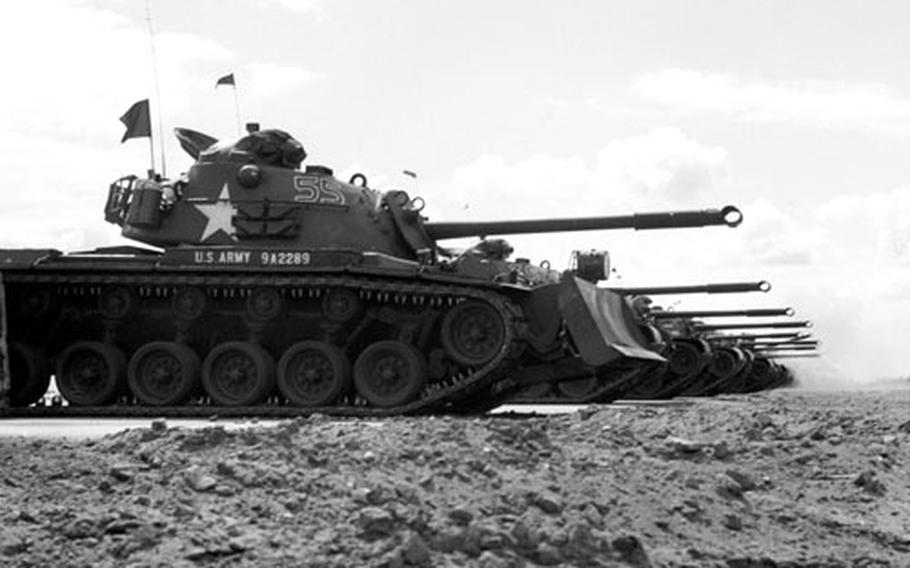
Military Forces
Notwithstanding Marshal Stalin’s assurances early this year that the Red Army had demobilized following World War II and had completed its demobilization in 1948, the armed forces of the
Soviet Union are recognized as the most powerful in the world today.
Although few data pertaining to the strength and composition of the Russian military forces are available, a report issued by the U. S. Senate Foreign Relations Committee in February of this year estimated the total strength of the Soviet armed forces as being in excess of 4 million men, including a ground force of some 175 divisions. These 175 Red Army divisions are roughly equivalent to 105 United States Army divisions in terms of the military manpower involved.
In contrast to the pattern set by the Soviet Union for the postwar maintenance of her military strength, the armed forces of the United States were reduced to a fraction of their wartime strength in a rapid, if not reckless, demobilization effort. Reductions in the strength of our military forces to meet budgetary limitations were still being effected during the first six months of 1950, and the outbreak of hostilities in Korea found less than 1.5 million per-sons in the armed forces of the United States. 4/ Of this total, approximately 591,000 were in the Army, 380,600 in the Navy, 74,200 in the Marine Corps, and 412,000 in the Air Force.
The statutory limitation which placed a ceiling of slightly more than 2 million on the total strength of the United States armed forces was suspended for an indefinite period in early August of 1950, and this country is now in the process of building up her military forces to approximately 3.5 million men, the number recommended to the President and the Congress by the Joint Chiefs of Staff as that required to meet the present foreseeable threat to our national security.
Data pertaining to the exact strength of the Soviet Air Force are not available, but it has been estimated that the Russians possess approximately 20,000 first-line aircraft. One military writer in this country has made the following observation: The Soviet Air Force is numerlcally the largest in the world. The most conservative estimate of the number of Soviet military aircraft is a figure substantially exceeding the total combat aircraft operated by the United States and all our possible allies.
In terms of naval forces, the U. S. S. R. is considerably weaker than this country and there is littIe doubt but that the United States Navy is capable of defeating any other naval surface force in the world. The principal offensive power of the Soviet Navy lies in her reportedly large submarine force which could constitute a major threat to this nation in the conduct of any military operations involving extended sea lines of communication. The Soviet Navy is estimated to have no fewer than 350-370 submarines in service, and another 120 are reported to be under construction in Soviet dockyards. It is noteworthy that the Red Navy is without aircraft carriers, the type of ship which proved to be our most powerful offensive naval weapon in World War II.
The Senate Foreign Relations Committee report, which has been referred to previously in this chapter, estimated that the European satellites of the U. S. S. R. have an additional 1 million men under arms. An article published in a British periodical this past summer substantiates this estimate, but points out the fast that a large portion of this satellite armed strength is not organized in the traditional military type units with which we are accustomed and that estimates of there forces will vary substantially depending upon whether security troops and similar units are included in or excluded from the total figures used,
The Senate Committee report also estimated the ground force strength of the United States and the North Atlantic Treaty nations at some 2.3 million men, and the combined land, air, and sea forces of these same nations at about 4.5 million men. Recent figures indicate that the NATO forces under General Eisenhower’s command in Europe have been increased this year from 7 to 22 divisions as part of the effort to achieve a strength of 28 divisions by the end of next year and a total of 60 divisions by the end of 1964.
Definite progress has been made in this direction, but it is evident that the present forces in being in western Europe can scarcely be considered adeguate to accomplish the mission they may be called upon to perform, and that much remains to be done in providing for their continued growth and reinforcement.
Armaments
The minor proportion of the postwar industrial output of the U. S. S. R. which has been allocated to the production of consumer’s goods or otherwise employed to improve the lot of the Soviet citizenry appears in itself to be prima-facie evidence of the fact that the Kremlin leaders are devoting the major portion of their industrial capacity to the production of armaments. While it is certain that some of the expanding capacity was, and probably still is, re-quired in connection with the reconstruction and rehabilitation of facilities destroyed during the war years, there is still reason to believe that armaments constitute a large part of the Soviet industrial production.
As might be expected, the estimated size of the Soviet military budget appears to be largely a matter of interpretation, with the result that estimates of the total amount of these funda may vary rather widely. Dr. Stefan T. Poasony has pointed out that the Soviet military budget in itself does not present a true picture of actual military appropriations in that a large part of the armament industry, aircraft production, atomic research and production, and even such purely military functions as the training of reserves are not financed with military funds, but are supported by appropriations hidden elsewhere in the budget strutture of the U. S. S. R. Schwartz shares this opinion and states that “the available evidence indicates that it [Soviet military budget ] covers only the direct cost of the land, sea, and air forces of the Soviet Union.” He further indicates that by reason of the fact that the Red military forces apparently purchase subsistence, weapons, and similar materials from other government agencies, little or no turn-over tax is levied upon these military purchases. This obviously increases the purchasing power of the “military ruble” over that in the hands of the Soviet citizen and places the relative value of military appropriations at a high-er level than the proportionate part of total budgetary expenditures they represent would seem to indicate at first glance.
The Soviet military budget for the current year has been estimated at 24 billion dollars, a sum twice as large as that ap-propriated in 1948 and even greater than the military budgets for the war years of 1942 and 1943. If the 19 billion dollars which is included in the 1951 Soviet budget for the expansion of her heavy industries and the 10 billion dollars required to finance the three police armies and certain other classified activities were considered as contributing to her military effort, the U. S. S. R. could be credited with an over-all military budget in the order of 53 billion dollars. Present indications are that the 1952 defense appropriation in the United States will be approximately 55 billion dollars.
In terms of national income, it is estimated that the U. S. S. R. allocates about 20 per cent of its total, either directly or in-directly, for miliary purposes. Military spending in this country, on the other hand, represents only about 6 per cent of our total national income.
In making a comparison of Russia’s military expenditures and those of the United States, consideration should be given to the relative purchasing power of the “military dollar” in each nation. At the present time, it appears that the Soviet “dollar” is capable of buying a greater amount of military manpower and weapons than is the American dollar. The low wages paid to Soviet labor are undoubtedly reflected in lower end item costa, at least where government purchases are involved, and, as has been previously pointed out, the Red military forces apparently procure the major part of their material from other agencies of the Soviet government.
Secondly, the simplified design which characterizes much of Russia’s military equipment contributes to lower manufacturing costs. It is generally agreed that much Russian materiel is constructed to perform the job expected of it and no more, with little thought, if any, given to the safety and well-being of the man who operates it in combat. A third factor which contributes materially to the greater purchasing power of the Soviet “military dollar” is the lower pay scale of the Russian armed forces. Past experience in this country indicates that during the period 1946-1950, the United States devoted an average of 40 per cent of its military budgets to paying, feeding, clothing, and transporting its armed forces.
While it is believed that the acceptance of this figure should be tempered by the realization that this seemingly high expenditure occurred during a period when the United States was demobilizing rather than arming, there appears to be little question that the per capita cost of maintaining military manpower is appreciably less in the Soviet Union than in this country.
Conclusion
Perhaps the most significant conclusion which can be drawn from the elements of economic and military strength discussed in the foregoing chapters is that the economic might of the Soviet Union iscomparable to that of the United States and that this country now faces a more formidable potential adversary than any encountered heretofore in its national history. There is reason to doubt that the U. S. S. R. will be in a position to challenge seriously the industrial capacity of the United States in the foreseeable future, but there is equal reason to believe that the Soviet Union commands sufficient industry to support a war effort great-er than any we have encountered in the past.
Previous mention has been made of the fact that the U. S. S. R. and the United States are the two most powerful nations in the world today. Both countries are large in terms of geo-graphical area, have populations large enough to support both military and industrial labor forces, and are largely self-sufficient in the resources and raw materials which provide the essential bases of war.
Russia, as has already been pointed out, now occupies an area 2.87 times as large as that of the United States and is therefore in indisputable possession of the advantage in size, an advantage which permitted the Soviets to withdraw their armed forces and relocate a large portion of their vital industrial facilities while they traded space for time in the months following the German invasion of Russia in 1941.
The United States, on the other hand, possesses the advantage of location and climate. Situated as she is between the Atlantic and Pacific Oceans, she has ready access to the principal trade routes of the world, and her major ports on the east, west, and Gulf coasts provide a marked contrast to the very limited ice-free sea frontier of the Soviet Union. From the climatic standpoint the United States possesses a definite advantage. The extremely cold climates encountered in the northern part of the U. S. S. R. have militated against the economic development of large areas in that nation, and the relatively harsh climate which is common to the remainder of the country is reflected in the short crop-growing seasons. From a purely military standpoint, how-ever, this same harsh climate is not entirely without advantage to the U. S. S. R., for the Soviet conscript who has already been hardened by the varied and severe conditions of the Russian climate and terrain is capable of being transformed rapidly into a first-rate infantryman who is little affected by geographic and climatic extremes. The performance of the Red soldier during the winter campaigns of World War II is testimony of his endurance in the field.
The industrial potential of the United States appears to be substantially greater than that of the Soviet Union and it seems reasonably certain that our technological advances will ensure the retention of this very important material advantage for some time to come, if not indefinitely. This affords little cause for complacency, however, for the fact remains that Russia’s productivity has been increased rapidly under the Soviet regime and it may be expected that her future Five-Year Plans will be concerned to a large extent with programs designed to further reduce the appreciable production advantage held by the United States.
In terms of military forces in being and available reserves of armaments, there appears to be little basis to argue that the present state of military preparedness of the U. S. S. R. does not surpass that of the United States, or that that of the Communist bloc, taken as a whole, does not exceed that of the Western Allies.
In considering the factors which contribute to the war potentials of these two nations, it becomes increasingly evident that the time element is of particular significance, for the period of time available to or required by a nation to being its full economic strength into play will determine, to a large extent, the degree of military power which can be brought to bear against the enemy.
When viewed in terms of a war in the immediate or even near future, it appears that the advantage will almost certainly lie with the Soviet bloc. As has been previously noted, the armed forces of the U. S. S. R. are predominantly larger than those of the Western Allies and are apparently being maintained in a state of readiness which will permit, the initiation of large-scale military operations on short notice. In supporting these forces, the Soviets can draw upon the stockpiles of both foodstuffs and armaments which have been accumulated since the end of World War II, as well as upon the reserves of strategic raw materials which have been obtained through large-scale postwar purchases from abroad. Soviet industry, which has been engaged primarily in the manufacture of armaments for the past several years, is already on a war footing for all intents and purposes, and it appears unlikely that the average Soviet citizen would recognize any marked change in the reversion from a “peacetime” to a war economy. In contrast, an outbreak of full-scale war in the immediate future would find the United States and her allies in the process of mobilizing and training military forces and in the process of converting industries and assembly line from the production of consumer’s goods to the manufacture of the armaments required to support these forces.
However, if all-out war with the Soviets and their satellites does not occur within the coming year or two, there is good reason to believe that the Western Allies will begin to dose the gap, and that the advantage which the Russians now hold will be materially decreased. We are steadily increasing the size of our military forces in being, and the rearmament program which was established following the outbreak of hostilities in Korea is designed to gear our industrial capacity to the orderly production of the armaments re-quired to support our expanding armed forces, together with those needed to supplement the equipment of our European allies. This diversion of a portion of our industrial capacity and material re-sources from the manufacture of consumer’s goods to armament production is of two-fold advantage, for, in addition to producing the necessary military supplies and equipment, it also provides a basis for immediate expansion to full-scale war production if need be. It is also apparent that with the major portion of our industry still devoted to the manufacture of civilian type products, the pro-. portions of our labor force and industrial capacity which can be made available for conversion to war production are far greater than those of the U. S. S. R.
The availability of atomic weapons is a new but important factor to be considered in assessing war potential. While the Soviet Union has been credited with having produced the atom bomb during the postwar period, it is probable that the United States possesses a substantial advantage in weapons of this type and will continue to maintain this advantage for some time to come.
It has been said that “a danger known is half overcome.” Certainly the invasion of South Korea by the Communists in June of last year served to bring to the free world the realization that the Soviet threat to world peace was indeed a real one, and that positive and immediate measures had to be taken if the Communists bloc was to be checked effectively. Now that the danger has been fully recognized, there seems to be reason to believe that time is now working in the favor of the United States and the Western Allies, rather than to the advantage of the Soviet Union and her Communist satellites.
“The Russian bear is certainly capable of anything, as long as he knows that the other animals he has to deal with are capable of nothing.” (Karl Marx)
Autore: Carl E. Grant
Fonte: Naval War College Review: Vol. 5: No. 5, Article 2
Categorie
Tags
 militartis.com
Lascia un commento